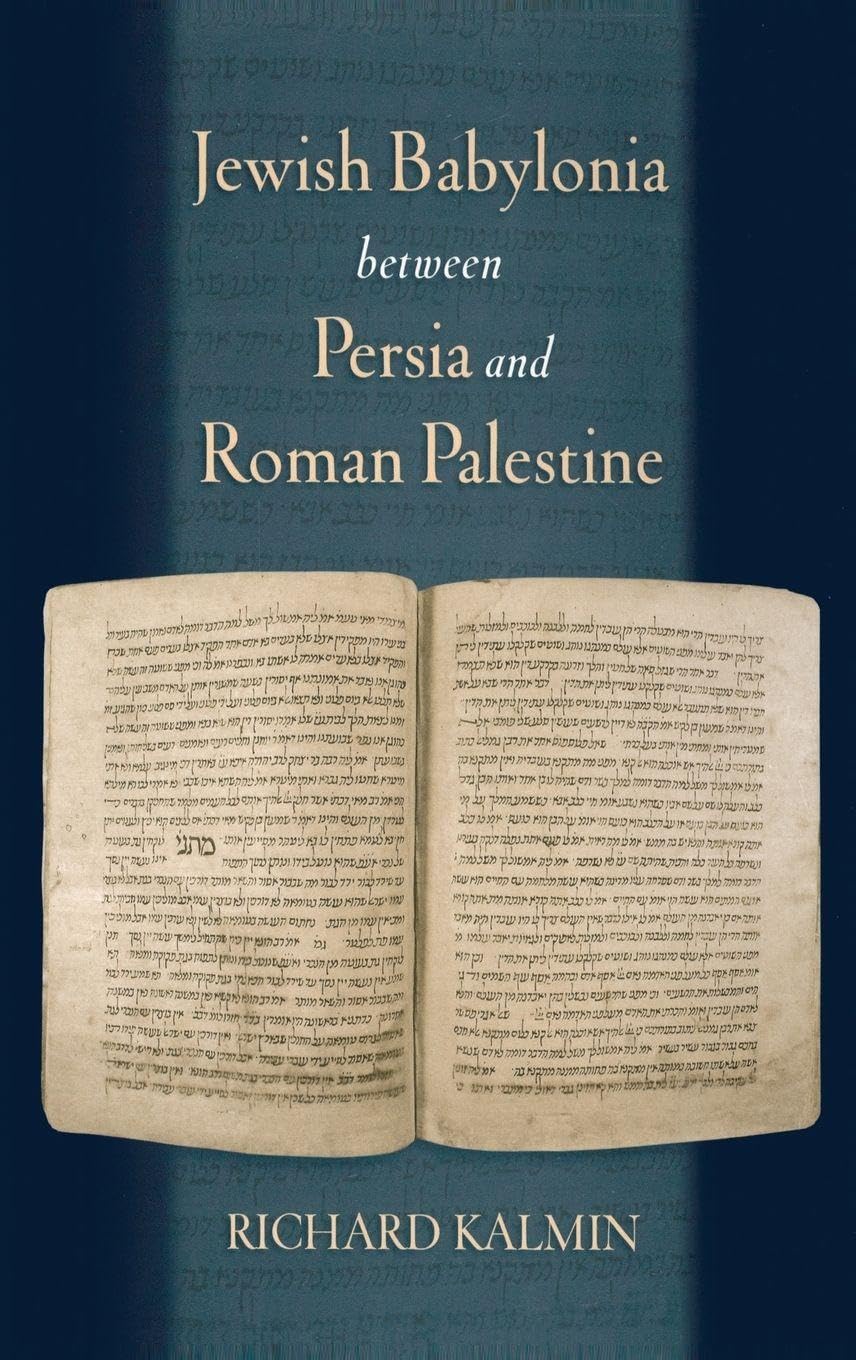



The Babylonian Talmud was compiled in the third through sixth centuries CE, by rabbis living under Sasanian Persian rule in the area between the Tigris and Euphrates rivers. What kind of society did these rabbis inhabit? What effect did that society have on important rabbinic texts? In this book Richard Kalmin offers a thorough reexamination of rabbinic culture of late antique Babylonia. He shows how this culture was shaped in part by Persia on the one hand, and by Roman Palestine on the other. The mid fourth century CE in Jewish Babylonia was a period of particularly intense "Palestinianization," at the same time that the Mesopotamian and east Persian Christian communities were undergoing a period of intense "Syrianization." Kalmin argues that these closely related processes were accelerated by third-century Persian conquests deep into Roman territory, which resulted in the resettlement of thousands of Christian and Jewish inhabitants of the eastern Roman provinces in Persian Mesopotamia, eastern Syria, and western Persia, profoundly altering the cultural landscape for centuries to come. Kalmin also offers new interpretations of several fascinating rabbinic texts of late antiquity. He shows how they have often been misunderstood by historians who lack attentiveness to the role of anonymous editors in glossing or emending earlier texts and who insist on attributing these texts to sixth century editors rather than to storytellers and editors of earlier centuries who introduced changes into the texts they learned and transmitted. He also demonstrates how Babylonian rabbis interacted with the non-rabbinic Jewish world, often in the form of the incorporation of centuries-old non-rabbinic Jewish texts into the developing Talmud, rather than via the encounter with actual non-rabbinic Jews in the streets and marketplaces of Babylonia. Most of these texts were "domesticated" prior to their inclusion in the Babylonian Talmud, which was generally accomplished by means of the rabbinization of the non-rabbinic texts. Rabbis transformed a story's protagonists into rabbis rather than kings or priests, or portrayed them studying Torah rather than engaging in other activities, since Torah study was viewed by them as the most important, perhaps the only important, human activity. Kalmin's arguments shed new light on rabbinic Judaism in late antique society. This book will be invaluable to any student or scholar of this period. "A compelling exploration of Jewish Babylonia. K[almin]'s care with his sources is inspiring, as is his passion to share specialized methods with his reader. In addition he asks important questions both about what happened in Jewish Babylonia, and how we might know. Ultimately, his exploration of Babylonian Talmud offers new perspectives on Late Antiquity that deserve our attention." -- Bryn Mawr Classical Review "It is difficult not to be impressed by the range and perception of what is set out here." -- Journal of Theological Studies "The book is important ... his work is exemplary in its careful argumentation, and Kalmin's wish that his work will serve as a model for those who desire to follow a text-critical approach will no doubt be granted." -- Journal of Jewish Studies "The book is a serious contribution to the ongoing debate on the use of the Bavli as a historical source. It contains thorough and well-articulated methodological discussions, raises serious questions, suggests original solutions, and points toward possible directions for future scholarship." -- AJS Review "Nuanced and balanced."-- Hebrew Studies "Full of valuable insights ... this is a rich and stimulating book." -- Shofar "A considerable achievement. This excellent book is...an important and convincing addition to the history of Babylonian Jewry in the period of the Talmu, which should light the way for every historian of the period of the Mishnah and the Talmud." -- Journal of the American Oriental Society Richard Kalmin is the Theodore R. Racoosin Professor of Talmud and Rabbinics at the Jewish Theological Seminary, where he specializes in the literature and history of the Jewish people of late antiquity. He is the author of The Sage in Jewish Society of Late Antiquity (1999), Sages, Stories, Authors, and Editors in Rabbinic Babylonia (1994), and The Redaction of the Babylonian Talmud: Amoraic or Saboraic (1989) ; and is the co-editor, with Seth Schwartz, of Jewish Culture and Society Under the Christian Roman Empire (2002).