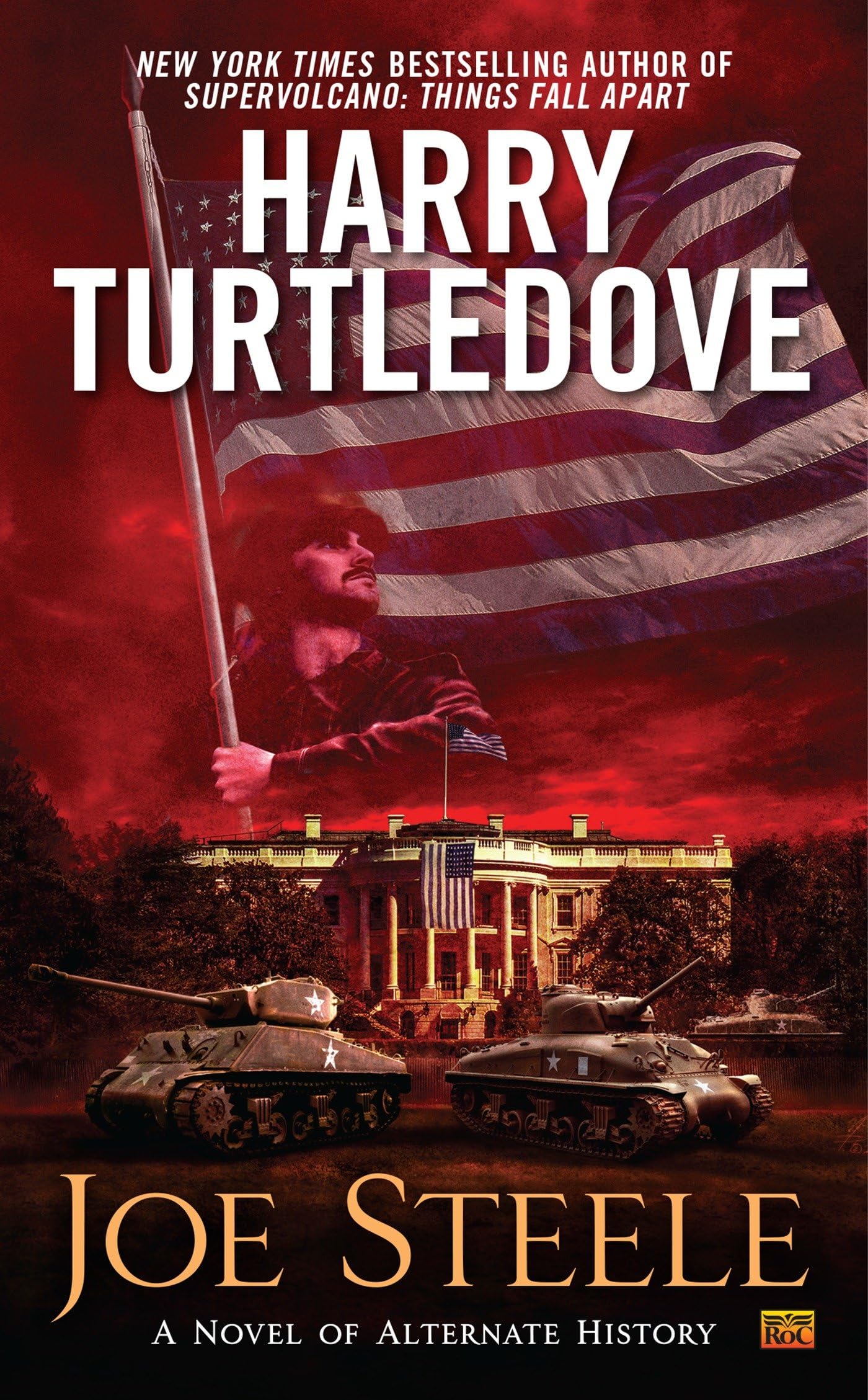



The New York Times bestselling author of the Supervolcano trilogy envisions the election of a United States President whose political power will redefine what the nation is—and what it means to be American… The Great Depression continues to cast its dark shadow over the country. Desperate times call for desperate measures, so the Democratic Party makes an interesting nomination for their Presidential candidate: California Congressman Joe Steele, the son of a Russian immigrant laborer who identifies more with the common man than with the wealthy power brokers in Washington D.C. Achieving a landslide victory, President Joe Steele wastes no time pushing through Congress reforms that put citizens back to work. Anyone who gets in his way is getting in the way of America, and that includes the highest in the land. But Steele’s homeland political enemies pale in comparison to European tyrants whose posturing seems sure to drag America into war… “Entertaining...Turtledove fans and people who enjoy dystopias will certainly want to pick up Joe Steele ."—SFFWorld “If you like playing with ‘what-if’s’ in your fiction, then Joe Steele offers you a lot to think about. In the end, I loved it."—Alternate HIstory Weekly Update Harry Turtledove , the New York Times bestselling author of the Supervolcano trilogy and the Atlantis trilogy, has a PhD in Byzantine history. Nominated for the Nebula Award, he has won the Hugo, Sidewise, and John Esthen Cook awards. He lives with his wife and children in California. ALSO BY HARRY TURTLEDOVE Joe Steele is for Janis Ian. The novel Joe Steele has plotline derived from the short story “Joe Steele,” which appeared in Stars: Original Stories Based on the Songs of Janis Ian, edited by Janis Ian and Mike Resnick (DAW Books: New York, 2001). In “god & the fbi,” Janis wrote “Stalin was a Democrat . . .” I started wondering how and why Stalin might have become a Democrat, and the story grew from there. So that’s one reason why I’ve dedicated the novel to her. But wait! There’s more! When I was a teenager, still living at home, I listened to Janis’ music and read the article about her in Life. (She was a teenager, still living at home, then, too.) I never dreamt then that I might one day meet her. I really never dreamt then that we might become friends. That we have means a lot to me in a lot of different ways. So thanks, Janis. Thanks for everything. This one’s for you. I Charlie Sullivan never expected to meet Joe Steele in the service elevator of a cheap hotel only a couple of blocks from the Chicago Stadium. The AP stringer gaped at the Presidential candidate when Steele boarded on the second floor. Charlie had slipped the boss cook a buck, so he got on and off in the kitchen as he pleased. “You’re—him!” Charlie blurted when Joe Steele and one of his aides strode into the car. Long-standing tradition said that candidates stayed away from the convention till it nominated them . . . if it did. Governor Franklin Roosevelt, Steele’s main rival for the Democratic nomination in this summer of America’s discontent, was still in the Executive Mansion in Albany. Charlie’s older brother, Mike, who wrote for the New York Post , was covering him there. Roosevelt’s operatives worked the Stadium hotels and bars just as hard as Joe Steele’s, though. They glad-handed. They promised. They spread favors around. “I am him,” the Congressman from California agreed. His smile didn’t reach his eyes. Charlie Sullivan was a scrawny five-eight, but he overtopped Joe Steele by three inches. Steele stood straight, though, so you might not notice how short he was. That his henchman, a cold-looking fellow named Vince Scriabin, was about the same size also helped. “But . . . What are you doing in town?” Charlie asked. The elevator door groaned shut. Joe Steele punched the button for 5. Then he scratched at his mustache. It was bushy and graying; he was in his early fifties. His hair, also iron-gray, gave a little at the temples. He had bad skin—either he’d had horrible pimples or he’d got through a mild case of smallpox. His eyes were an interesting color, a yellow-brown that almost put you in mind of a hunting animal. “Officially, I’m in Fresno,” he said as the elevator lurched upward. That fierce, hawklike stare burned into Charlie. “You might embarrass me if you wrote that I was here.” Vince Scriabin eyed Charlie, too, as if fitting him for a coffin. Scriabin also wore a mustache, an anemic one that looked all the more so beside Joe Steele’s. He had wire-framed glasses and combed dark, greasy hair over a widening bald spot. People said he was very bad news. Except for the scowl, you couldn’t tell by looking. Joe Steele’s stare, though less outwardly tough, worried Charlie more. Or it would have, if he’d been on FDR’s side. But he said, “We need some changes—need ’em bad. Roosevelt talks big, but I think you’re more likely to deliver.” “I am.” Joe Steele nodded. He wasn’t a big man, but he