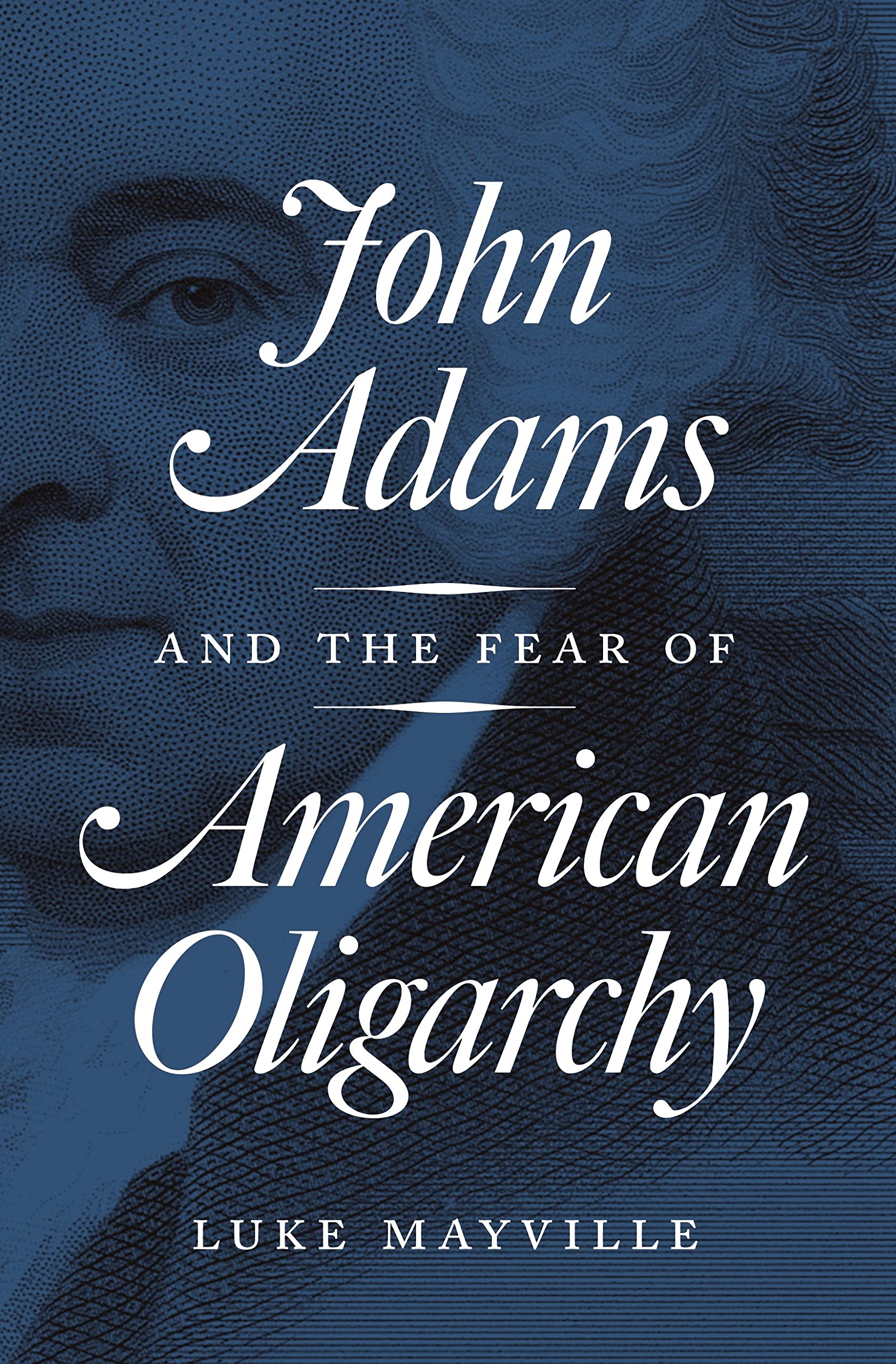



Why American founding father John Adams feared the political power of the rich―and how his ideas illuminate today's debates about inequality and its consequences Long before the "one percent" became a protest slogan, American founding father John Adams feared the power of a class he called simply "the few"―the wellborn, the beautiful, and especially the rich. In John Adams and the Fear of American Oligarchy , Luke Mayville explores Adams’s deep concern with the way in which inequality threatens to corrode democracy and empower a small elite. Adams believed that wealth is politically powerful not merely because money buys influence, but also because citizens admire and even identify with the rich. Mayville explores Adams’s theory of wealth and power in the context of his broader concern about social and economic disparities―reflections that promise to illuminate contemporary debates about inequality and its political consequences. He also examines Adams’s ideas about how oligarchy might be countered. A compelling work of intellectual history, John Adams and the Fear of American Oligarchy has important lessons for today’s world. John Adams and the Fear of American Oligarchy is a most timely, valuable, and enlightening book. It shows conclusively that Adams was one of the sharpest critics of oligarchy among the American founders and, indeed, in the history of political thought. The book will generate much-needed discussion in political thought, American political studies, and contemporary democratic theory. --John McCormick, University of Chicago A needed examination of Adams's political thought on wealth-based aristocracy. -- Choice Remarkably well-written and astonishingly lucid, John Adams and the Fear of American Oligarchy makes an absolutely central point about Adams's thought, persuasively reestablishing him as a genuine democrat in his ultimate sympathies. --Sanford Levinson, University of Texas Law School John Adams and the Fear of American Oligarchy is a most timely, valuable, and enlightening book. It shows conclusively that Adams was one of the sharpest critics of oligarchy among the American founders and, indeed, in the history of political thought. The book will generate much-needed discussion in political thought, American political studies, and contemporary democratic theory. ―John McCormick, University of Chicago Remarkably well-written and astonishingly lucid, John Adams and the Fear of American Oligarchy makes an absolutely central point about Adams’s thought, persuasively reestablishing him as a genuine democrat in his ultimate sympathies. ―Sanford Levinson, University of Texas Law School A needed examination of Adams’s political thought on wealth-based aristocracy. ― Choice Luke Mayville is a postdoctoral fellow at the Center for American Studies at Columbia University. He is a contributor to Commonweal . John Adams and the Fear of American Oligarchy By Luke Mayville PRINCETON UNIVERSITY PRESS Copyright © 2016 Princeton University Press All rights reserved. ISBN: 978-0-691-18324-4 Contents Acknowledgments, ix, Introduction, 1, ONE A Perennial Problem, 23, TWO The Goods of Fortune, 58, THREE Sympathy for the Rich, 95, FOUR Dignified Democracy, 124, CONCLUSION American Oligarchy, 148, Notes, 155, Bibliography, 193, Index, 205, CHAPTER 1 A Perennial Problem It is that rapacious spirit described by the elder Adams; and no one understood the true character of a purse-proud, grasping oligarchy better than he did. — Senator John Milton Niles, speech delivered in the US Senate, 18 February 1838 Should Americans fear oligarchy? In other words, should citizens of a republic founded upon ideals of civic equality fear the political power of the rich? Even if this question is being asked today with a special urgency, the question itself is hardly new. At the outset of the American republic, when the framers of the United States Constitution first submitted the document to the public for approval, the question of oligarchy was hotly debated. Critics of the Constitution — the so-called Anti-Federalists — argued that the new system would elevate to power a wealthy ruling class. Rather than empowering those "who have been used to walk in the plain and frugal paths of life," the new system of government would guarantee rule by America's "aristocracy." What the Constitution's defenders had fancifully called "representative democracy" would in fact be "a mere burlesque." There would be "no part of the people represented, but the rich," and no security provided against the undue influence of a social and economic elite. Meanwhile, Federalist proponents of the Constitution argued that there was little reason to view the rich as a dangerous political force. After all, the aristocratic orders of the Old World were absent in post-Revolution America, and the Constitution mandated that this remain the case by expressly prohibiting titles of no