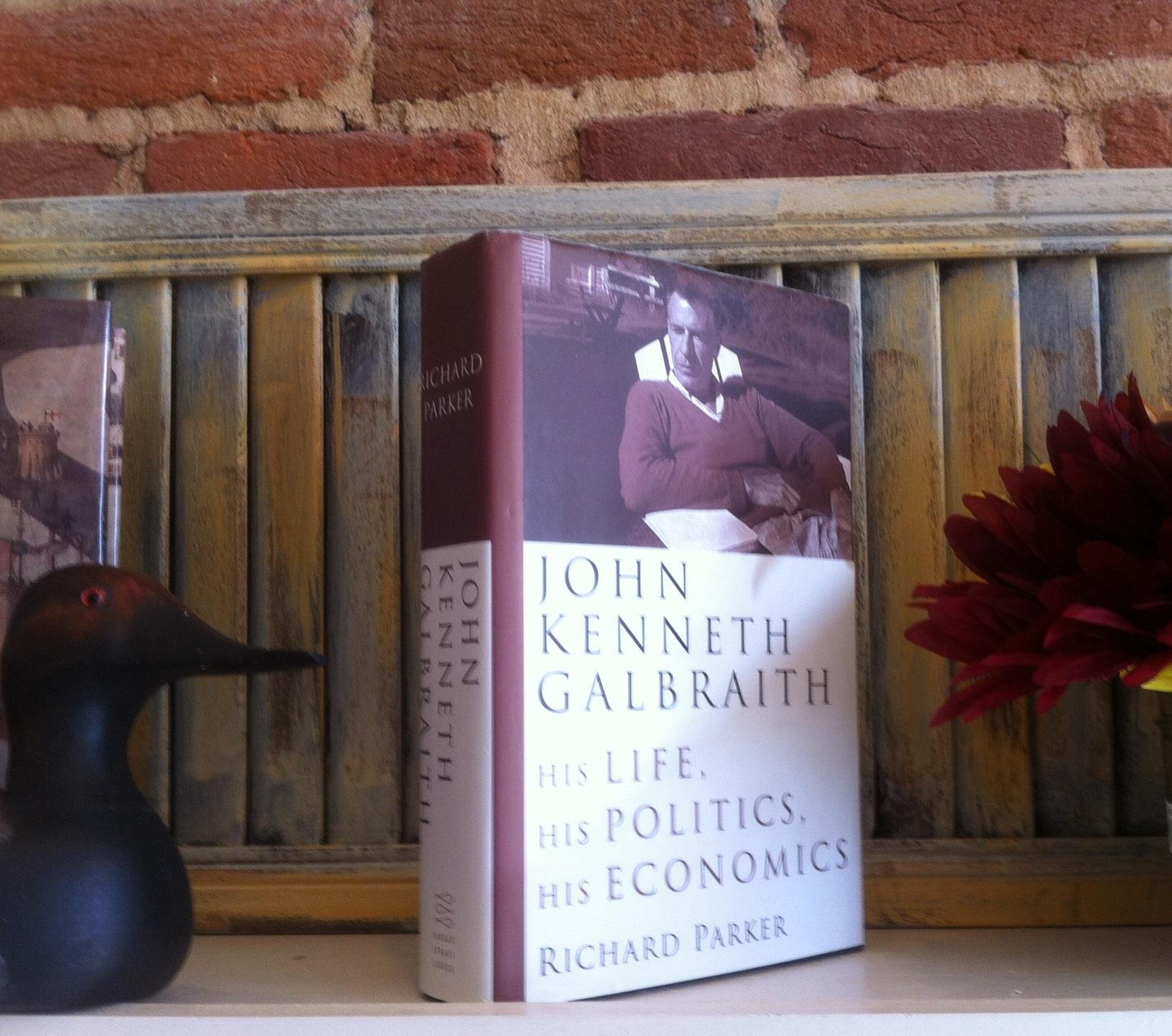



The life and times of America’s most celebrated economist, assessing his lessons—and warnings—for us today John Kenneth Galbraith’s books—among them The Affluent Society and American Capitalism —are famous for good reason. Written by a scholar renowned for energetic political engagement and irrepressible wit, they are models of provocative good sense that warn prophetically of the dangers of deregulated markets, war in Asia, corporate greed, and stock-market bubbles. Galbraith’s work has also deeply—and controversially—influenced his own profession, and in Richard Parker’s hands his biography becomes a vital reinterpretation of American economics and public policy. Born and raised on a small Canadian farm, Galbraith began teaching at Harvard during the Depression. He was FDR’s “price czar” during the war and then a senior editor of Fortune before returning to Harvard and to fame as a bestselling writer. Parker shows how, from his early championing of Keynes to his acerbic analysis of America’s “private wealth and public squalor,” Galbraith regularly challenged prevailing theories and policies. And his account of Galbraith’s remarkable friendship with John F. Kennedy, whom he served as a close advisor while ambassador to India, is especially relevant for its analysis of the intense, dynamic debates that economists and politicians can have over how America should manage its wealth and power. This masterful chronicle gives color, depth, and meaning to the record of an extraordinary life. John Kenneth Galbraith has led an extraordinary life. The world's most famous living economist started teaching at Harvard when he was just 25 years old and has sold seven million copies of his four dozen books. One reviewer said Galbraith wrote "history that reads like a poem." During World War II, at age 32, he was named "tsar" of consumer-price controls in the United States, and he later advised three American presidents and served as ambassador to India. Now in his 90s, Galbraith is still active and has received 50 honorary degrees. All this was accomplished by a Canadian born in a tiny Ontario farming hamlet, whose major at an obscure agricultural college wasn't even economics but animal husbandry. Such an irony is typical of Galbraith's renowned iconoclasm, writes Richard Parker in his 820-page biography John Kenneth Galbraith . Parker shows how Galbraith's irreverent views were shaped by the Depression, which helped turn him into a passionate advocate of Keynesian economics, the philosophy that inspired FDR's New Deal. Galbraith later became one of the architects of the expansion of federal social services after World War II. Because of his influence in successive administrations, readers get a fascinating fly-on-the-wall picture of debates and intrigue inside the White House during many of the major crises of the Cold War. Galbraith frequently played crucial behind-the-scenes roles that went beyond the duties of an economist: advising President Kennedy during the Cuba missile crisis, helping Lyndon Johnson write his first speech after Kennedy was assassinated, and opposing the Vietnam War, which became his most passionate cause. He later criticized the dismantling of government programs under Ronald Reagan and seemed to love clashing with conservative economists. Parker managed to sift through a mountain of material from Galbraith's long and lively years to distill an engaging narrative that, like Galbraith's own books, is easily accessible to non-economists. --Alex Roslin Parker is an economist, like his subject, and his biography of one of American liberalism's articulators imbibes most deeply from Galbraith's career. One of the two greatest influences on Galbraith's ideological outlook, Parker declares, was John Maynard Keynes' macroeconomic landmark The General Theory of Employment, Interest, and Money (1936), and the other was Galbraith's father, an agrarian populist in early 1900s Ontario. Galbraith has witnessed nearly a century of change, a span Parker traces in its public and personal dimensions. He departed Canada in 1931, and until his permanent arrival at Harvard in 1948, moved among jobs in academia, the U.S. government, and Fortune magazine. Quoting Galbraith's belief that the latter job turned him into a writer, Parker extensively paraphrases and excerpts from Galbraith's stable of best-sellers, which includes such classics as The Affluent Society (1958). Also covering Galbraith's involvement in Democratic Party politics, Parker's portrait of the urbane, ironic Galbraith and his fortunes as a liberal diagnostician of American economic problems is a stout biography that will be the standard for years. Gilbert Taylor Copyright © American Library Association. All rights reserved "Richard Parker's timely biography of Ken Galbraith and his brilliant career is an extraordinary gift to a nation grappling more than ever with the profound issues that Galbraith addressed so eloquently over so