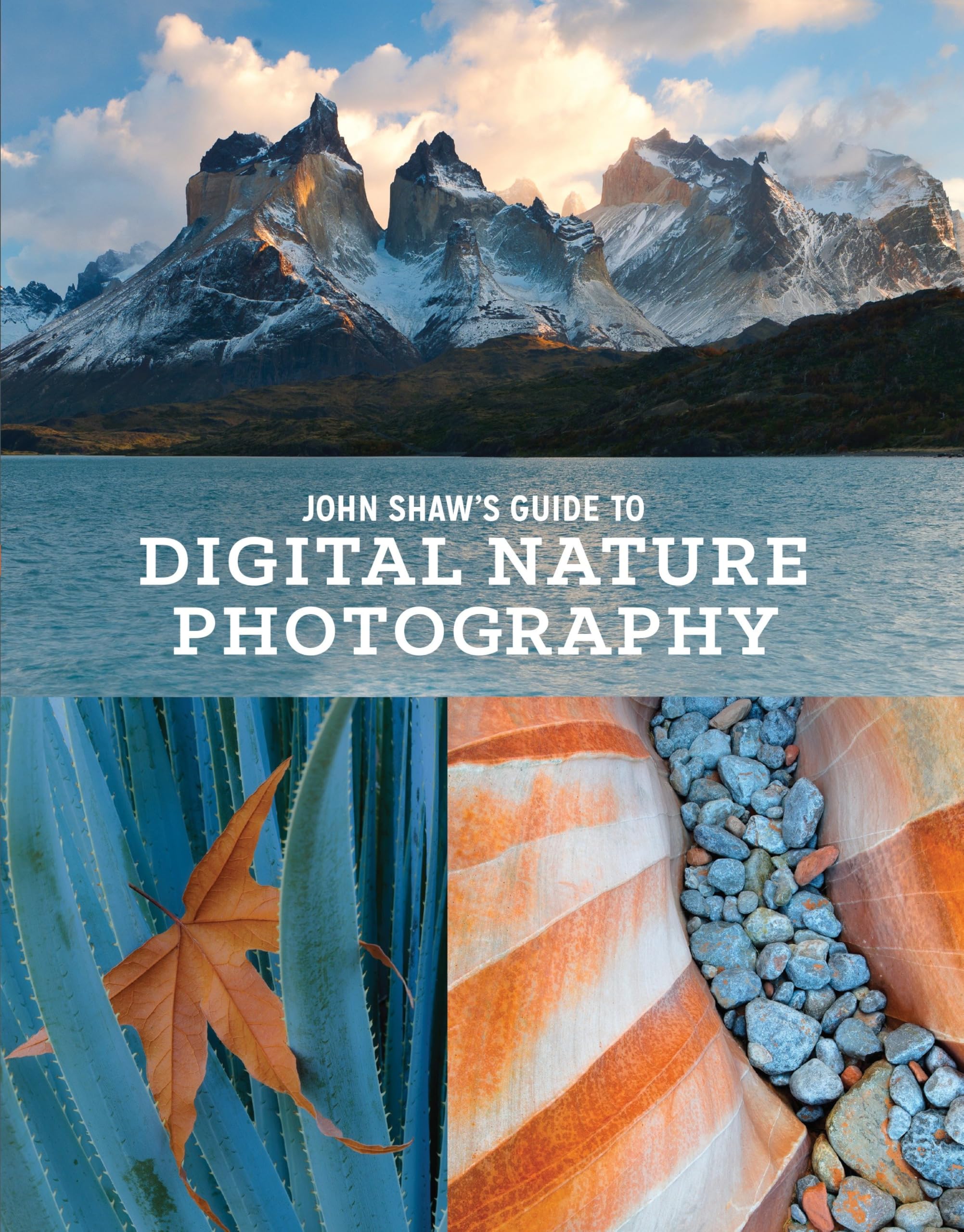



Photography legend John Shaw returns with his much-anticipated guide to digital nature photography, complete with more than 250 extraordinarily beautiful photographs . For over four decades, John Shaw’s authentic voice and trusted advice has helped photographers achieve impressive shots in the great outdoors. In his first-ever book on digital photography, Shaw provides in-depth advice on everything from equipment and lenses to thorough coverage of digital topics including how to use the histogram. In addition, he offers inspirational and frank insight that goes far beyond the nuts and bolts of photography, explaining that successful photos come from having a vision, practicing, and then acquiring the equipment needed to accomplish the intention. Easily digestible and useful for every type of photographer, and complete with more than 250 jaw-dropping images, John Shaw’s Guide to Digital Nature Photography is the one book you’ll need to beautifully capture the world around you. JOHN SHAW is the author of many enduring bestsellers, including seven previous books on nature photography. His work is frequently featured in National Geographic , Nature’s Best , National Wildlife , Outdoor Photographer , Natural History , Sierra , and Audubon magazines, as well as in calendars, books, and advertisements. He has photographed on every continent, from the Arctic to the Antarctic, and leads sold-out workshops around the globe. Visit him at johnshawphoto.com. What Is There to Photograph? Each year, I travel the globe to take pictures, often leading photo tours or workshops. The people in these groups are specifically interested in photographing the natural world, yet it’s on these trips that I inevitably hear the question “What is there to photograph?” Truly this is the wrong question to ask; it leads photographers to take pictures that are empty of emotional content. Without passionate involvement, our pictures are nothing more than records. The question we should be asking is “What is there to discover?” Only after we have let our minds and eyes deal intimately with the abundance of natural marvels around us should we attempt to photograph them. Photography should be both a process of discovery and a procedure for recording that discovery. In the process of photography, we order the chaos around us by making decisions. We decide to emphasize one aspect of the world—what we have discovered—and ignore all others. We want to represent that subject in a way that conveys how it has emotionally involved us. To do this, we must make conscious decisions about what to include within the photographic frame and how to organize the content. At this point, the procedure of photography enters. Now we must make technical choices involving the mechanics of photography: lenses, light, and exposure. The photographic process should be deliberate and studied. Structuring our visual environment is the role of composition, but that structure doesn’t just appear from nowhere. Nor is the procedure of choosing lenses and setting exposure values automatic. We must become adept in dealing with both the aesthetics and the mechanics of photography; otherwise, our results will be failures. Photography’s dual nature has always fascinated me. In a good photograph, both aspects work in tandem, neither overwhelming the other. Form and content go hand in hand to produce a synthesis, an interesting work that engages both the viewer’s mind and emotions. To achieve this synthesis, you, the photographer, must play two simultaneous roles as well. On one hand, you must be a poet and an artist, opening yourself to the intuitive and mystical world of your inner vision. On the other hand, you must be a technician, rationally dealing with shutter speeds, f-stops, and focal lengths. Vision without craftsmanship is as much a failure as craftsmanship without vision. We’ve all seen photos that are intensely personal and emotional yet lack any technical competence. We dismiss these as lacking organization and think the creator cannot control the medium. We’ve all also seen photos that are technically superb but have no soul. These are aesthetically insipid, dull, and uninspiring works. Most people have more difficulty with the technical aspect. We all see images in our mind’s eye . . . but how to record these? We take an interesting trip, but the resulting pictures seem to have little relationship with our experiences. Why? I’m convinced that the main factor is that most of us are only occasional photographers; consequently, we’re always starting over in the learning process. A solution many people adopt is to buy a fancy camera and then set it in autofocus/autoexposure/auto-everything mode so that they don’t have to think about what the camera is doing. However, this means that they have abdicated their photographic responsibilities; they have become camera carriers, not photographers. They are allowing a machine to make decisions for them,