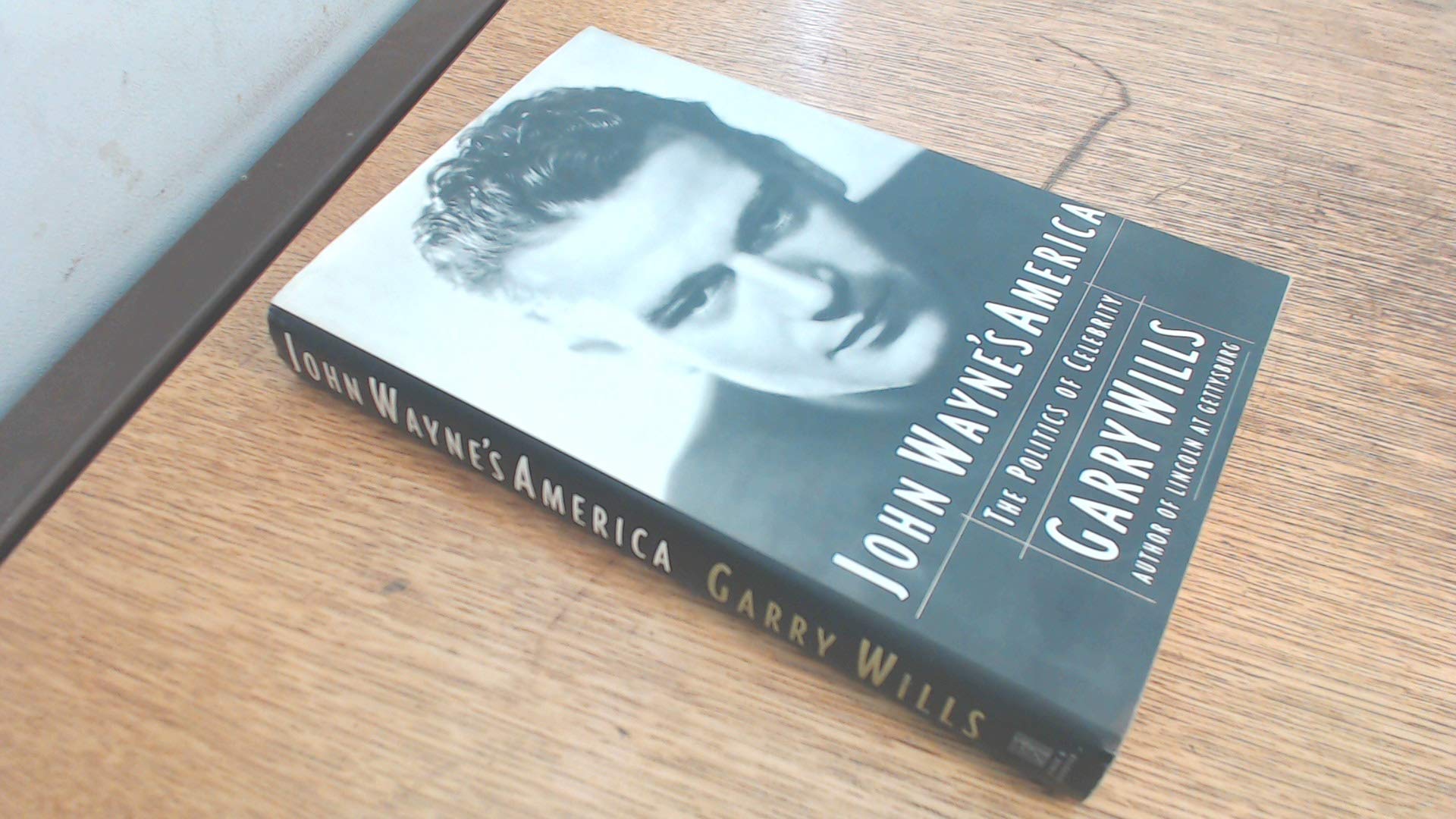



The best-selling author of Lincoln at Gettysburg explores the life and times of John Wayne and his legend, explaining how the man, Marion Morrison, became a myth and how that myth shaped Americans' political attitudes and ideas. 75,000 first printing. $60,000 ad/promo. Tour. This book poses an interesting question: How is it that John Wayne came to embody a certain politics for America? In giving his answer, Wills flashes his usual encyclopedic knowledge of intellectual and cultural materials. He knows his Aristotle and his Groucho and knows when to use them. The knee-jerk analysis of Wayne's status is that he was a blustery flag-waver. Wills's answer is more subtle: that Wayne "stood for an America that was disappearing or had disappeared." And according to Wills, Wayne did this in different ways at different stages of his career. In his early successes (such as Stagecoach ), he represented naive virtue; later he would portray the dark acceptance of responsibility ( Sands of Iwo Jima ). And finally, he moved on to model a conscious acceptance of the anachronism of all such individual honor ( The Shootist ). Wills here examines American icon John Wayne and tries to determine why, 16 years after his death, Wayne was still voted America's favorite movie star. Why has the public persona of Wayne as created by his film roles had such a resounding and lasting popularity with the American masses? Wills argues that Wayne, mostly through his close association with the Western film genre, became the most recent embodiment of the "American Adam," the mythic American roaming free on the frontier, untainted by education but wise in the ways of nature and reaching success through his own efforts. This thesis isn't presented until the last chapter of the book, however, and despite the subtitle, politics are not emphasized. The body of the work is a critical analysis of some of Wayne's films. Academic subject collections should consider, but this latest work from the author best known for his Pulitzer Prize-winning Lincoln at Gettysburg (LJ 5/1/92) is not an essential purchase. -?Marianne Cawley, Enoch Pratt Free Lib., Baltimore Copyright 1997 Reed Business Information, Inc. Rather than pen yet another biography of Wayne, whose lasting broad appeal transcends his prowess as an actor, historian and cultural commentator Wills attempts to trace the story of "John Wayne" as an idea. Concentrating on Wayne's "historically important" works, nearly all westerns, from the early sound (and wide-screen) film The Big Trail (1930) through his valedictory The Shootist (1976), Wills delineates the star's three phases: callow young cowboy, middle-aged authority figure, and heroic anachronism. Although it is generally believed that Wayne's image was created by John Ford--a myth both men did much to perpetuate--Wills shows that directors Raoul Walsh and Howard Hawks were more instrumental in developing the Wayne persona. Later, guilty over his avoidance of military service in World War II, the previously apolitical Wayne compensated by loudly proclaiming his anticommunism during the postwar Red Scare, which led to his assuming a cultural importance that eventually subsumed his status as an actor. Although Wills focuses on Wayne's transformation into a symbol and influence on the American psyche, his perceptive observations on Wayne's movies would do any film critic proud. This illuminating account of how a Hollywood superstar became a political and social icon makes a fitting companion to Wills' Reagan's America (1987), which depicted an actor who parlayed second-tier stardom into political triumph. Gordon Flagg Pulitzer Prize winner and author of 18 previous books, Wills (Witches and Jesuits, 1994, etc.) brings his usual insightful and far-reaching erudition to bear on one of the most culturally important ``stars'' America has ever produced. At one time or another John Wayne has been blamed for everything from cowboy diplomacy to the Vietnam War (see Editor's Letter, p. TK); the critic Eric Bentley called him ``the most dangerous man in America.'' But as Wills expertly details, the fault is not so much with Wayne as with ourselves: ``By a confluence of audience demand and commercial production, the Wayne that took shape in the transaction between the two expressed deep needs and aspirations that took `Wayne' as the pattern of manly American virtue.'' Wills is not particularly interested in Wayne's personal life, although he offers a number of fascinating details. He focuses almost exclusively on a close analysis of Wayne's image as it played itself out in his major movies (made with such visionary directors as Raoul Walsh, Howard Hawks, and John Ford). Most of these films--classics such as Stagecoach, Red River, and The Searchers--were prime examples of a uniquely American genre. ``The Western,'' Wills writes, ``can deal with the largest themes in American history--beginning with the `original sin' of our country. . . . It expl