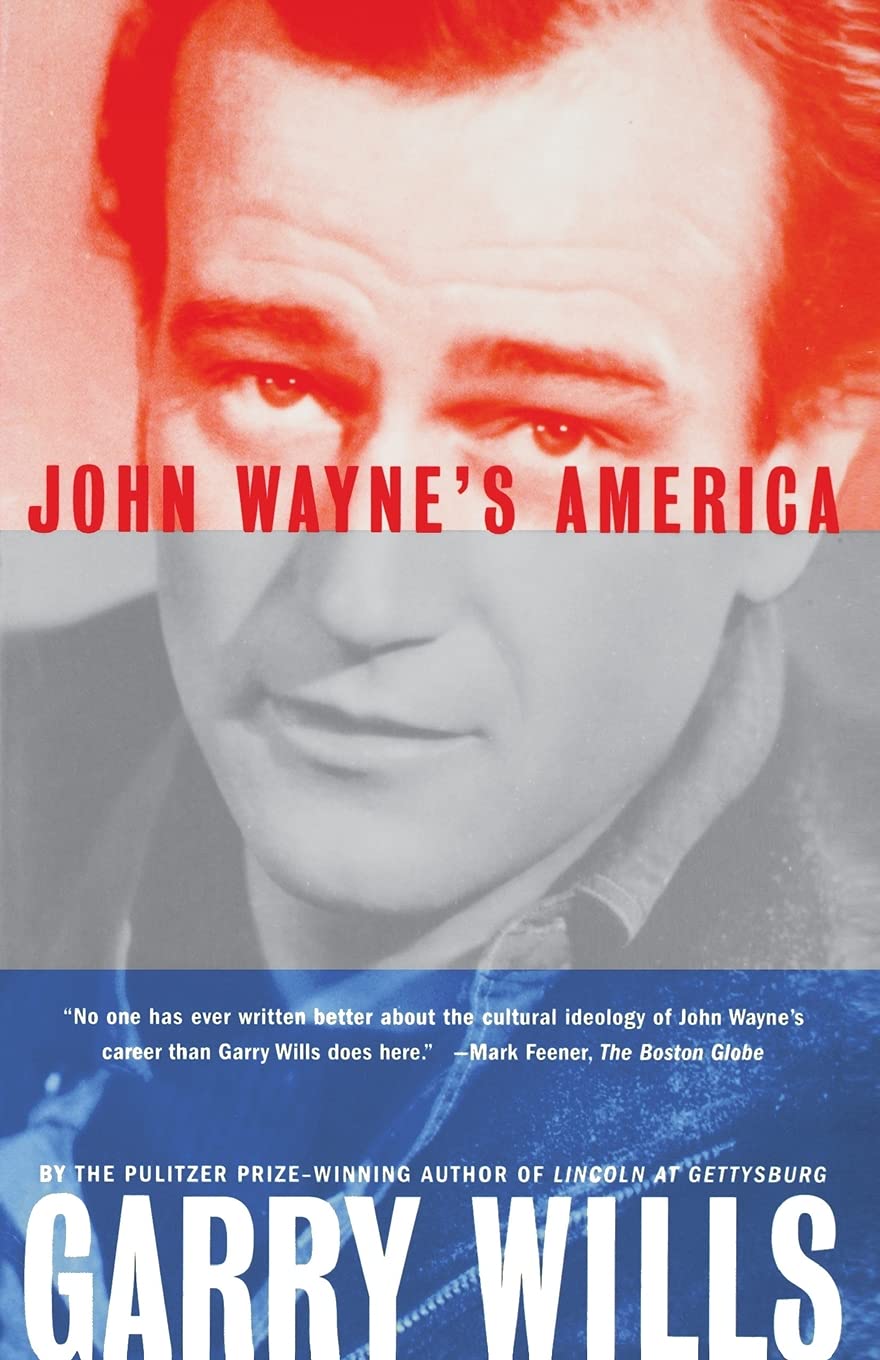



The Pulitzer Prize-winning author of Lincoln at Gettysburg brings his eloquence, wit, and on-target perceptions of American life and politics to this fascinating, well-drawn protrait of a twentieth-century hero. In this work of great originalitythe biography of an ideaGarry Wills shows how John Wayne came to embody Amercian values and influenced our cultoure to a degree unmatched by any other public figure of his time. In Wills's hands, Waynes story is tranformed into a compelling narrative about the intersection of popular entertainment and political realities in mid-twentieth-century America. Steve Neal Chicago Sun Times A fascinating and insightful study about the making of an American myth. Of more than a dozen books about Wayne, John Wayne's America is by far the best; it is a fresh and original interpretation of his film career and of his impact on American culture. Dennis McLellan Los Angeles Times A stunning book...essential reading for anyone interested in Wayne and popular culture. Molly Haskell The New York Times Book Review I hope this new book will find its way into the hands of those who are ready to think seriously about a pivotal figure in our culture, a figure who was a great star and a flawed man. Mark Feener The Boston Globe No one has ever written better about the cultural ideology of John Wayne's career than Garry Willis does here. Garry Wills is the author of 21 books, including the bestseller Lincoln at Gettysburg (winner of the 1992 Pulitzer Prize and the National Book Critics Circle Award), John Wayne's America, Certain Trumpets, Under God, and Necessary Evil. A frequent contributor to many national publications, including the New York Times Magazine and the New York Review of Books, he is also an adjunct professor of history at Northwestern University and lives in Evanston, Illinois. John Wayne's America By Garry Wills Simon & Schuster Copyright © 1998 Garry Wills All right reserved. ISBN: 0684838834 From Chapter One John Wayne, like Ronald Reagan (born four years after him), was part of Iowa's great exodus to California. A net of commercial and filial connections dragged people from their cornfields off to citrus groves. Wayne's family was typical: first his paternal grandfather went, then his father, then his mother with his maternal grandmother and grandfather. Reagan went, taking a whole cluster of friends from his broadcasting days, to be followed by his brother and his parents. Iowans turned like sunflowers toward the California sun. Wayne forgot Iowa, and Iowa forgot him, while Reagan kept up ties with his Midwestern past. This is mainly, but not only, because Wayne left as a child (seven), and Reagan as a young man (twenty-five). Studio publicists highlight or invent links to a star's roots if they are useful to the star's image. It served Reagan to be a homey and down-to-earth Iowan, the unpretentious star of Des Moines radio. But Western heroes appear from nowhere. Their past is mysterious, their name a title or a mask?the Virginian, the Texan, the Kid. Is Shane a first or last name?or both, or neither? Even when not masked, this Western hero is always a lone ranger, come back from beyond the farthest ridge, not formed "back East" in settled ways. John Wayne had nothing to gain from the farmlands in his past. It is accidental but appropriate that Reagan lost his nickname (Dutch) in California returning to his real name (Ronald), while Wayne lost his real first name (Marion) there, gaining a nickname (Duke) before trading his family name (Morrison) for a stage name. If Wayne was not quite Sergio Leone's "Man with No Name," he was at least a man from nowhere. The nowhere was Winterset, Iowa. Later on, residents of Winterset entertained a myth that Wayne sneaked back, once, to look at his native place?as if Wayne could slip unnoticed through the rows of corn. Wayne's son Michael fed this illusion by saying that he showed Wayne, toward the end of his father's life, a movie made in Winterset (Cold Turkey), without telling him where it was set. Wayne, his son averred, found something familiar about the Madison County courthouse?a remarkable achievement for a child who left Winterset at age two, moving on to other towns in Iowa. The Wayne family took few happy memories away from Iowa, and some of the happy few were false. Wayne later boasted that his father's Iowa pharmacy was a real drugstore, not a place for selling general products. But the store Clyde Morrison owned specialized in paint and wallpaper, and the drugs he sold were mainly patent medicine. Even more important was the memory that Clyde had been a football star, an "all-state halfback" at Simpson College. The Simpson College yearbooks and school papers tell a different story. Clyde Morrison grew up in Indianola, the site of Simpson College, and attended its preparatory academy. In his freshman year at the college, he started on the football team's first string