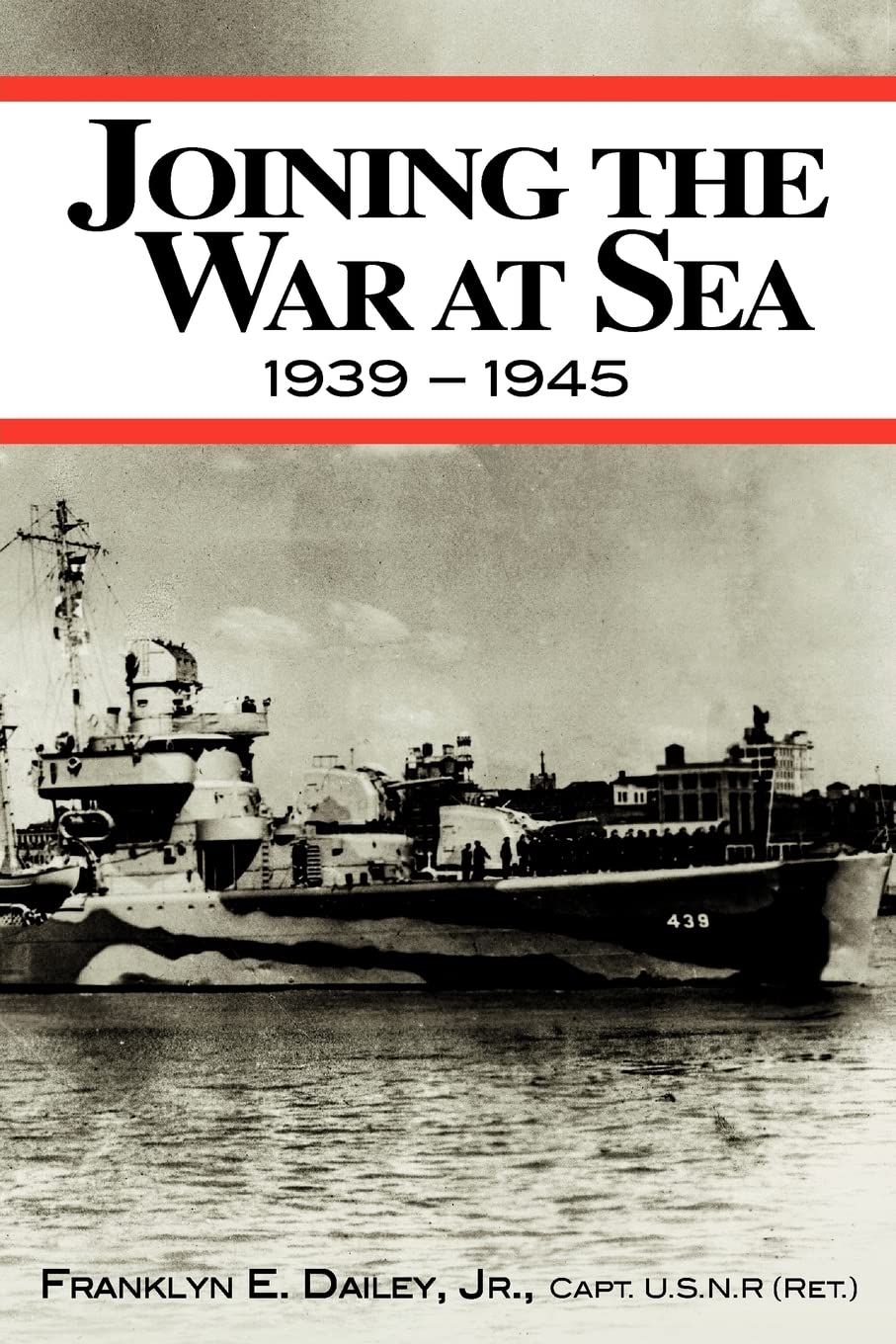
Joining the War at Sea 1939-1945: A Destroyer's Role in World War II Naval Convoys and Invasion Landings
$19.50
by Franklyn E Dailey Jr



Franklyn E. Dailey. Jr. takes the reader back to two challenging U.S. Navy missions in World War II. First, he offers a participant's view of the defense of convoys against German U-boats. Then, as his destroyer's primary mission changed, he brings the reader to a live-action view of five amphibious landing force operations - Casablanca, Sicily, Salerno, Anzio and Southern France. Churchill and Roosevelt had made defeat of Germany a priority ahead of the defeat of Japan. For Normandy to be successful, the Allies had to assure a supply line to the British Isles and then wrest back control of the Mediterranean from Germany. Army Divisions, Rangers, warships, attack transports and combatant aircraft, many with prominent unit names, are found in this book. Dailey also outlines the wartime geopolitical background, which will give the reader a good grasp of the larger picture of the action experienced by sea warriors in W.W.II. I was the last Gunnery Officer on the destroyer USS Edison (DD-439) to fire a salvo in anger in World War II. This occurred at the invasion of Southern France beginning August 15, 1944. Edison's gunfire support missions there centered on the Gulf of Cannes, eastward to the Italian seacoast on the Tyrrhenian Sea. Edison was assigned D-day gunfire support missions to aid amphibious landings beginning at Casablanca (Fedala) on November 8, 1942, then Sicily (Licata beach) in July 1943, Salerno (Paestum beaches) in September 1943, Anzio ('a long siege') in December 1943-January 1944, and Southern France. Home-ported at Oran, Algeria, after the British took that port, and supported there by the repair ship USS Vulcan (AR-5), Edison assisted U.S. destroyers Trippe and Woolsey in sinking submarine U-73. This book is not just an Edison story. Included are Allied aircraft, the Luftwaffe and its standoff guided bombs and glider bombs, U.S.Army amphibious divisions, U.S. and Allied warships, U.S. AKAs, APAs, oilers (AOs), and the complete arsenal of amphibious craft that landed and supported our troops on the beaches. This concentration of U.S. and Allied war-craft and amphibious divisions and Rangers made huge sacrifices to take the Mediterranean Sea and the countries it bordered back from Axis control. The massive human and logistic operations also re-opened the sealanes through the Suez Canal to India, saving the Allies thousands of miles of sea transport and wolfpack exposure for its merchant ship supply train to India, and on to the war against Japan. Edison received six battle stars, one for ASW support of convoys in the North Atlantic and one each for the five invasions noted. The Fourth Edition (June 2009) ISBN 0966625153 contains a 47-page Index compiled by Dutch scholar Pieter Graf from his reading of the Third Edition, which Graf felt deserved indexing by a professional.. Franklyn E. Dailey Jr. attended Niagara University. He then took employment at Eastman Kodak, first in its Tabulating Dept., then in the Billing Dept. In 1939 he received appointment to the U.S. Naval Academy, graduating in June 1942. Dailey went to the destroyer, USS Edison. As Gunnery Officer in 1944, Lt. USN Dailey was ordered to the U.S. for flight training. He began at Ottumwa, Ia, then basic flight training at Pensacola, Fl. He received Navy wings in Oct. 1945. Before proceeding to Squadron VP-107 at NAS Whidbey Island Wa. in 1946, Dailey received training in PB4Y-2 Privateers at Hutchinson, Kan. and Whiting Field in Florida. Extensive Aleutian instrument flights were followed by two Naval PG School years at Annapolis (BSEE), and then the Westwood campus, UCal., for an MS Physics in 1951. LCdr Dailey then went to Squadron VX-2 at Chincoteague, VA. This was followed by Undersea Wpns duty at the Naval Ord.Lab. in Silver Spring, Md. Cmdr. Dailey resigned his regular Navy commission in 1956. He worked for Stromberg Carlson in Rochester NY, and commanded VP-852, a Naval Reserve squadron transitioning from PB4Y-2 aircraft to Lockheed P2V-6M at NAS Niagara Falls. He accepted a commission as Cdr. USNR and later was promoted to Capt. USNR. After retirement from naval service he headed Stromberg's San Diego Eng. Ops' post, held senior technical positions with Ryan Aero.and a Scott Paper subsidiary in Massachusetts. In retirement, Dailey worked at McGraw Hill in New York City, and Coulter Systems in Bedford MA, and consulted for Fuji Photo. He established Dailey International Publishers, authoring a series of business/tech reports for Frost and Sullivan and Computer Tech. Research Corp. He and a partner established website daileyint.com in continuous operation since the mid 1990s. Three Amazon-available print books were then published, followed by Dailey's first e-book in Sept. 2012. Used Book in Good Condition