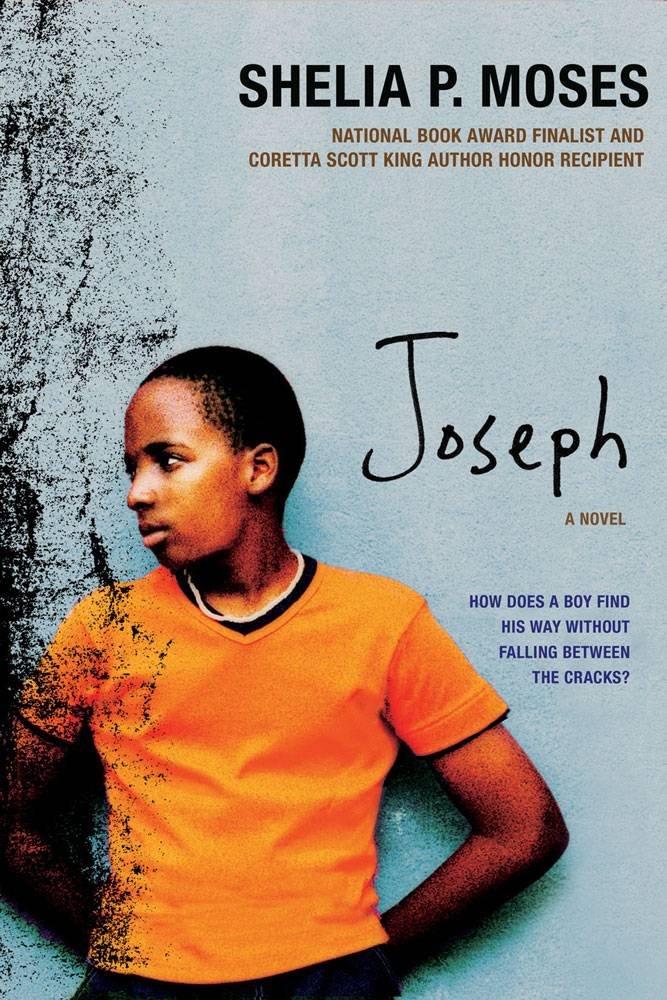



For Joseph Flood, life is tough. Tough because of Mama's addiction to drugs and alcohol. Tough because Daddy is away with the army fighting in Iraq. Tough because it looks like there's no way out once you're living in a homeless shelter in a North Carolina ghetto neighborhood. And tough because Joseph is enrolled in yet another new school where he doesn't know anyone and has to keep what's going on in his life a secret. Joseph struggles to keep Mama clean and to hold their broken family together while trying to make new friends and join the school tennis team. Can a boy who's only fifteen years old win his daily battle to survive? Joseph is a powerful and moving story from the author of National Book Award finalist The Legend of Buddy Bush that looks at what it really takes for a boy to begin to become a man. Grade 6–8—Joseph Flood's mother's problems with drugs, alcohol, and men have kept them in a near-constant state of chaos. The 15-year-old's loving father tries to help, but his military career and repeated overseas deployments—the latest to Iraq—have made it difficult for him to do much to intervene. The turmoil reaches a new low with a move into a homeless shelter. With the help of a sympathetic and stable aunt and uncle, Joseph must navigate the difficulties of adolescence while learning to handle a mother who is in a continual state of adolescence herself. Despite Moses's earnest efforts at creating a realistic voice for her protagonist, Joseph's story never seems to get off the ground; the first-person narration is flat, too young, and strangely monotone, with none of the authenticity of a real adolescent dealing with a troubled family life. It's unclear who the intended audience is. Short, simple sentences and a limited vocabulary make this slim novel accessible to struggling and reluctant teen readers, but the book's lack of sophistication may fail to hold their interest. Meanwhile, the age of the main character and more teen-appropriate issues like (implied) sex and drug abuse may make the plot too mature for younger readers. Ultimately, Joseph just doesn't ring true as a coming-of-age story.— Meredith Robbins, Jacqueline Kennedy Onassis High School, New York City Copyright © Reed Business Information, a division of Reed Elsevier Inc. All rights reserved. Poet, author, playwright, and producer Shelia P. Moses was raised the ninth of ten children on Rehobeth Road in Rich Square, North Carolina. She is the coauthor of Dick Gregory’s memoir, Callus on My Soul , as well as the award-winning author of several books for young readers: The Legend of Buddy Bush ; The Return of Buddy Bush ; I, Dred Scott: A Fictional Slave Narrative Based on the Life and Legal Precedent of Dred Scott; and The Baptism . Shelia lives in Atlanta, Georgia. Joseph By Shelia P. Moses Margaret K. McElderry Copyright © 2008 Shelia P. Moses All right reserved. ISBN: 9781416917526 CHAPTER ONE I did not want my new homeroom teacher, Ms. Adams, to shake Momma's hand. The last time I changed schools, my teacher Mr. Colgate tried to shake my momma Betty's hand, but he noticed the burns on the tips of her fingers. Burns from smoking cigarettes down to the filter. Burns from smoking marijuana every night before she goes to bed. I know Mr. Colgate saw her burns, because he looked at her and frowned. People are always frowning at Momma, and that makes me sad. Sad that she cannot see herself. Sad that she finds fault in everyone's life except her own. I wonder how long it will take the people at this school to realize that Momma is a crackhead. I wonder how long it will take them to realize that I feel more like her father than she acts like my momma. When will they realize that we are homeless? Two days after Mr. Colgate saw Momma's burns, a social worker was standing at the door of our run-down townhouse. The house that stopped being home when Momma ran Daddy away. The social worker said that she had received a call from someone saying that I was living alone and in need of help. That was a lie. They were coming to investigate Momma. Again! The social worker was coming to see if it was true that I could not let Momma stay alone too long because she cannot take care of herself. Social Services wanted to see if we had food in the house. I was really sad that they were treating us like two-year-olds. It did not bother Momma at all that the social worker had stopped by again. She yelled at her and said the same old thing when she left: "What they stopping by here for? I got it going on." I just looked at her and went to bed. I was ashamed to go to school the next day. I liked going to Lincoln High School, the school I attended last year for two semesters. But I had to transfer, just like I had to transfer from all the other schools. We never stay in one place too long, not since Daddy left and Granddaddy died. My new school, Dulles High, is bigger than Lincoln. The counselor says that there are only