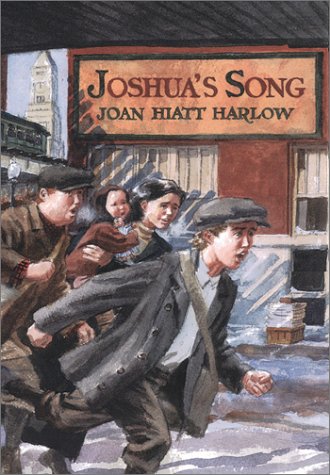



Set in Boston in 1919, Joshua Harper finds his world turned upside down due to the influenza outbreak as his family loses their income and he must work as a paperboy with hardened street kids to make the money to keep his family going. Gr 4-6-A fast-paced novel with a likable main character. World War I has ended and the influenza epidemic has taken Joshua's father. His mother, formerly one of Boston's elite, is struggling to make ends meet because of her husband's debts. She takes in boarders whom her son must call "uncle" and "aunt" so the neighbors don't know she's running a boarding house, and Joshua must give up his private school and find work. Harlow quickly sets up this background, then begins the boy's adventures the day he becomes a newsboy. The plot moves swiftly as he falls in with Charlestown Charlie, who oversees the newsboys in downtown Boston; meets a reporter who will pay for the stories Joshua can bring him; and learns about the darker side of city life when he meets a girl who sells papers to help her sick mother. The climax of the story is based on the Molasses Flood of 1919, when a huge tanker full of molasses exploded in Boston's North End, killing 21 people. The conclusion is somewhat pat; Joshua's mother sells property and is no longer poor. One hopes that the boy won't forget his friends or the lessons he's learned. Harlow skillfully integrates historical fact to make a colorful setting believable. An afterword gives other interesting details. A worthwhile title for historical-fiction collections. Sally Bates Goodroe, formerly at Harris County Public Library, Houston, TX Copyright 2001 Cahners Business Information, Inc. Gr. 5-8. Thirteen-year-old Joshua Harper's life has altered dramatically since his father's death in the 1918 influenza pandemic: he has had to quit school and go to work as a newsboy, and his changing voice has made it impossible for him to continue to sing with the Boston Boys' Choir. He earns good money as a newsboy, but Charlie, his tough, street-smart newsboy boss, is constantly challenging him. He can't find a place. He doesn't fit in with his former friends or with the news kids, who view him as a snob. It's not until a storage tank ruptures, flooding Boston's North End with millions of gallons of molasses that Josh finds his new "voice" and gets the respect he deserves. Even readers who don't usually like historical fiction will enjoy Harlow's vivid depiction of early-twentieth-century working-class life and conditions. They will also like the fast-paced story, which revolves around an actual incident, the Great Molasses Flood of 1919. Chris Sherman Copyright © American Library Association. All rights reserved Author Joan Hiatt Harlow reveals a little-known tragedy in historic Boston, presenting readers with a fast-paced story. -- St. Louis, MO Post-Dispatch November 11, 2001 Author of last year's popular "Star in the Storm" does a marvelous job weaving historic detail into JOSHUA'S SONG. -- Buffalo, NY News, October 9, 2001 JOSHUA'S SONG: Chosen by the Children's Book Committee, Bank Street College's list of BEST CHILDREN'S BOOKS OF THE YEAR 2001. -- Children's Book Committee at Bank Street College of Education Joshua's Song makes for an exciting and fast-moving story based on true incidents in history. -- Tampa Tribune - November 25, 2001 Tampa Tribune - November 25, 2001 Joan Hiatt Harlow is the award-winning author of several novels, including Star in the Storm, which was the winner of the ASPCA Henry Bergh Children's Book Award and an IRA-CBC Children's Choice Award, and most recently, Thunder from the Sea. A native of Boston, Massachusetts, Ms. Harlow now lives in Venice, Florida. Visit her Web site at www.joanhiattharlow.com. Chapter 1: Job Jitters The sound of creaking wagon wheels and clinking bottles broke through Joshua's dreams. Was it dawn already? The milkman's horse neighed softly in the alley beneath the window. Joshua yawned and stretched in the small brass bed. His room wasn't heated, and the January morning was cold. His mother was already clattering pans in the kitchen. Before the Spanish Influenza struck the family several months ago, things had been different. Every morning his mother used to sleep late while Annie, the housekeeper, brought coffee and toast up to the big bedroom. Dad would be shaving and humming in the bathroom. Joshua's morning had been full of his father's singing, his mother's soft laughter when Dad teased her from her sleep, and the smell of coffee. That was before that awful day -- the day Joshua's father died from the virulent pneumonia that was part of the influenza. Just when it seemed that the whole family would recover, Joshua's dad lost his fight. The flu epidemic had taken another victim. Mom didn't laugh anymore. Instead, she cried late at night and banged the pots and pans early in the morning. Two weeks ago, Christmas had been a disaster. Just one long, dreary time of sadness and mem