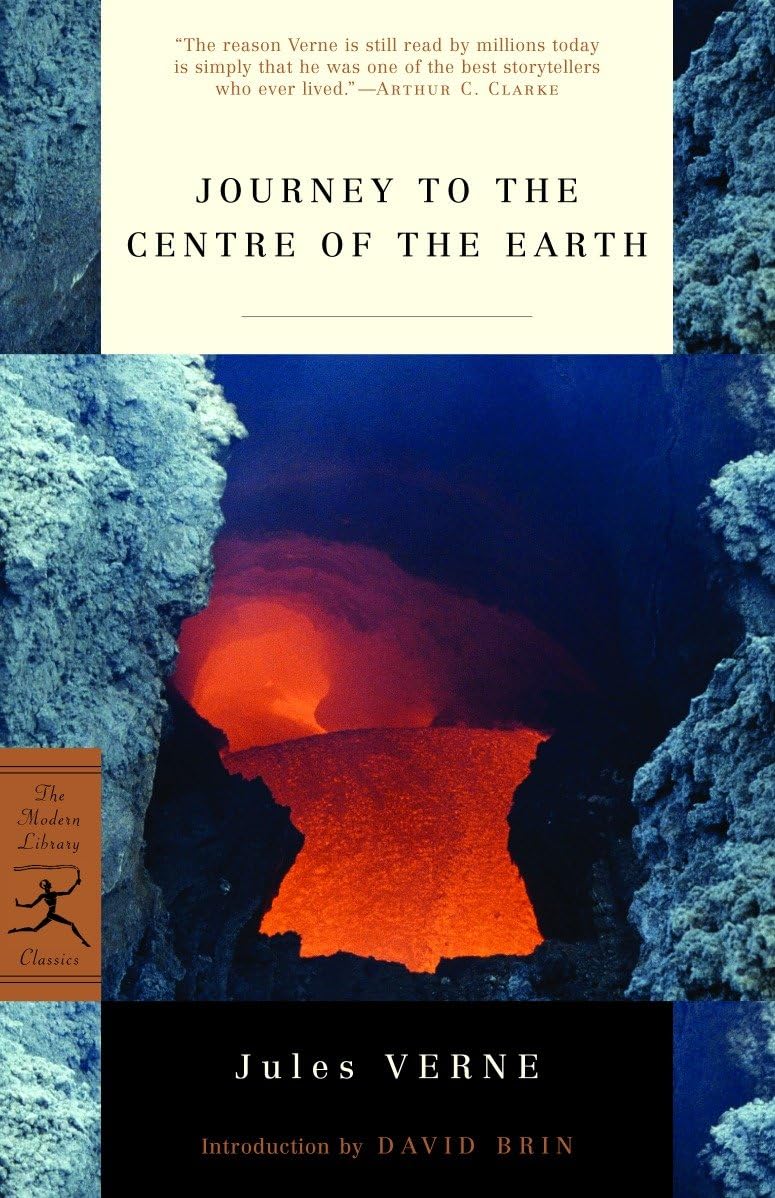



The intrepid Professor Lindenbrock embarks upon the strangest expedition of the nineteenth century: a journey down an extinct Icelandic volcano to the Earth’s very core. In his quest to penetrate the planet’s primordial secrets, the geologist—together with his quaking nephew Axel and their devoted guide, Hans—discovers an astonishing subterranean menagerie of prehistoric proportions. Verne’s imaginative tale is at once the ultimate science fiction adventure and a reflection on the perfectibility of human understanding and the psychology of the questor. As David Brin notes in his Introduction, though Verne never knew the term “science fiction,” Journey to the Centre of the Earth is “inarguably one of the wellsprings from which it all began.” “The reason Verne is still read by millions today is simply that he was one of the best storytellers who ever lived.”—Arthur C. Clarke The intrepid Professor Lindenbrock embarks upon the strangest expedition of the nineteenth century: a journey down an extinct Icelandic volcano to the Earth?s very core. In his quest to penetrate the planet?s primordial secrets, the geologist?together with his quaking nephew Axel and their devoted guide, Hans?discovers an astonishing subterranean menagerie of prehistoric proportions. Verne?s imaginative tale is at once the ultimate science fiction adventure and a reflection on the perfectibility of human understanding and the psychology of the questor. As David Brin notes in his Introduction, though Verne never knew the term ?science fiction,? Journey to the Centre of the Earth is ?inarguably one of the wellsprings from which it all began.? The intrepid Professor Lindenbrock embarks upon the strangest expedition of the nineteenth century: a journey down an extinct Icelandic volcano to the Earth's very core. In his quest to penetrate the planet's primordial secrets, the geologist--together with his quaking nephew Axel and their devoted guide, Hans--discovers an astonishing subterranean menagerie of prehistoric proportions. Verne's imaginative tale is at once the ultimate science fiction adventure and a reflection on the perfectibility of human understanding and the psychology of the questor. As David Brin notes in his Introduction, though Verne never knew the term "science fiction," Journey to the Centre of the Earth is "inarguably one of the wellsprings from which it all began." David Brin is the Hugo Award–winning author of fifteen bestselling novels and collections, including Earth, The Postman, and the Uplift saga. His nonfiction book, The Transparent Society, won the American Library Association’s Obeler Freedom of Speech Award. I It was on Sunday, the 24th of May, 1863, that my uncle, Professor Lidenbrock, came rushing suddenly back to his little house in the old part of Hamburg, No. 19, Königstrasse. Our good Martha could not but think she was very much behindhand with the dinner, for the pot was scarcely beginning to simmer, and I said to myself: “Now, then, we’ll have a fine outcry if my uncle is hungry, for he is the most impatient of mortals.” “Mr. Lidenbrock, already!” cried the poor woman, in dismay, half opening the dining-room door. “Yes, Martha; but of course dinner can’t be ready yet, for it is not two o’clock. It has only just struck the half-hour by St. Michael’s.” “What brings Mr. Lidenbrock home, then?” “He’ll probably tell us that himself.” “Here he comes. I’ll be off, Mr. Axel; you must make him listen to reason.” And forthwith she effected a safe retreat to her culinary laboratory. I was left alone, but not feeling equal to the task of making the most irascible of professors listen to reason, was about to escape to my own little room upstairs, when the street-door creaked on its hinges, and the wooden stairs cracked beneath a hurried tread, and the master of the house came in and bolted across the dining-room, straight into his study. But, rapid as his flight was, he managed to fling his nutcracker-headed stick into a corner, and his wide-brimmed rough hat on the table, and to shout out to his nephew: “Axel, follow me.” Before I had time to stir he called out again, in the most impatient tone imaginable: “What! Not here yet?” In an instant I was on my feet and in the study of my dreadful master. Otto Lidenbrock was not a bad man. I grant that, willingly. But, unless he mightily changes, he will live and die a terrible origi- nal. He was professor in the Johannæum, and gave the course of lectures on mineralogy, during which he regularly put himself into a passion once or twice. Not that he troubled himself much about the assiduity of his pupils, or the amount of attention they paid to his lessons, or their corresponding success. These points gave him no concern. He taught subjectively, to use a German philosophical expression, for himself, and not for others. He was a selfish savant— a well of science, and nothing could be drawn up from it without the grinding noise of the pulleys: in a w