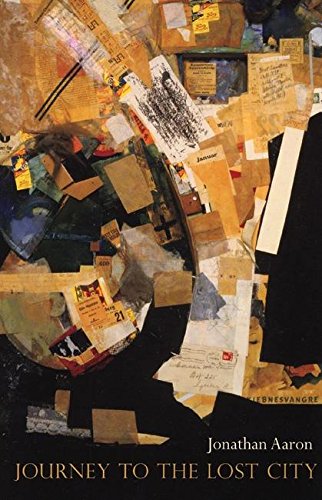



Taking its title from the cult horror movie classic, Jonathan Aaron’s third book, Journey to the Lost City , is a work of sharp wit, irony, and disarming tenderness. Cool, metaphysically quizzical, almost Eastern-European in sensibility, Aaron’s poems are a far cry from the dull, personal anecdotal quality that infects so much contemporary poetry. Savvy, intelligent, personal yet reserved, they take us on imaginative forays into a world where time swirls the past into the present, juxtaposing historical persons and places with the here and now. This allows the poet to speak with a weird authority that’s both wholly American and timeless, intimate yet without the intrusion of a confiding individual self. Aaron is a poet whose work is well known and admired by poets but has not yet reached the larger audience it deserves, though his poems have appeared numerous times in Best American Poetry and his second book, Second Sight , was a National Poetry Series winner. He is a frequent contributor to The New York Review of Books , The Times Literary Supplement , and the London Review of Books , as well as the Boston Globe , and has taught for many years at Emerson College. Journey to the Lost City is his first book since 1992. It has been eagerly awaited by his fans, and will introduce new readers to a poet of great range and stature. Nostalgia for the past becomes a kind of twilight zone... The reader finds identity and imagination forever entangled and fused. -- Poetryfoundation.org, October 2006 Book Picks On Poetry and Existence: "If there's an overarching question my poems bring to mind as I reread them, it's this: Is it possible to be at home in the world?" On Poetry and the Reader: "I want my poems to speak directly to the reader. At the same time, I hope they complicate the thinking of anyone who reads them. My poems are out of a desire to ask questions, not to supply answers." "As a reader, I look for poems that prompt some kind of change in how I experience the world." "I've always loved stories--not just `literature,' but personal and historical anecdotes, myths, parables, jokes, rumors, weird news items, the movies. Maybe that's why my poems are basically narrative in character and intent. Long or short, elaborate or plain, they aim to convey in terms of incident or description some kind of information that the reader can make something of. " "I believe that on one level stories reveal what teller and listener (or reader, or viewer) have in common. Stories remind us that in spite of their differences, people are always basically capable of understanding each other." "Of course, what I end up seeing in a poem I write may well have little in common with what a reader ends up seeing in it. My experience of writing a poem has to be different from a reader's in reading it. Once I've finished it, a poem isn't mine anymore. It's out there on its own, connecting with its reader in ways I have nothing to do with. For example, having written it, I may think `The House' is about trying to come to terms with a certain kind of loss. Someone else might think the poem focuses on how things--inanimate objects--have lives of their own. Any true poem should offer its reader paths through thought and intuition toward an altered awareness of his or her own life." On Poetry and Memory: "Like most people, I have a horror of forgetting things. Writing poems can be a way of recovering lost experience, lost knowledge, lost awareness. Since I can't see into the future, I sometimes look to people and events and motifs from the recent or not-so-recent past (World War II airplanes, film noir, modernist painting and photography, the 16th-century silversmith Cellini, Joan of Arc) for ways of understanding the present I live in. " Jonathan Aaron is the author of two books of poems, Second Sight and Corridor. He has received grants from the National Endowment for the Arts and the Massachusetts Artists Foundation. Aaron has published poetry and criticism in Paris Review, Partisan Review, The London Review of Books, and others. Used Book in Good Condition