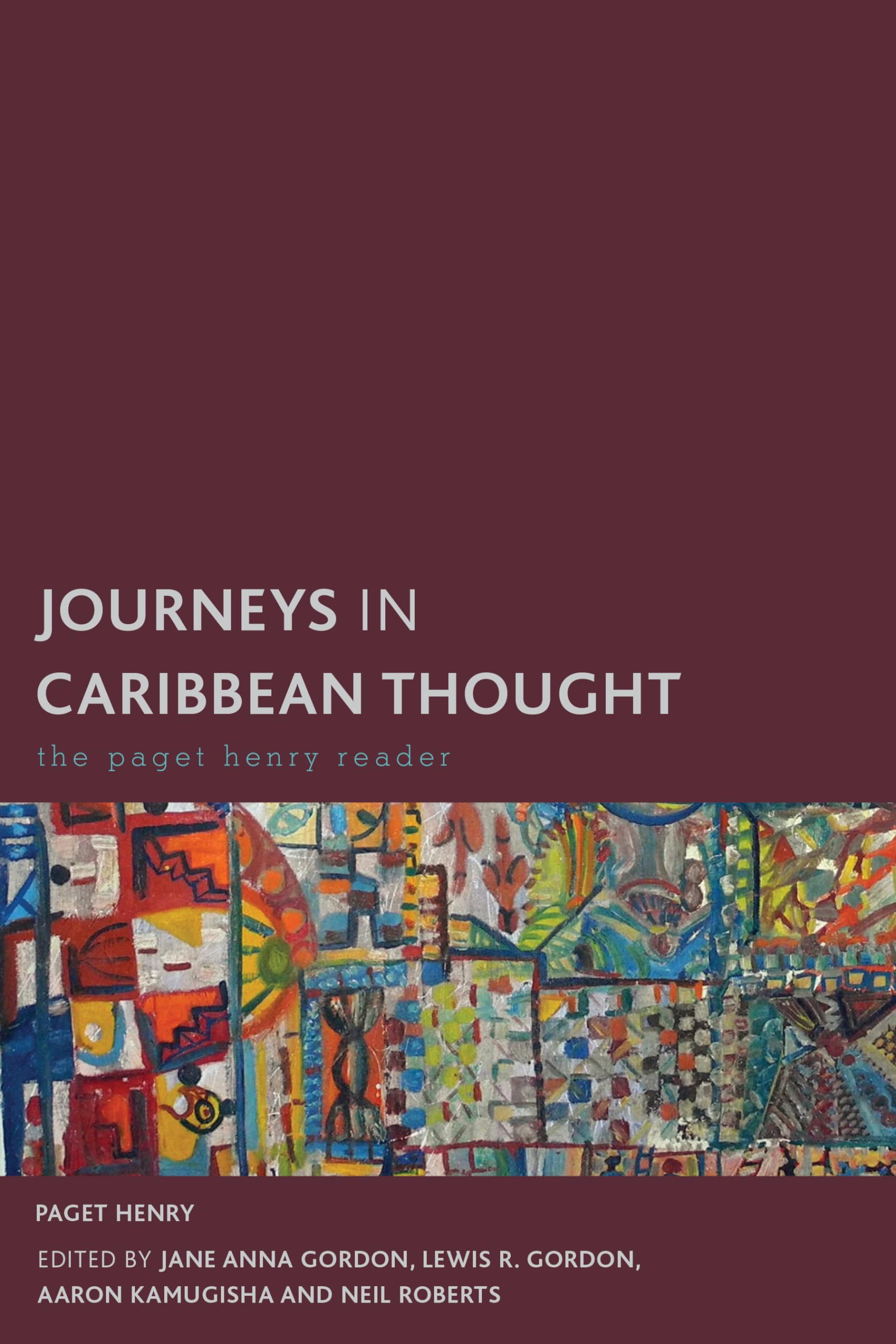
Journeys in Caribbean Thought: The Paget Henry Reader (Creolizing the Canon)
$39.20
by Paget Henry



For the past 30 years, Paget Henry has been one of the most articulate and creative voices in Caribbean scholarship, making seminal contributions to the study of Caribbean political economy, C.L.R. James studies, critical theory, phenomenology, and Africana philosophy. In the case of Afro-Caribbean philosophy, he inaugurated a new philosophical school of inquiry. Journeys in Caribbean Thought: The Paget Henry Reader outlines the trajectory of Henry’s scholarly career, beginning and ending with his most recent work on the distinctive character of Africana and Caribbean philosophy and political and intellectual leadership in his home of Antigua and Barbuda. In between, the book returns to Henry’s early consideration of the relationship of political economy to cultural flourishing or stagnation and how both should be studied, and to the problem with which Henry began his career, of peripheral development through a focus on Caribbean political economy and democratic socialism. Henry’s canonical work in Anglo-Caribbean thought draws upon a heavily creolized canon. “This book constitutes a multi-dimensional and multi-layered text of great depth and complexity not to be reduced to a single theme. For what it gives us is Henry’s quest to excavate, systematize and articulate Afro Caribbean intellectual production in varied intellectual endeavours such as sociology, literature, political economy and philosophy. The book is not only a negation of but also an antidote to the peripheralization of Caribbean thought. It is a must read for all interested in Caribbean thought’s complexity and depth precisely because it shifts the Geography of Reason.” ―Mabogo Percy More, Professor of Philosophy, University of Limpopo “In these succinct reflections on Caribbean thought through its tortuous journey Paget Henry perceives a clear pattern in the contrapuntal relationship between two seemingly opposing strands, one coming from the "historicism" of WEB DuBois and CLR James and the other from the "poeticism" of Wilson Harris and Sylvia Wynter. However, these strands are joined by invisible threads which could be perceived through a heightened consciousness of "creative realism”.” ―Prafulla C. Kar, Professor of English and Director of the Centre for Contemporary Theory, The Maharaja Sayajirao University of Baroda, India “For the student of Caribbean philosophy, however, this is an essential work. Paget Henry has made clear that in the realm of ideas, as in every other space, we Caribbean people have creolised reality and made it our own” ― Carribean Quarterly Lewis R. Gordon is Professor of Philosophy and Africana Studies at the University of Connecticut, visiting Professor at the University of the West Indies at Mona, Jamaica, Nelson Mandela, visiting Professor at Rhodes University, South Africa, European Union Visiting Chair in Philosophy at Université Toulouse Jean Jaurès, France, and Writer-in-Residence at Birkbeck School of Law. His most recent book is What Fanon Said: A Philosophical Introduction to His Life and Thought (2015). Journeys in Caribbean Thought The Paget Henry Reader By Jane Anna Gordon, Lewis R. Gordon, Aaron Kamugisha, Neil Roberts, Paget Henry Rowman & Littlefield International, Ltd. Copyright © 2016 Jane Anna Gordon, Lewis R. Gordon, Aaron Kamugisha and Neil Roberts All rights reserved. ISBN: 978-1-78348-936-7 Contents Acknowledgments, xi, Introducing Paget Henry, 1, Part I: The Distinctive Character of Africana Philosophy, 1 The General Character of Afro-Caribbean Philosophy, 9, 2 Africana Phenomenology: Its Philosophical Implications, 27, 3 Between Naipaul and Aurobindo: Where Is Indo-Caribbean Philosophy?, 59, 4 Wynter and the Transcendental Spaces of Caribbean Thought, 87, Part II: Caribbean Political Economy and Cultural Development, 5 Grenada and the Theory of Peripheral Transformation, 115, 6 Political Accumulation and Authoritarianism in the Caribbean: The Case of Antigua, 143, 7 Caribbean Dependency in the Phase of Informatic Capitalism, 171, 8 C. L. R. James, Walter Rodney and the Rebuilding of Caribbean Socialism, 199, Part III: A Homeward Turn: Antigua and Barbuda, 9 V. C. Bird's Political Philosophy, 227, 10 Philosophy and Antigua/Barbudan Political Culture, 253, 11 Badminded Nikki: A Review of Joanne Hillhouse's Oh Gad!, 277, 12 The Socialist Legacy of Tim Hector, 289, Epilogue: An Interview with Paget Henry (2015), 311, Bibliography, 331, Index, 347, About the Editors, 357, CHAPTER 1 The General Character of Afro-Caribbean Philosophy The power of philosophy floats through my head Light like a feather, heavy as lead. — Bob Marley There are idealist views of philosophy that see it as an affirmation of the autonomy of a thinking subject. As the primary instrument of this absolute subject, philosophy shares in its autonomy and therefore is a discipline that rises above the determinations of history and everyday life. The distinguishing ch