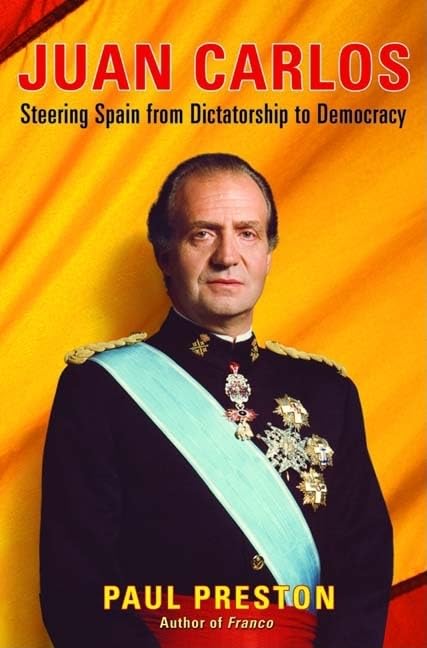



The definitive biography of Spain's enigmatic king, a riveting work of late-twentieth-century history. Paul Preston, the author of the definitive biography Franco, explores the political and personal mysteries of the Spanish monarch's life in Juan Carlos, a story of unprecedented sweep and exquisite detail. Handed over to the Franco regime as a young boy, Juan Carlos was raised according to authoritarian traditions designed to make him a cornerstone of the dictatorship. How then did he later emerge as an emphatic defender of the democracy that began to form after Franco's death? In his peerless voice, Preston provides the details necessary to answer this central question, examining the king's troubled relationship with his father and his vital work in consolidating parliamentary democracy in Spain. What begins as the story of one monarch becomes at once a history of modern Spain and an indispensable exegesis of how democracies come to be. 16 pages of b/w illustrations *Starred Review* King Juan Carlos of Spain is a hero. He has created an effective--no, vital-- place for the monarchy in Spanish politics and national life at a time in European history when the institution of monarchy is somewhat on the wane. Preston, author of the definitive Franco (1994), supplies a much-needed, serious, comprehensive, and absolutely dynamic biography of el rey , impressively researched and deeply probing--not only into Juan Carlos the character and king but also into recent Spanish history, which is the necessary context for understanding the king's life. Two major points are stressed here in effecting such an understanding: Juan Carlos was raised from boyhood with one purpose, to help regain for the Borbon royal house the throne left vacant in 1931 by the establishment of the Spanish republic; and, once installed as king upon the demise of the seemingly everlasting dictator Franco, Juan Carlos was determined that the restored monarchy would function as the force for democracy in the newly opened up, post-Franco Spain. What is learned here is that Juan Carlos' "long march to the throne" was most certainly not an easy journey, but the king's adeptness at performing as a constitutional monarch has been the primary factor in bringing Spain the political security it enjoys today. Brad Hooper Copyright © American Library Association. All rights reserved "[Preston] is a master of narrative, with an eye for the arresting and sometimes horrific detail." ― Nicholas Gordon-Lennox, Daily Telegraph Paul Preston , author of The Spanish Civil War , Franco , Juan Carlos , and The Spanish Holocaust , is the world’s foremost historian on twentieth-century Spain. A professor at the London School of Economics, he lives in London. A few pages into this biography of Spain's constitutional monarch, Juan Carlos I, one learns that the king's mother declared upon his birth, "He is as ugly as sin." Most contemporary biographers would likely tease out of this comment a telling theme that came to define the Spanish king's life -- for example, that Juan Carlos, who grew up to be quite handsome, has indeed defied many expectations. But readers of biographies of Princess Diana and John Adams, beware: This book, written by one of the most energetic and respected historians of modern Spain, does not seek out salacious details or purport to tell the essence of the man. This is really a history of modern Spanish politics, the dictatorial years of Francisco Franco and the surprisingly central role the king played in bringing about Spain's peaceful transition to democracy. In fact, the political nature of this biography is surprising, given how its subject remains a fairly anodyne figure in contemporary Spain. No tabloid has grown rich on steamy gossip or sordid rumors about the king's private life. Even his recently married son, once the most eligible of royal bachelors, has rarely received much more than amused and supportive coverage of his love affairs. Preston's goal is to explain why, given Juan Carlos's inoffensive image (he was once even called king of the Republicans), he remains one of the most politically influential monarchs in Europe. This result could not easily have been predicted, and the author suggests that the trajectory that led Juan Carlos through the difficult years of the Franco regime and culminated with his stewardship of Spain's peaceful transition to democracy merits serious political study. At his most psychological, Preston focuses on the personal sacrifices that were forced on Juan Carlos from a young age but which primed him for the sacrifices that his later political life demanded. This willingness for self-sacrifice largely resulted from a lack of fatherly affection and the subjugation of Juan Carlos's life to the political feuds between his father, Don Juan de Borbón, the heir to the Spanish throne, and Francisco Franco. In 1947, eight years after the end of the Civil War, Franco decided to name himself rege