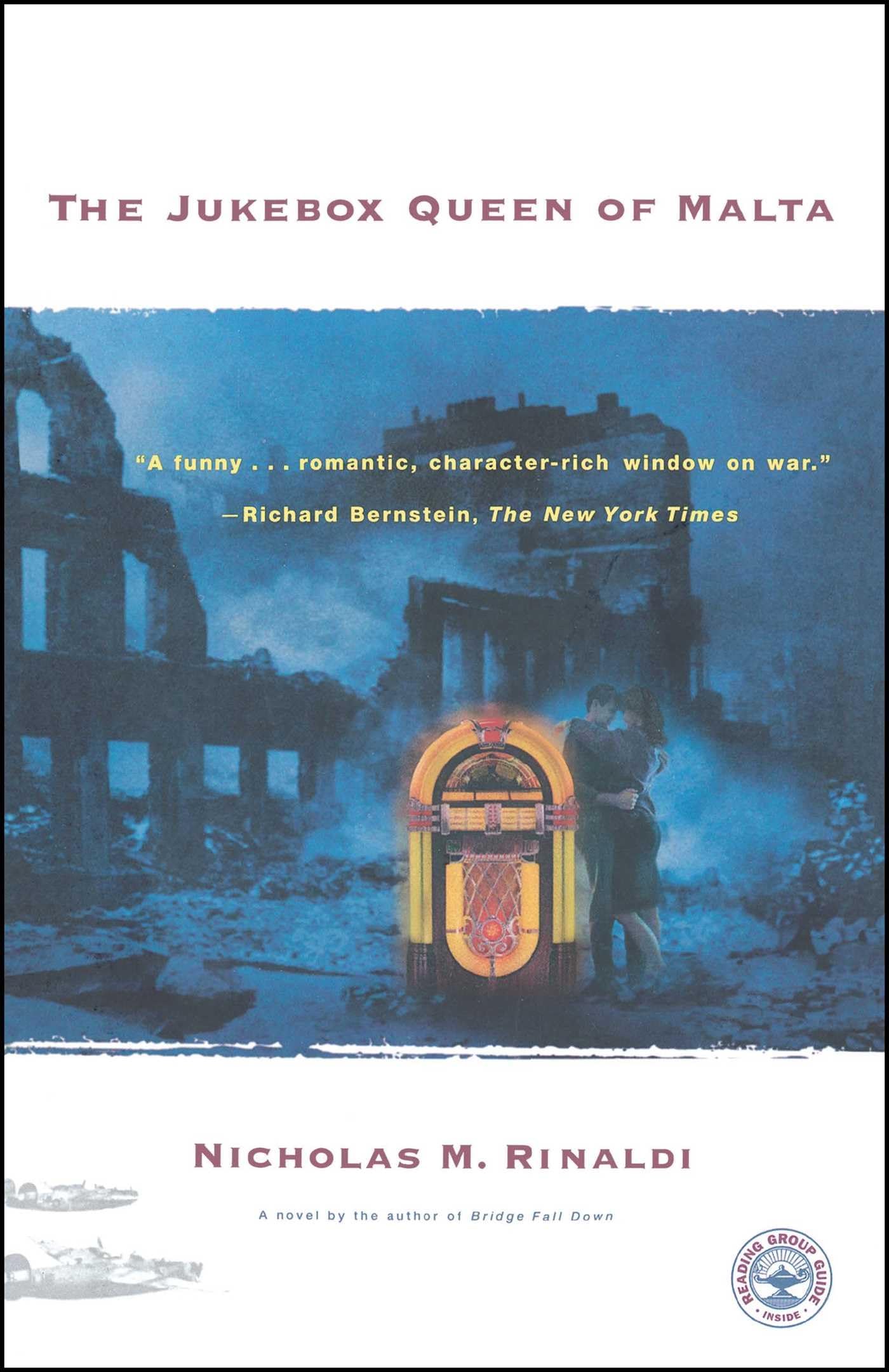



The Jukebox Queen of Malta is an exquisite and enchanting novel of love and war set on an island perilously balanced between what is real and what is not. It's 1942 and Rocco Raven, an intrepid auto mechanic turned corporal from Brooklyn, has arrived in Malta, a Mediterranean island of Neolithic caves, Copper Age temples, and fortresses. The island is under siege, full of smoke and rubble, caught in the magnesium glare of German and Italian bombs. But nothing is as it seems on Malta. Rocco's living quarters are a brothel; his commanding officer has a genius for turning the war's misfortunes into personal profit; and the Maltese people, astonishingly, testify to the resiliency of the human spirit. When Rocco meets the beautiful and ethereal Melita, who delivers the jukeboxes her cousin builds out of shattered debris, they are drawn to each other by an immediate passion. And, it is their full-blown affair that at once liberates and imprisons Rocco on the island. In this mesmerizing novel, music and bombs, war and romance, the jukebox and the gun exist in arresting counterpoint in a story that is a profound and deeply moving exploration of the redemptive powers of love. Richard Bernstein The New York Times A funny...romantic, character-rich window on war. Tom Drury The New York Times Book Review An incendiary-pastoral novel of life during the Axis bombardment of Malta...vividly rendered. Joseph Heller author of Catch-22 A beguiling romantic story in an illuminating and surprising setting. Richard Russo author of Straight Man and Nobody's Fool I hope this year will offer us another novel as smart and hilarious and magical as Nicholas Rinaldi's The Jukebox Queen of Malta, but I'm not holding my breath. Nicholas M. Rinaldi teaches literature and creative writing at Fairfield University in Connecticut. Chapter One: Buy Lace -- Save Malta They had names for the wind, for the different gusts and breezes that blew across the island. There was a wind that brought rain in October, and that was good, relief from the heat and the dust and the merciless sun that beat down through the long, torrid summer. But there were other winds, less welcome. The worst was the xlokk, which began in the Sahara and blew across the sea, picking up moisture and bringing hot, humid weather that sucked the breath from your lungs and brought on lethargy, inertia, frayed nerves. When Rocco was told he was being sent to Malta, he recognized the name, Malta, but had only the fuzziest notion where it was -- somewhere out there, far off, north or south, in a hazy distance, as dark and mysterious as the name itself, which he repeated over and over, hearing the strangeness, almost tasting it: Malta, Malta, Malta. It was, they told him, in the middle of the Mediterranean, just below Sicily. It belonged to the British, and -- the thing he didn't want to hear -- it was being bombed day and night by the Germans and the Italians. He knew nothing about the winds, the majjistral and the tramuntana, the grigal and the scirocco, blowing through the green clumps of cactus and the sun-scorched carob trees, nor did he know about the rows of houses and tenements made from blocks of limestone that were quarried on the island. The limestone was soft enough to cut with a saw, but in the open air, baked by the sun, it hardened, shading to a rich golden brown. It was early April when they told him to gather his gear for Malta. There was an American team over there, a major and a few lieutenants, who needed a radioman. They were doing liaison work, talking with the British, who were having a hard time of it with the bombing, hanging on by their fingernails. They'd already moved their ships and submarines out of the harbor, to safer waters, off to Egypt and Gibraltar. "Why me?" Rocco said to the sergeant who handed him his orders. "Because you have such frantic brown eyes," the sergeant said, with no trace of a smile. They put him aboard a Liberator and flew him to Gibraltar, where they gave him cheese and Spam in a sandwich, and a beer, then shipped him out on a British bomber, a Wellington, loaded with sacks of mail, and ammunition for the Bofors antiaircraft guns. Rocco rode in the nose, with the front gunner, catching a view of the sea through the Plexiglas -- a thousand miles of water passing beneath them, from Gibraltar all the way to Malta. The crew was exhausted, making the long run daily, back and forth, sometimes twice in a day. The gunner slept the whole way, undisturbed by the roar of the big Pegasus engines. From ten thousand feet, Rocco watched the wakes of freighters and warships, white scars on the water. The plane entered a long cloud, and when they emerged, back into clear sky, Malta lay far to the left, a dark pancake on the sea, the electric blue of the water turning to a clear vivid green where it rimmed the island. The Wellington seemed to hang, unmoving, as if the distance to the island was too great to overcom