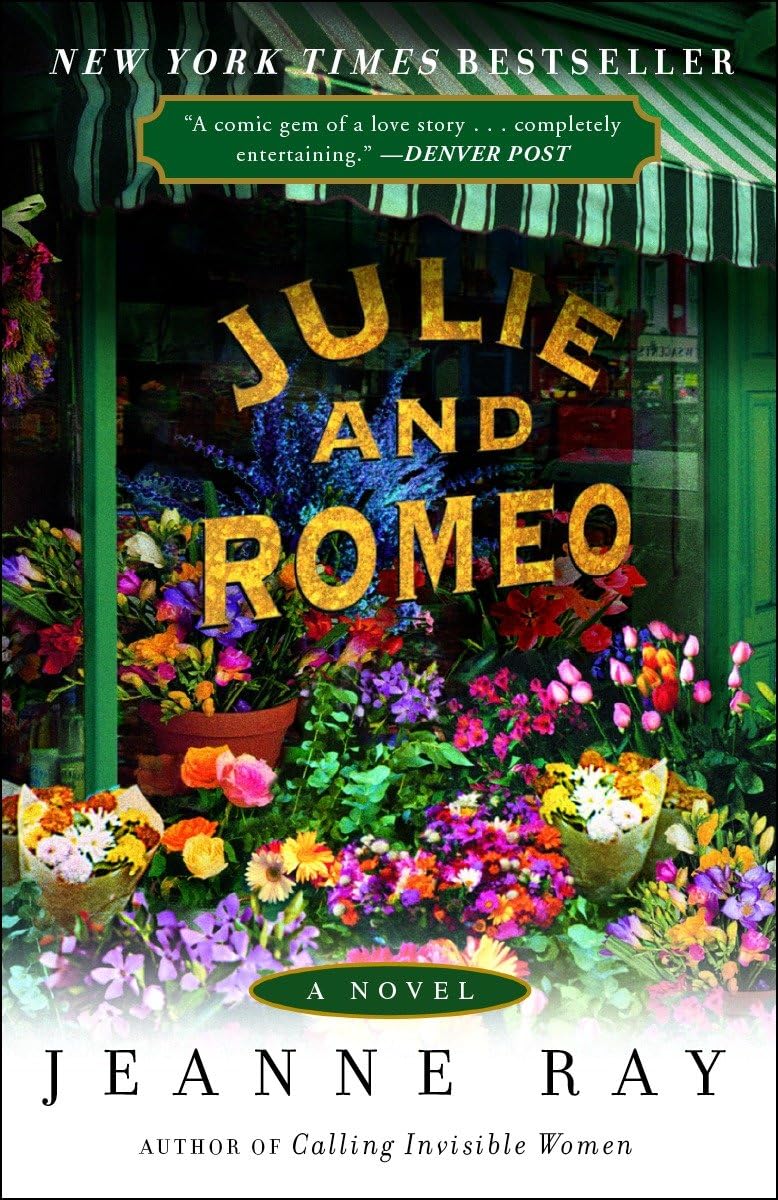



Romeo Cacciamani and Julie Roseman are rival florists whose families have hated each other for as long as anyone can remember, yet no one can remember why. When the two meet at a small business owners' seminar, an intense and unwavering attraction blooms between them. Unsure of what fate has in store, but deeply in love, Julie and Romeo are not about to let something as silly as a generations-long feud stand in their way. That is, until Romeo's octogenarian mother, Julie's meddling ex-husband, and a cast of grown Cacciamani and Roseman children begin to intervene with a passionate hatred that matches that of the Montagues and Capulets. A love story for the ages – all ages – Julie and Romeo is a stunning novel of star-crossed love finally found, threatened by family, but with a profound and modern finale of delicious proportion. "At last, someone has written a love story for and about grown-ups! And that someone is a marvelous new writer named Jeanne Ray, whose contemporary take on old rivalries, star-crossed passions, and clandestine intrigues charts a fresh, funny, exquisitely plotted tale of, well, Shakespearean proportions. Julie and Romeo is absolutely delicious. A smart, sexy celebration of the timeless nature of romance." —A. Manette Ansay, author of Vinegar Hill and Midnight Champagne "Love and desire will not be denied in this lighthearted inversion of a classic story. Filled with the delicate sweetness of fresh flowers and new love, Julie and Romeo is a smart, funny, touching book. Where has Jeanne Ray been hiding all these years?" —Alison McGhee, author of Shadow Baby JEANNE RAY is a nurse living in Nashville. She is the mother of the novelist Ann Patchett. This is her first novel. The first time I heard the name Cacciamani I was five years old. My father said it, and then he spit. The spitting I had seen before. I watched my father spit out his toothpaste into the sink. I had seen him spit once while mowing the lawn when he claimed to have taken in a mouthful of gnats. But this particular spitting, the spitting done in association with the word Cacciamani, was done directly onto the cement floor of the back room of Roseman's, our family's florist shop. That floor, like everything else in my father's world, was kept meticulously clean, nary a leaf hit that floor, and so even as a child I recognized the utter seriousness of his gesture. "Pigs," my father said, referring not to himself for what he had done to his floor but to the name that had led him to do it. I wish I could remember the rest of this story, how the Cacciamanis had come up in the first place, but I was five. Fifty-five years later, only the highlights of such childhood memories remain. Commentators, the people reading their opinions on the news, the people on the op-ed page of the Globe, love to say that hate is a learned thing. Children mimic the appalling racial slurs of their appalling parents, every bitter, contemptible piece of narrow-mindedness is handed down from generation to generation like so much fine family silver. I doubt it is as easy as this, as I know my own two daughters have picked up a few things in this world I will not take responsibility for, but then I think of my father and the small, shimmery pool of his spit on the floor. I hated Cacciamani with all the passionate single-mindedness of a child without even knowing what or who it was. I decided it was a fish. My father, who loved just about everything, was not a fan of fish, and so I assumed the conversation must have gone something like this: My mother: Howard, I got some nice fresh Cacciamani for dinner tonight. My Father: Cacciamani! [Spit] Pigs! For the next several years I imagined pale-fleshed, rubbery bottom feeders, the dreaded Cacciamani, snuffling around blindly at the bottom of Boston Harbor. No doubt my mother intended to fry them and serve them up in a buttery lemon sauce. When exactly I made the transition from fish to family, from family to rival florists, I don't know (again, remember, this was the distant past). It hardly ruled my life. My path did not cross with the Cacciamanis', and when it did, they had to be pointed out to me like a patch of poison ivy I could have walked right into. We did not go to the same school. Their son went to the idol-worshiping, uniform-wearing Catholic school, while my brother and I attended perfectly normal public school. Their name was rarely spoken and when it was there was a great fanfare of unexplained wrath that I gladly participated in. We were a liberal family, aware of the recent persecution of our people and therefore unlikely to persecute others. As far as I knew, the only prejudice we had was against the Cacciamanis. It didn't extend to other Catholics or all Italians, just those people, those wretched, worthless fish. A prejudice can be a lovely thing to have, which is exactly why so many people have them in the first place. A prejudice is a simplification: Every member of this group