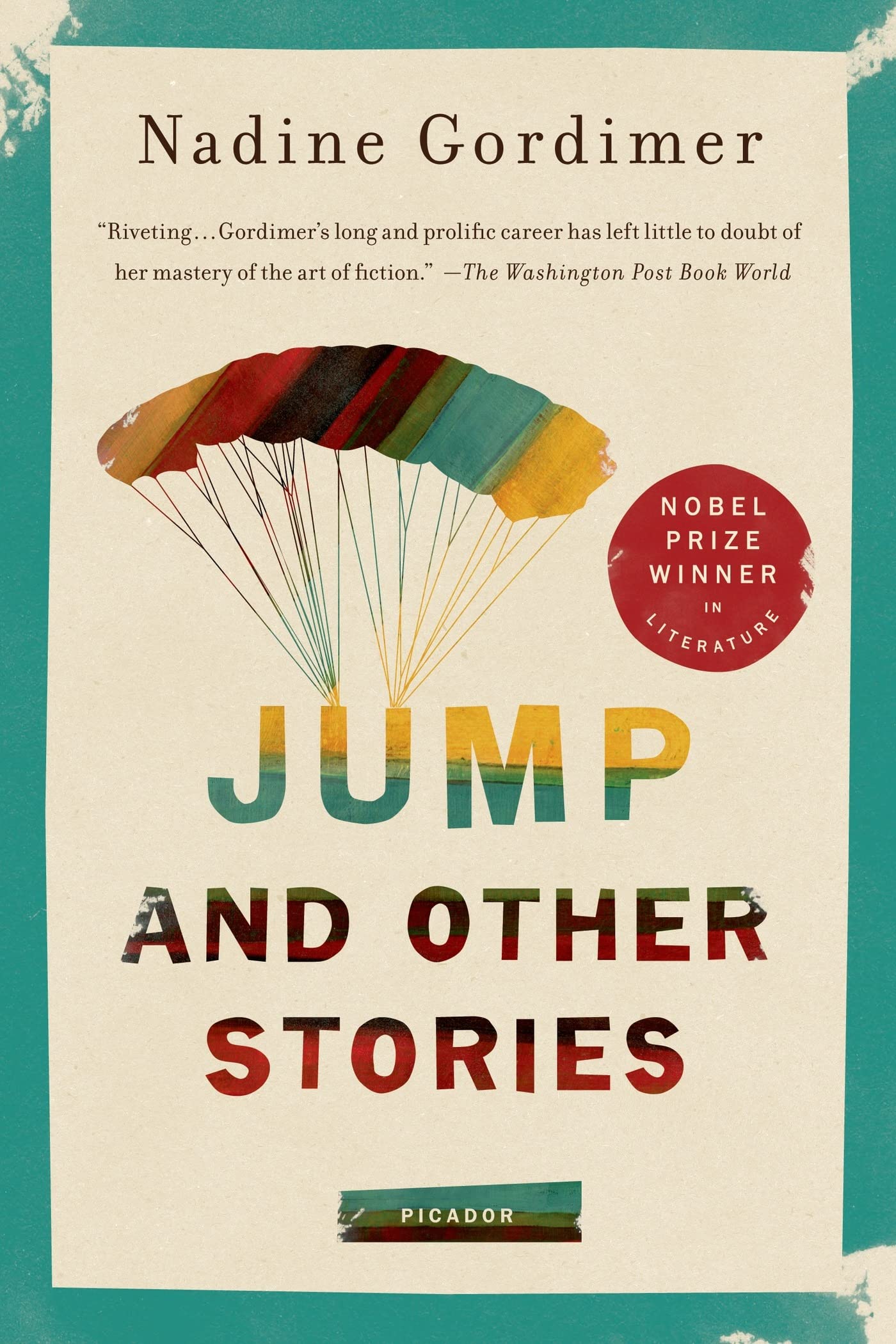



Jump and Other Stories collects fifteen thematically and geographically wide-ranging tales from political activist and Nobel Prize-winning author Nadine Gordimer, with settings ranging from suburban London to Mozambique. With unflinching depictions of how South Africa's apartheid policies drove racial inequality, wartime atrocities, marital strife, and family struggles, Gordimer's stories feature characters coping with morality in unjust socieites--uncovering both the beauty and tragedy found in human interactions with each other and with the natural world. “A gallery of riveting tales . . . Gordimer's long and prolific career has left little doubt of her mastery of the art of fiction.” ― The Washington Post Book World “Gordimer has rarely been more profound or more quietly brilliant than in these exquisitely subtle stories.” ― Publishers Weekly “Readers of Ms. Gordimer's fiction know that the riveting details, the epiphanies scattered throughout the narrative that shock and surprise, function within a larger vision. This expansive vision, its moral power and artistic integrity, are what elevate her fiction above that of most of her contemporaries.” ― The New York Times Book Review “Gordimer's stories are captivating, in the literal sense of holding in thrall the reader's entire attention. ” ― Chicago Tribune Nadine Gordimer (1923-2014), the recipient of the 1991 Nobel Prize in Literature, was born in a small South African town. Her first book, a collection of stories, was published when she was in her early twenties. Her ten books of stories include Something Out There (1984), and Jump and Other Stories (1991). Her novels include The Lying Days (1953), A World of Strangers (1958), Occasion for Loving (1963), The Late Bourgeois World (1966), A Guest of Honour (1971), The Conservationist (1975), Burger's Daughter (1979), July's People (1981), A Sport of Nature (1987), My Son's Story (1990), None to Accompany Me (1994), The House Gun (1998), The Pickup (2001), Get a Life (2005), and No Time Like the Present (2012). A World of Strangers , The Late Bourgeois World , and Burger's Daughter were originally banned in South Africa. She published three books of literary and political essays: The Essential Gesture (1988); Writing and Being (1995), the Charles Eliot Norton Lectures she gave at Harvard in 1994; and Living in Hope and History (1999). Ms. Gordimer was a vice president of PEN International and an executive member of the Congress of South African Writers. She was a fellow of the Royal Society of Literature in Great Britain and an honorary member of both the American Academy of Arts and Letters and the American Academy of Arts and Sciences. She was also a Commandeur de'Ordre des Arts et des Lettres (France). She held fourteen honorary degrees from universities including Harvard, Yale, Smith College, the New School for Social Research, City College of New York, the University of Leuven in Belgium, Oxford University, and Cambridge University. Ms. Gordimer won numerous literary awards, including the Booker Prize for The Conservationist , both internationally and in South Africa. Jump and Other Stories By Nadine Gordimer Picador Copyright © 2012 Nadine Gordimer All right reserved. ISBN: 9781250003768 Jump and Other Stories Jump He is aware of himself in the room, behind the apartment door, at the end of a corridor, within the spaces of this destination that has the name HOTEL LEBUVU in gilt mosaic where he was brought in. The vast lobby where a plastic-upholstered sofa and matching easy chairs are stranded, the waiting elevator in its shaft that goes up floor after floor past empty halls, gleaming signs—CONFERENCE CENTRE, TROPICANA BUFFET, THE MERMAID BAR—he is aware of being finally reached within all this as in a film a series of dissolves passes the camera through walls to find a single figure, the hero, the criminal. Himself.The curtains are open upon the dark, at night. When he gets up in the morning he closes them. By now they are on fire with the sun. The day pressing to enter. But his back is turned; he is an echo in the chamber of what was once the hotel.The chair faces the wide-screen television set they must have installed when they decided where to put him. There is nothing to match its expensive finish—the small deal table and four chairs with hard red plastic-covered seats, the hairy two-division sofa, the Formica-topped stool, the burning curtains whose circles and blotches of pattern dazzle like the flicker of flames: these would be standard for a clientele of transients who spend a night, spill beer, and put out cigarettes under a heel. The silvery convex of the TV screen reflects a dim, ballooned vision of a face, pale and full. He forgets, and passes a hand over cheek and chin, but there is no beard there—it’s real that he shaved it off. And they gave him money to fit himself out with the clothes he wears now. The