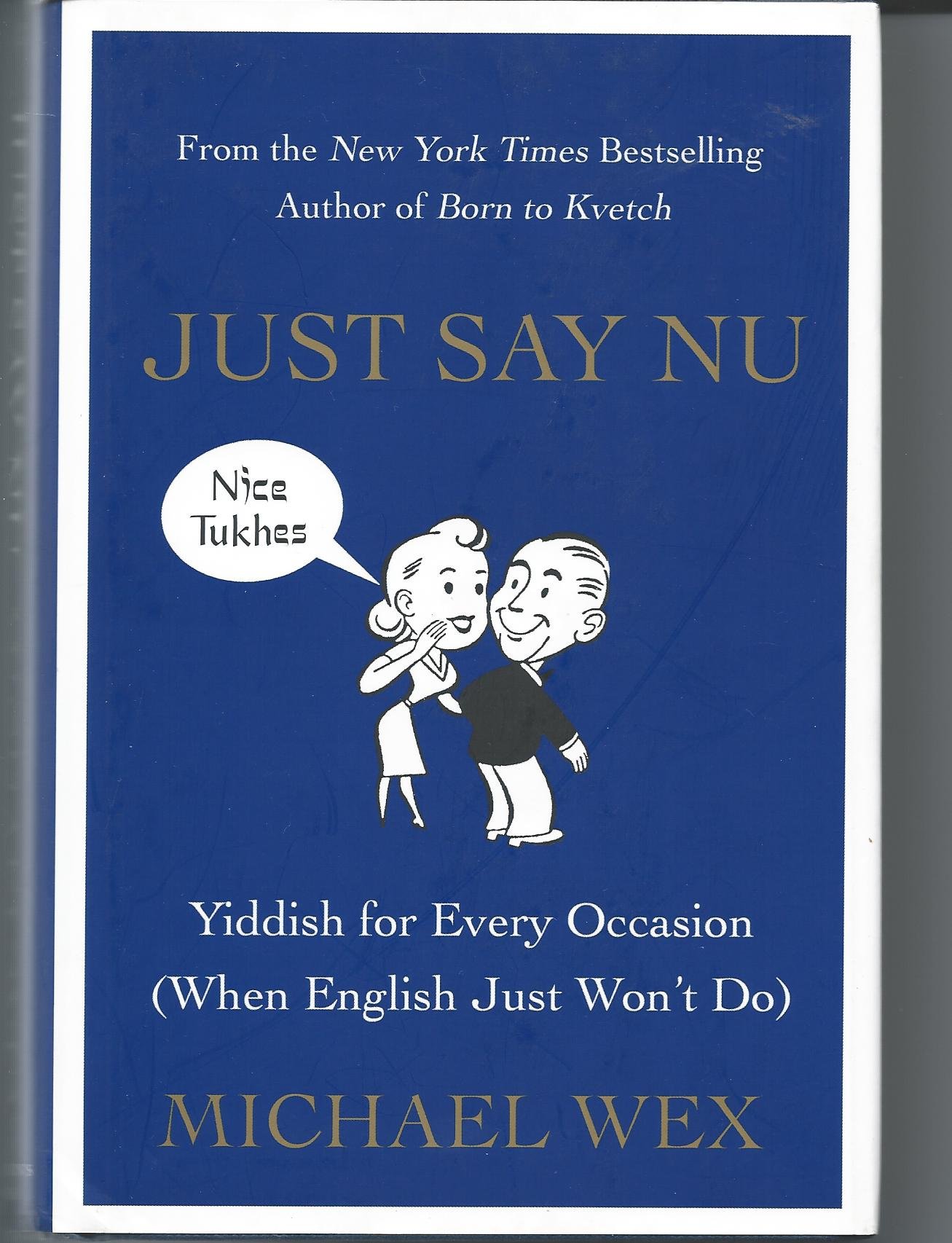



A cross between Henry Beard's Latin for All Occasions and Ben Schott's Schott's Original Miscellany , JUST SAY NU is a practical guide to using Yiddish words and expressions in day-to-day situations. Along with enough grammar to enable readers to put together a comprehensible sentence and avoid embarrassing mistakes, Wex also explains the five most useful Yiddish words– shoyn, nu, epes, takeh, and nebakh –what they mean, how and when to use them, and how they can be used to conduct an entire conversation without anybody ever suspecting that the reader doesn’t have the vaguest idea of what anyone is actually saying. Readers will learn how to shmooze their way through such activities as meeting and greeting; eating and drinking; praising and finding fault; maintaining personal hygiene; going to the doctor; driving; parenting; getting horoscopes; committing crimes; going to singles bars; having sex; talking politics and talking trash.Now that Stephen Colbert, a Catholic from South Carolina and host of the "Colbert Report," is using Yiddish to wish viewers a bright and happy Chanukah, people have finally started to realize that there’s nothing in the world that can’t be improved by translating it into Yiddish. Wex’s JUST SAY NU is the book that’s going to show them how. Praise for JUST SAY NU: “With verve, élan and something only a non-Yiddish speaker would call chutzpah, Michael Wex returns to the linguistic mother lode that yielded Born to Kvetch , his brilliant cultural history of Yiddish. This time around in Just Say Nu , he gets down to the everyday business of putting Yiddish to use.” -- NY Times “This is not your bubbe’s—or Leo Rosten’s—Yiddish. Translator, novelist and performer Wex follows his witty and erudite Born to Kvetch with a colorful, uncensored guide to the idiomatic, use of Yiddish in such areas as “madness, fury and driving.” Wex’s advice on the complex usage of these words can help even the greenest Yiddish speaker.” -- Publisher’s Weekly Praise for BORN TO KVETCH: “This treasure trove of linguistics, sociology, history and folklore offers a fascinating look at how, through the centuries, a unique and enduring language has reflected an equally unique and enduring culture.” – Publishers Weekly “Wise, witty and altogether wonderful…Mr. Wex has perfect pitch.” –William Grimes, The New York Times “All the wonderful elements of Yiddish language and culture are represented here. Highly recommended” – Library Journal “A great read for those who know and love Yiddish, and those who just drop the occasional ‘schmuck’ into the conversation.” – New York Press MICHAEL WEX is a novelist, professor, translator (including the only Yiddish translation of The Threepenny Opera), lecturer, and performer (of stand-up and one person shows). Wex has been hailed as "a Yiddish national treasure" and is one of the leading lights in the current revival of Yiddish, lecturing widely on Yiddish and Jewish culture. He lives in Toronto. Just Say Nu 1 Greeting and Meeting HelloIt 's supposed to be simple. An English greeting helps to move two people across the great divide from quiet to conversation, from separation to communication. You say hello, good morning, or good evening, and you get hello, good morning, or good evening in return. Each formula is a well-paved pathway, a gentle ramp that leads easily from one state of being to another.A Yiddish greeting does nothing of the kind. Take a look at the most basic way of saying hello,SHOOLEM ALAYKHEM,which has a literal meaning of "peace upon you." Now compare it with the sole permissible response,ALAYKHEM SHOOLEM,and you'll see what you need to know from the start: Yiddish conversation begins with a willingness to say the reverse of whatever has just been said to you --even when you happen to agree. You're not obliged to disagree, but you have to be ready to do so: Yiddish conversations progress as much by means of rhetorical questions and outright contradiction as by supposedly direct logical paths leading from conversational point A to conversational point B. Alaykhem shoolem implies no disagreement, of course; Hebrew and Arabic both use almost identical greetings, but they don't use them as warm-ups for the gainsaying yet to come.Don't be put off by this propensity to disagree; it's a good thing, and helps to mark the boundary between real conversation and random acts of speech. Simple speech acts-- raid, they're called, "talk"--are as cheap in Yiddish as in any other language and tend not to be valued highly in a linguistic culture that prefers silence to lack of focus. Raid can be PISTEH, empty; HARBEH, strong or harsh; they can even be GESHLIFENEH, polished, and thus all the more slippery. The one thing they don't have to be is listened to:MEH RAIT IN DER VELT AREIN One speaks into the world, means that you're talking to the void; your words are in vain because they are aimless, directed to no one. Raid --which Yiddish uses no