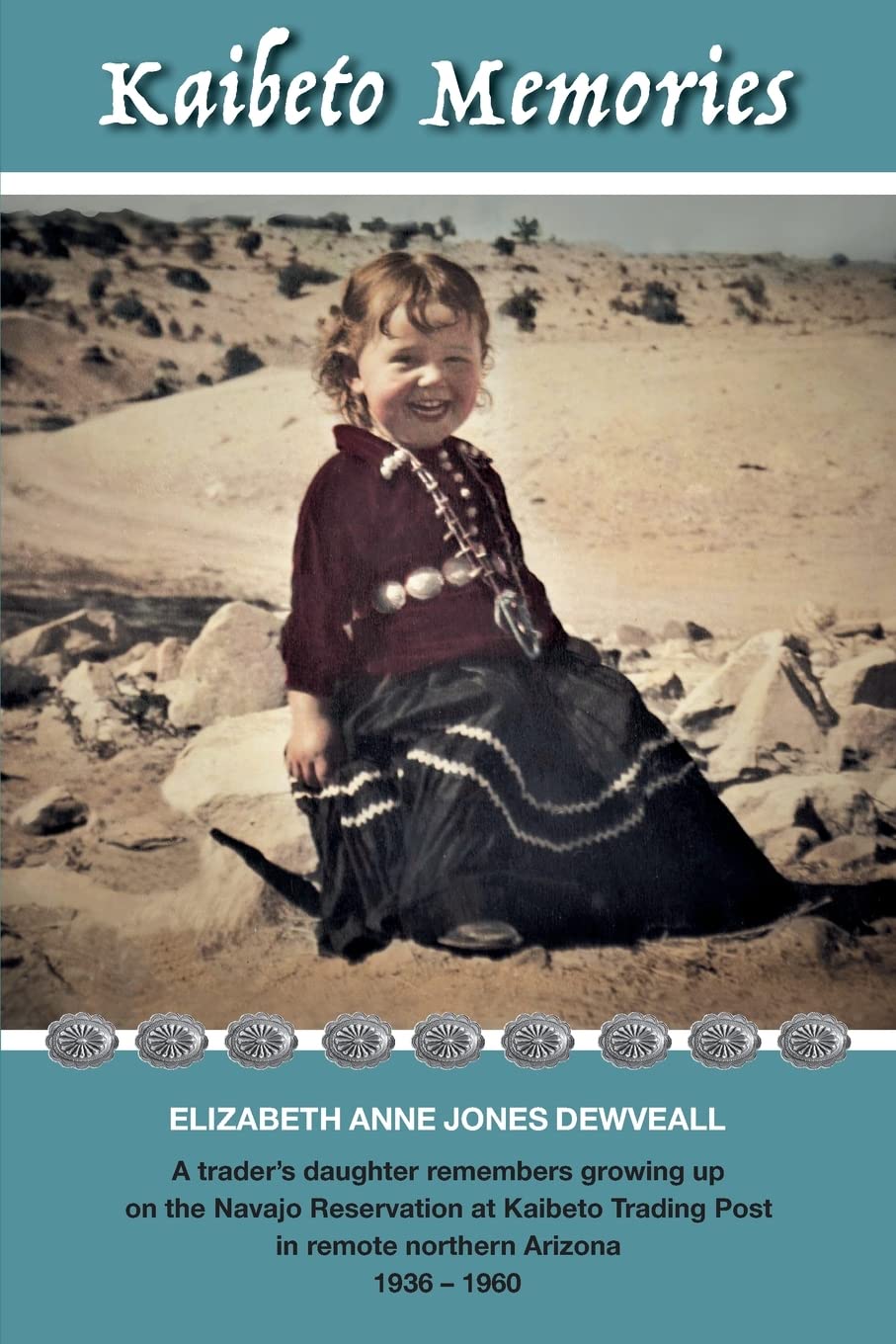
KAIBETO MEMORIES: a trader's daughter remembers growing up on the Navajo Reservation at Kaibeto Trading P
$14.95
by Elizabeth Anne Jones Dewveall



KAIBETO MEMORIES: a trader's daughter remembers growing up on the Navajo Reservation at Kaibeto Trading Post in remote northern Arizona, 1936-1960. By Elizabeth Anne Jones Dewveall. With her parents our author witnessed first-hand a special chapter in U.S.-Native history as they traded with a rural population of Native Americans. Theirs was an isolated operation that was open dawn to dusk nearly every day. Their trading post provided canned meats and fruits, tobacco, ammunition, and cloth for dress-making-- and received in exchange sheep hides, wool, artfully-woven rugs, and silver-and-turquoise jewelry. Transactions were in pawn, credit, or cash. There was no other store. The Natives adapted their culture as the traders adapted theirs. Elizabeth Anne makes points, often incidentally, that understanding and cooperation are the ways to meet mutual needs, with a byproduct being acceptance of differences that begets mutual respect. For instance, trader parents Ralph and Juia Jones interacted compatibly with their patrons and occasional employees in ways that induced a Native couple to name their children Ralph and Julia: "Little Ralph" and "Little Julia". And again, Elizabeth Anne tells of "watermelon day" when a truckload of the sweet and juicy fruit arrived from the nearby Hopi Reservation, and all present sliced and slurped together: "We may have been a group divided by language and culture, but on watermelon day we were supremely united by taste buds and flavor. " The Kaibeto Memories were remembered long after their occurrence, for during recent COVID downtime Elizabeth Anne recorded her experiences for family and friends. After urging that her stories were an important aspect of U.S., Native, and Southwest history and anthropology, she allowed them to be published for others. Now abandoned, the Kaibeto Trading Post was situated near a life-giving spring in a region where roads were more like paths in the sand and over rocky ridges, snow-covered in winter and subject to flash floods any time. Here is where author Elizabeth Anne spent her childhood, with more Native Americans as playmates than those of her own race and where she learned to be a young trader. She chronicles incidents with rattlesnakes, favorite dogs, fishing in a now-forgotten desert lake, exploring nearby canyons alone, visits from relatives to her "digs"--always in the context of an only child in close contact with involved parents--and then away to distant schools, and finally her own marriage and operation of the post as her own family comes to be. To Elizabeth Anne, some of her stories must be told. Here is another: "We had a picnic where some huge cottonwood trees provided luxuriant shade. I was at the stage of pregnancy where I didn't care if I had a boy or a girl, I just wanted "it" out... I was seated on the ground, leaning against a tree trunk and thinking I was not going to be able to get up until my husband showed up to help. I dozed off and then heard footsteps. When I opened my eyes, it was not Bob who stood there but a little Hopi man named Mark Quarshero. In his right hand he held a beautifully painted gourd rattle which he began shaking over my bulging middle. It didn't take long for him to tell me there was a little girl in there. He gave me the rattle for her protection, then walked away as if he had done the most normal thing in the world. SueAnne still has the rattle. I still have the sweet memory." "Intriguing", as one museum curator called Elizabeth Anne's account, a "project of such historical merit and deep personal interest!" noted another reviewer. "Her life story is fascinating and she was a witness to an important aspect of US-Native history...the memoir should be published," from one university editor and this from another, "Elizabeth Anne experienced an unusual and special youth that, beyond an individual life, can reveal much about Kaibeto and Navajo life in the mid-twentieth century..." AUTHOR ELIZABETH ANNE DEWVEALL JONES has been playing the flute since her days when growing up on the Navajo Indian Reservation at the Kaibeto Trading Post. A lifelong Arizonan with an interest in the state's past, she also became a source for history of the Kaibito region for the period since 1936, when she was born to trader parents. Childhood activities and observations on the reservation -watching Natives and Anglos interact with and among themselves and with their land and livelihoods, witnessing extremes of weather, exploring the desert landscape, learning some Navajo words and about Native customs as well as her own, herself trading as a young merchant, and imagining-all this was the early learning foundation for Elizabeth Anne's life. Formal schooling both on and off the reservation and at times at home in the trading post were added, some of it in Leupp and much of it in Winslow where she lived with her Aunt Zada's and Uncle John's family during the academic year, going home to the trading post for holidays a