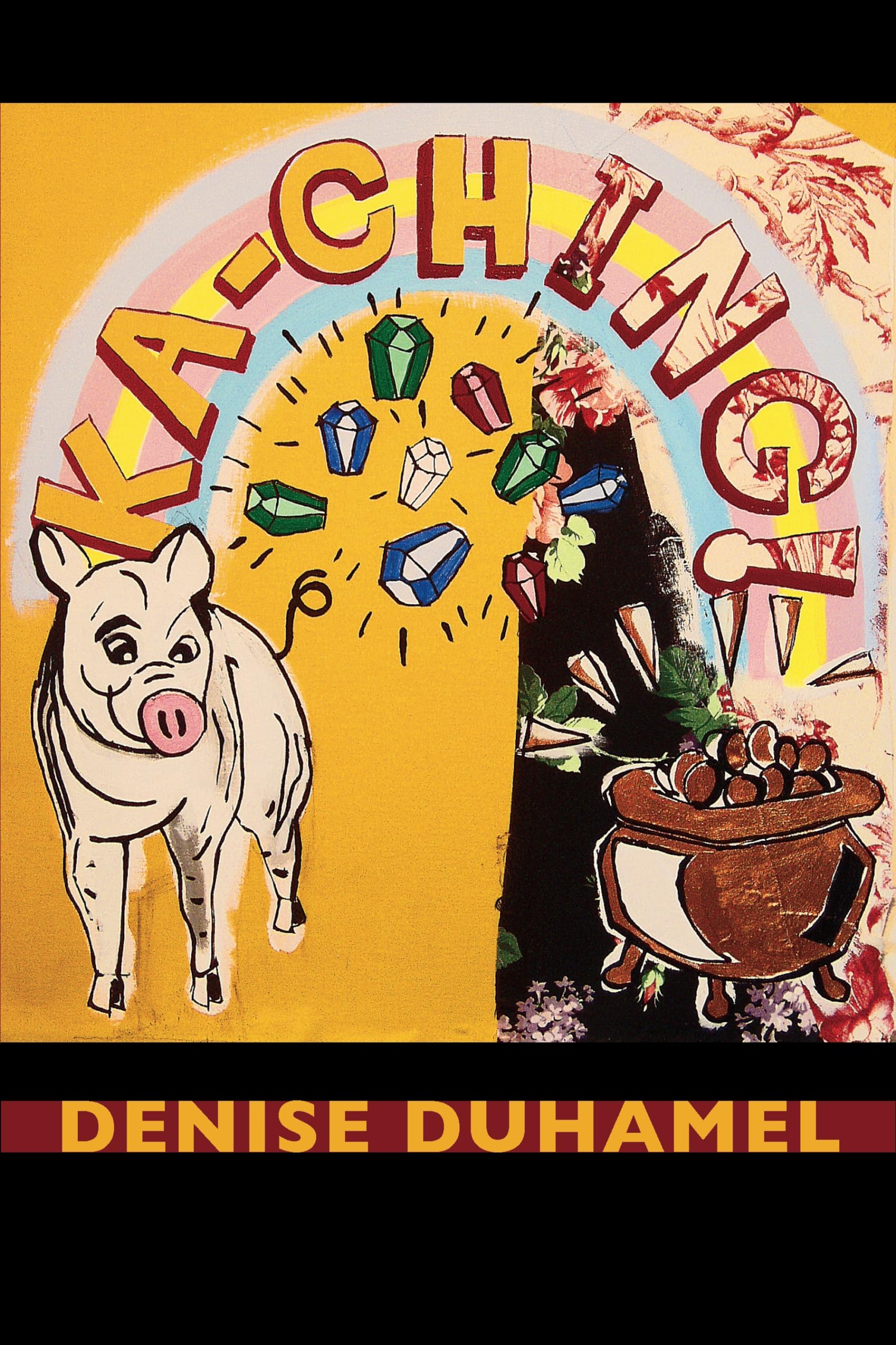



Ka-Ching! is a book of poems that explores America’s obsession with money. It also includes a crown of sonnets about e-bay, sestinas on the subjects of Sean Penn and the main characters of fairytales, a pantoum that riffs on a childhood riddle, and a villanelle inspired by bathroom grafitti. *Starred Review* The sound of a slot machine paying off entitles the reliably sharp and entertaining Duhamel’s new collection and tips us off to its underlying theme: money, which the five lowercase section titles broach baldly or implicatively. A series of linked sonnets about, eventually (the journey is always a large part of the pleasure of a Duhamel poem), giving up poetry readings and little magazines for selling poets’ bones and clothes online is in “play money,” whose other contents touch on money in social interactions ranging from playing Monopoly to attempting a career. In two sections, only a few pieces touch money directly. One about having insufficient funds is in “small tip.” Another on rewarding an informant is in “big tip.” In more than one poem in “throwing the dice,” money impinges on an uncomfortable situation, but predicaments in which one must “take a gamble” arise in all. The nine prose poems in “one-armed bandits” fester with money; they report the horrific accident Duhamel’s parents suffered in a New Jersey casino and its expense-laden aftermath. Duhamel’s knack for blending tones—especially the personal and the sociological, the ludicrous and the horrifying, the silly and the pathetic—gives poem after poem its distinctive and unforgettable character. --Ray Olson With wry intelligence and wit, Duhamel's Ka-Ching! explores the mysteries of luck and accident in the welter of pop culture and private struggle. From a child's monopoly money to the harsh realities of aging parents recovering from a horrifying accident, her colloquial ease belies the poignancy of human predicament, celebrates the resilience of imagination, and leaves us with poems in which we recognize anew the wealth of our language, our lucky hearts. ― Beckian Fritz Goldberg Duhamel keeps alive the bright-eyed, naughty little girl, innocently letting shocking revelations slip out in flustered distraction, without her seeming to notice-but don't be fooled, this is a woman of power. She is funny and charming and unique. Her poems shine, a beacon in a dark time, fulfilling poetry's duty not only of refreshing the language but, with their humanity and clear thinking, lighting up the path for a country in need of honesty and cheer. ― Edward Field I don't know where we'd be without Denise Duhamel's funny, touching, and inventive poems. In book after book, she's raised her own bar, and in this new one reaches a zenith of postmodern tricksterism, while at the same time tackling feminist and political issues, as well as personal tragedy. Ka-Ching! is a treasure trove of a book. ― David Trinidad With their playful ingenuity, the poems in Ka-Ching lull you into just plain enjoying them, but when you're finished you realize what sharp observations of contemporary America they contain. This is an extraordinarily original book, often making old forms look new, and filled with both acidic criticism and generous wisdom. ― Peter Meinke "Ka-Ching is an unforgettable collection of poems. Carefully crafted to look and feel like a board game with section titles such as 'play money' and 'small tip,' the book reads and feels like a game of chance in which tragic losses are but part of the play. Thought-provoking, disturbing, deeply moving, masterfully composed— Ka-Ching clearly demonstrates why Denise Duhamel is one of the finest poets of our time." ― Nin Andrews Reliably sharp and entertaining. Duhamel's knack for blending tones—especially the personal and sociological, the ludicrous and the horrifying, the silly and the pathetic—gives poem after poem its distinctive and unforgettable character. ― Booklist , starred review Duhamel's blunt, occasionally playful voice is versatile . . . Although long lines and expository prose blocks dominate this collection, the poet's lyricism emerges in moments when she employs traditional form in surprising ways. Duhamel . . . has written some of the first poetry to deeply register the current economic crisis. ― Publishers Weekly This is the wildest, most honest book of poetry written in a long time. The various forms Duhamel uses prove that her imagination is keen and totally unpredictable. Dominated by prose poems, the book ranges across every contemporary worry, obsession, and conflict possible. The result is a voice that brings solutions to the challenges of everyday life while investigating how language rebuilds hope in a troubled and chaotic time. ― The Bloomsbury Review Duhamel is a wily technician, a touching humanist, a poet deserving stardom. ― Entertainment Weekly The reader gets his or her money's worth . . . The poems, which are by degrees humorous, inventive and heartbre