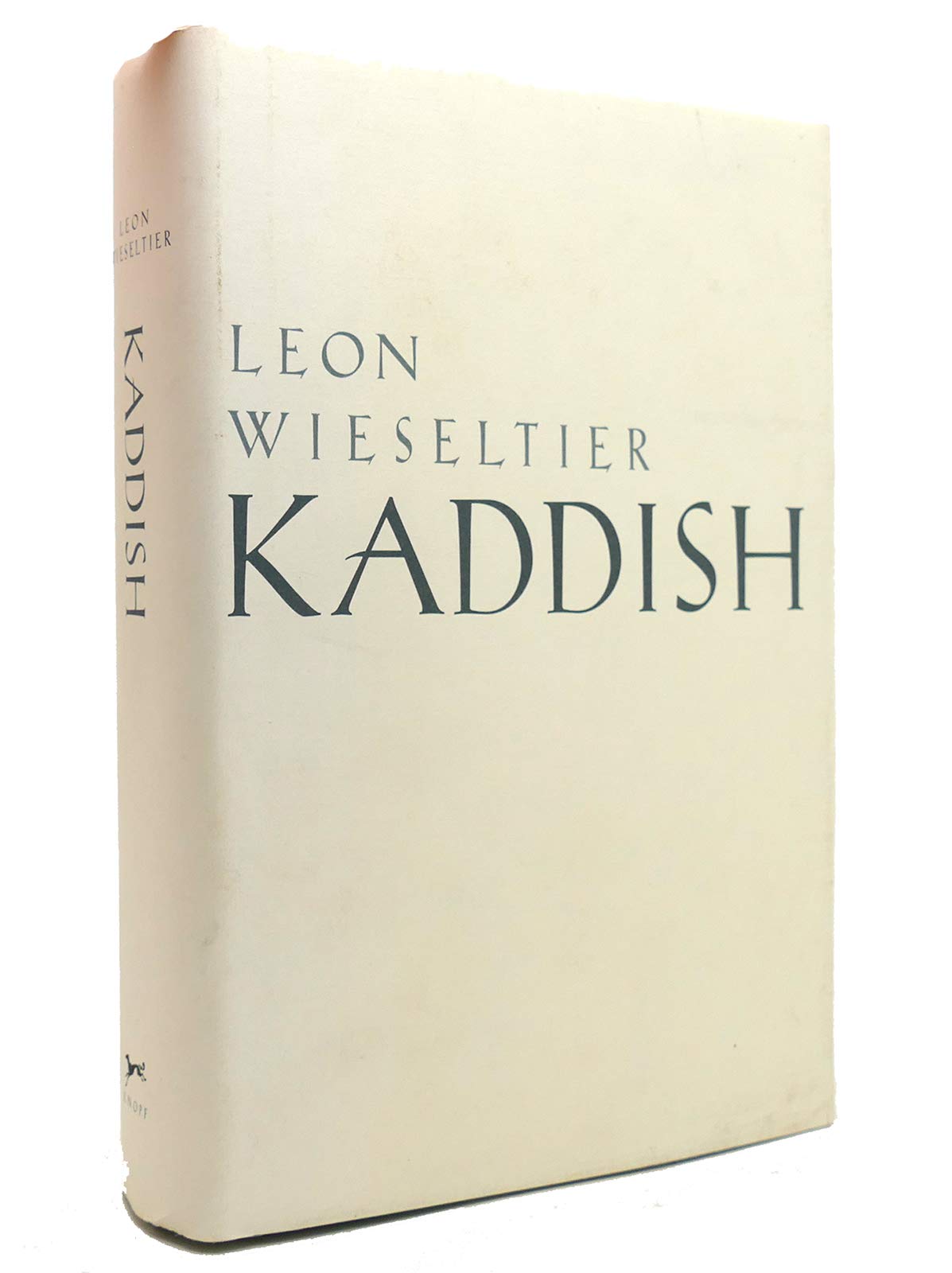



Everything struck hard. The door slamming behind me in the black car. The shovel stabbing the mound of soil. The wooden box hitting the floor of the pit. I stood and I swayed and I said what I was told to say. I was presented with the words that justify the judgment, and I justified the judgment. "He is the Rock, His work is perfect, for all His ways are judgment . . ." I was presented with the words of the kaddish, the long one for the funeral, the one about the world that will be made new, the one that I had never said before, and I uttered it. "Magnified and sanctified may His great Name be . . ." "Magnified and sanctified . . ." Sounds, not words. Words that were nothing but sounds. The words spilled into the pit and smashed upon my father's coffin. I watched the words disperse across the surface of the wood like the clods of dirt that were falling upon it. I saw them there, the shattering words. I saw the letters and their shades. Finally they vanished into the earth. They were buried with him. Justify the judgment, but judge the judgment, too. Bring the judgment to judgment!Out of tears, thoughts. So begins this extraordinary spiritual journal--a record of the inner life of one of America's most brilliant intellectuals during a year of mourning. When Leon Wieseltier's father died in March 1996, he began to observe the rituals of the traditional year of mourning, going daily to the synagogue to recite the kaddish. Be-tween his prayers and his everyday responsibilities, he sought out ancient, medieval, and modern Jewish texts in pursuit of the kaddish's history and meaning. And every day he studied, translated, and wrote his own reflections on the obscure texts that he found, punctuating his journal with stories about life in his synagogue and about his family's progress through grief. In reflecting upon the fate of his father and of his people, he wrestles with problems of loss and faith, the meaning of tradition, freedom and determinism, and the perplexity of rational religion. Kaddish is a work of history, philosophy, and interior autobiography, of moral force and emotional power. Leon Wieseltier's Kaddish is a completely new kind of book. It is not quite philosophy, autobiography, history, or Midrash, but it blends all of these genres into a narrative of Wieseltier's grief during the year following his father's death. Wieseltier, the literary editor of The New Republic, is a mostly unobservant Jew whose grief compelled him to observe his religion's rituals of mourning, daily attending synagogue to recite the Kaddish (the traditional Jewish prayers of mourning). He also delved deeply into a vast range of texts describing the history and spiritual significance of these prayers. And he wrote incessantly, describing with force and clarity the process of bringing his mind and heart to bear on the grief that consumed him. Perhaps the best way of describing this moving, illuminating, hopeful, awe-filled book is to quote a stray line from the first page of the book's first chapter: "Out of tears, thoughts." -- Michael Joseph Gross Wieseltier, literary editor of the New Republic, has written a meditation on and history of the Jewish prayer for the dead. After his father's death, Wieseltier recited the Kaddish in the prescribed manner and studied its development and use. Moving from the 12th century onward, using Nahmanides, Rashi, Maimonides, the Vilna Gaon, and other rabbis, he explores various thinkers' views on mourning, Kaddish on holidays, Akiba stories, and the drinking of water during the Sabbath. Parts of the endless ocean of the Talmud, midrash, and responsum are all discussed by Wieseltier with the same love and respect Jacob Neusner brings to the task. Wieseltier writes about grief, the nature of death, and the meanings of life. A noble and dignified volume, Kaddish belongs on the same shelf with S.Y. Agnon's Days of Awe (Schocken, 1995), Martin Buber's Tales of the Hasidim (Pantheon, 1991), and Gershom G. Scholem's Origins of the Kabbalah (Princeton Univ., 1990). Essential for Jewish studies collections.?Gene Shaw, NYPL Copyright 1998 Reed Business Information, Inc. When his father died, the recitation of a ritual prayer of mourning (the kaddish) summoned Wieseltier to a thrice-daily duty--and unexpectedly opened the way to a profound inner journey. This poignant record of that journey recounts what the author discovered about his traditions, his people, and himself as he pored over the ritual's ancient sources and opened himself to its hidden powers to heal--and challenge--the participant. Naturally, Jewish readers will enjoy great advantages in understanding the Talmudic scholarship to which the author repeatedly turns for insight into his patrimony. But ultimately the struggles with grief, the pleadings for faith and healing, resonate with universal emotions. Readers from all religious backgrounds will conclude this remarkable book at once harrowed and renewed. Highly recommended for an