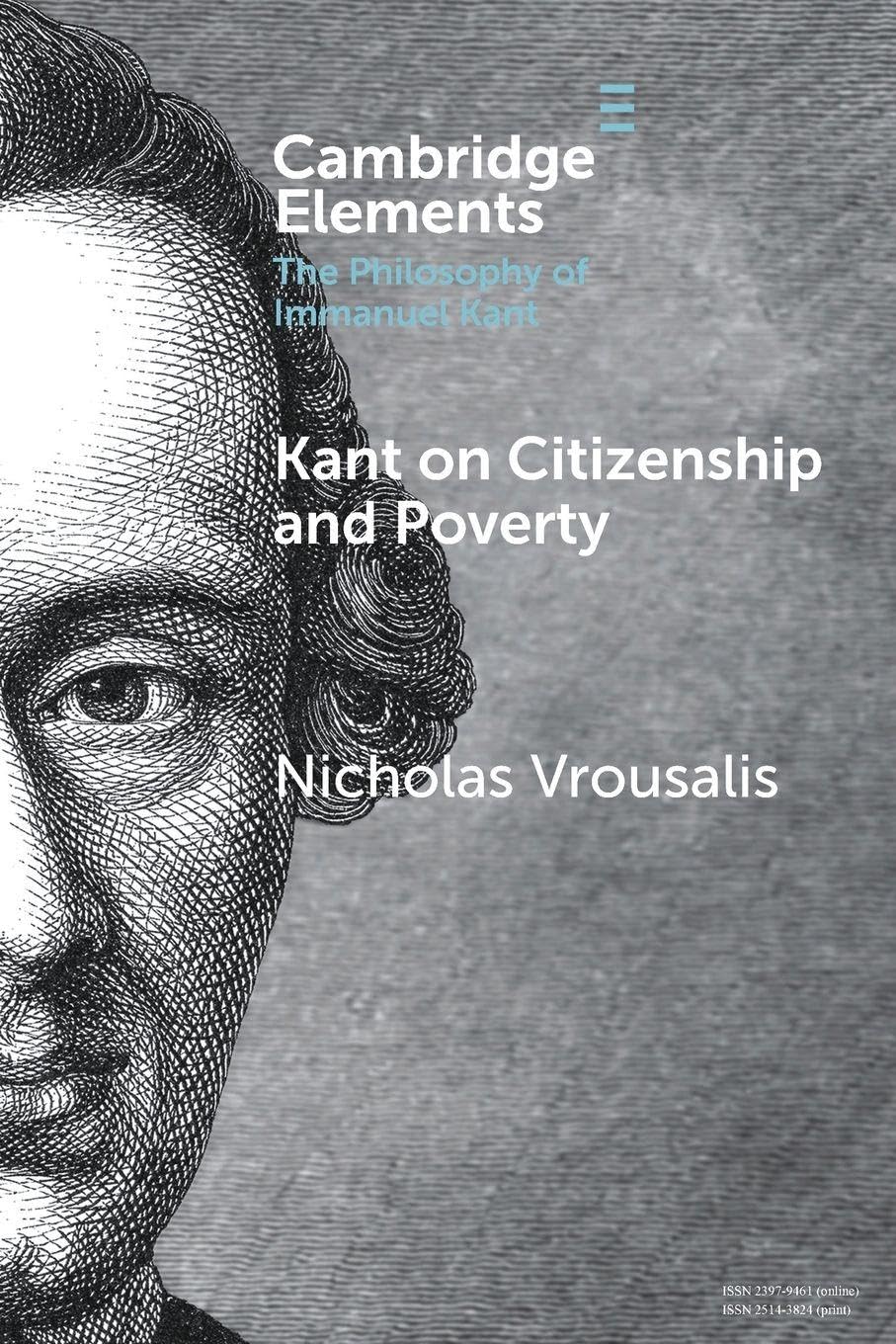
Kant on Citizenship and Poverty (Elements in the Philosophy of Immanuel Kant)
$23.00
by Nicholas Vrousalis



According to Kant, citizenship amounts to freedom (Freiheit), equality (Gleichheit), and civil self-sufficiency (Selbständigkeit). This Element provides a unifying interpretation of these three elements. Vrousalis argues that Kant affirms the idea of interdependent independence: in the just society, citizens have independent use of their interdependent rightful powers. Kant therefore thinks of the modern state as a system of cooperative production, in which reciprocal entitlements to one another's labour carry a justificatory burden. The empirical form of that ideal is a republic of economically independent commodity producers. It follows that citizenship and poverty, for Kant, are inextricably connected. Vrousalis explains how Kant's arguments anticipate Hegel's discussion of the division of labour, Marx's account of alienated labour, and Rawls' defence of a well-ordered society. This title is also available as Open Access on Cambridge Core. Kant's theory of citizenship shows the state as a system of cooperative labour, in which reciprocal service precludes reciprocal servitude.