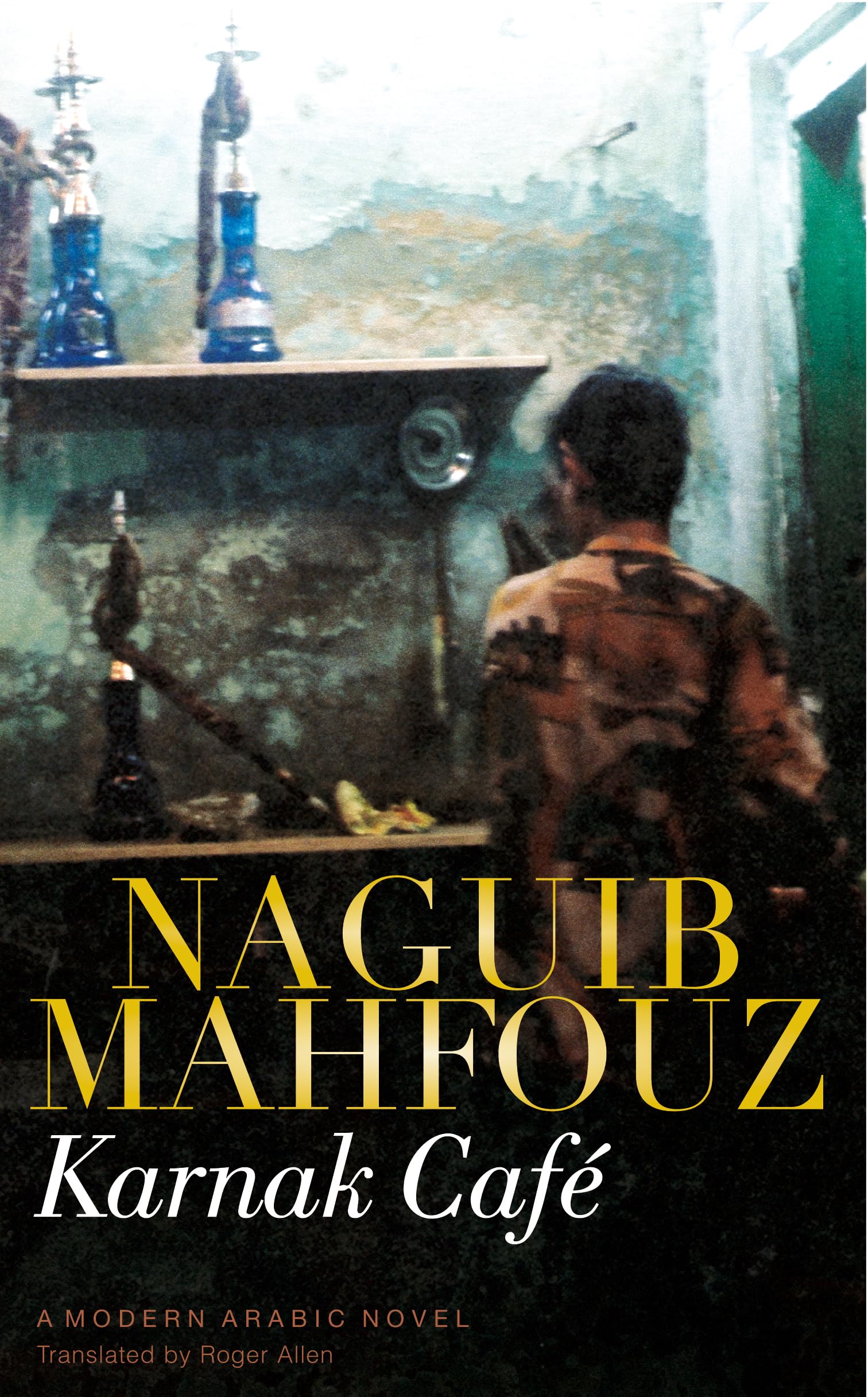



A politically charged novel from Egypt’s Nobel laureate At a Cairo café, a cross-section of Egyptian society, young and old, rich and poor, are drawn together by the quality of its coffee and the allure of its owner, legendary former dancer Qurunfula. When three of the young patrons disappear for prolonged periods, the older customers display varying reactions to the news. On their return, they recount horrific stories of arrest and torture at the hands of the secret police, and the habitués of the café begin to withdraw from each other in fear, suspecting that there is an informer among them. With the nighttime arrests and the devastation of the country’s defeat in the 1967 War, the café is transformed from a haven of camaraderie and bright-eyed idealism to an atmosphere charged with mounting suspicion, betrayal, and crushing disillusionment. Exposing the dark underbelly of ideology, and delving into the idea of the ‘necessary evils’ of social upheaval, Karnak Café remains one of the Nobel laureate’s most pointedly critical works, as relevant and incisive today as it was when it was first published in 1974. Like Arthur Koestler's "Darkness at Noon" or Victor Serge's "The Case of Comrade Tulayev," this fierce yet subtle novel lays bare the worst evil of totalitarian states . . .In other hands this novel might have become a tract. Although every page smolders with justified fury, Mahfouz was above mere denunciation. His loving descriptions of the Karnak, with its passionate and enigmatic proprietress every café worthy of the name must have a lady with a past together with his selfeffacement before his characters, each of whom speaks in turn to the unnamed narrator, push the novel beyond simplistic categories. " --The New York Sun "First published more than thirty years ago, but only available in English translation now, it's surprisingly (indeed, shockingly) contemporary and relevant, as the present-day Egyptian government continues to act much as its earlier incarnation does in the book. The cost, to those who are basically innocent -- generally average folk, who just want to get on with their lives -- is well-presented in Karnak Café, and though there is no radical or particularly violent reaction in the novella, it's clear that these conditions can only lead to a worse future, not a better one. A surprisingly dark book, Karnak Café is a good, quick read, combining both Mahfouz's usual presentation of the Cairo-world (though less in-depth than in most of his fiction), as well as a more bitter presentation of the conditions of the times (and misguided direction of the state)." --The Complete Review Naguib Mahfouz was born in Cairo in 1911 and began writing when he was seventeen. His nearly forty novels and hundreds of short stories range from re-imaginings of ancient myths to subtle commentaries on contemporary Egyptian politics and culture. In 1988, he was the first writer in Arabic to be awarded the Nobel Prize in Literature. He died in August 2006. Roger Allen is emeritus professor of Arabic language and literature at the University of Pennsylvania. Among his translations are Naguib Mahfouz’s Mirrors (AUC Press, 1999) and Bensalem Himmich’s The Polymath (AUC Press, 2000). Used Book in Good Condition