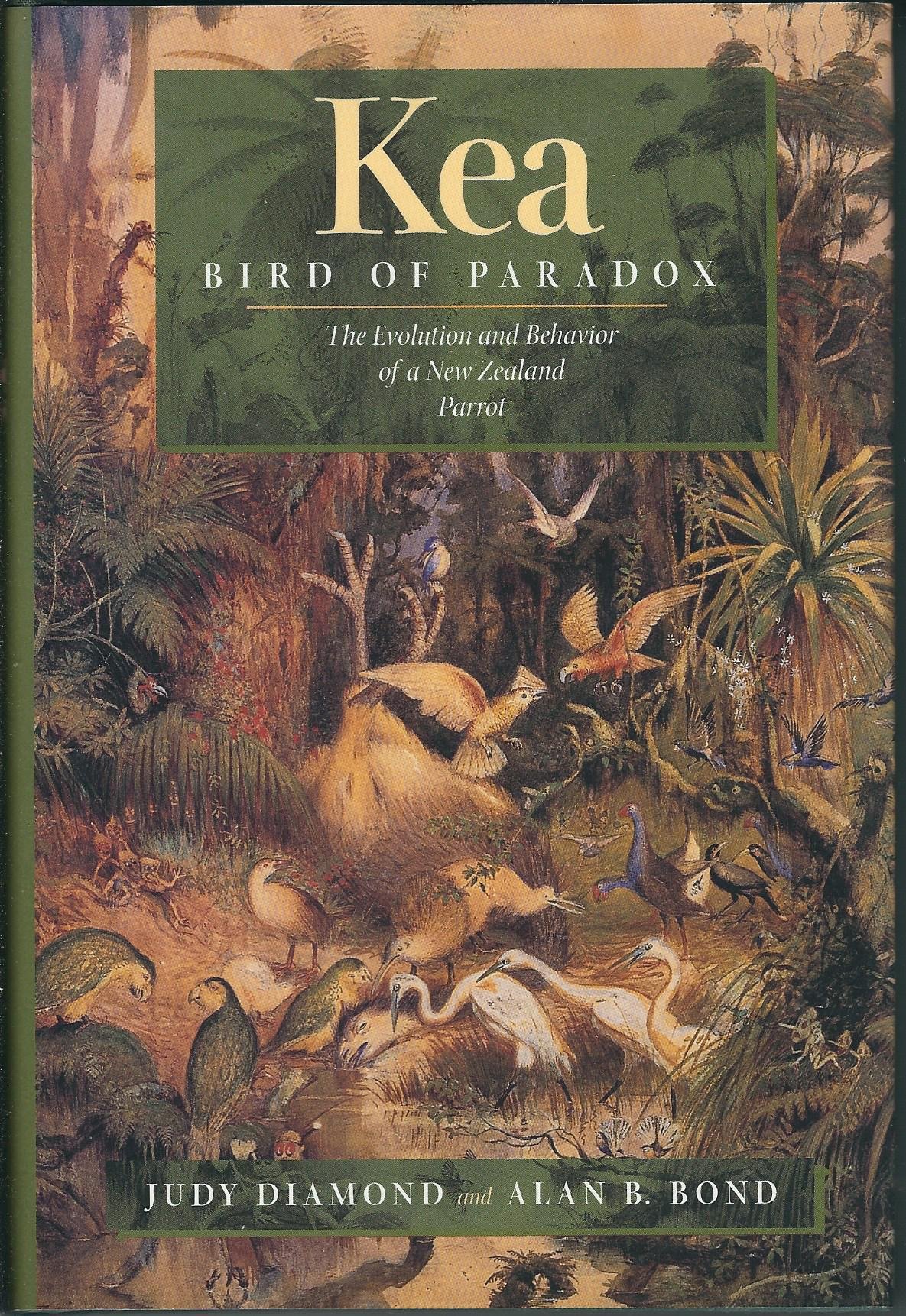
Kea, Bird of Paradox: The Evolution and Behavior of a New Zealand Parrot
$41.19
by Judy Diamond



The kea, a crow-sized parrot that lives in the rugged mountains of New Zealand, is considered by some a playful comic and by others a vicious killer. Its true character is a mystery that biologists have debated for more than a century. Judy Diamond and Alan Bond have written a comprehensive account of the kea's contradictory nature, and their conclusions cast new light on the origins of behavioral flexibility and the problem of species survival in human environments everywhere. New Zealand's geological remoteness has made the country home to a bizarre assemblage of plants and animals that are wholly unlike anything found elsewhere. Keas are native only to the South Island, breeding high in the rigorous, unforgiving environment of the Southern Alps. Bold, curious, and ingeniously destructive, keas have a complex social system that includes extensive play behavior. Like coyotes, crows, and humans, keas are "open-program" animals with an unusual ability to learn and to create new solutions to whatever problems they encounter. Diamond and Bond present the kea's story from historical and contemporary perspectives and include observations from their years of field work. A comparison of the kea's behavior and ecology with that of its closest relative, the kaka of New Zealand's lowland rain forests, yields insights into the origins of the kea's extraordinary adaptability. The authors conclude that the kea's high level of sociality is a key factor in the flexible lifestyle that probably evolved in response to the alpine habitat's unreliable food resources and has allowed the bird to survive the extermination of much of its original ecosystem. But adaptability has its limits, as the authors make clear when describing present-day interactions between keas and humans and the attempts to achieve a peaceful coexistence. New Zealand, noted life scientist Jared Diamond has remarked, offers science an approximation of studying life on other planets, because the islands of New Zealand lie so distant from other landmasses that their flora and fauna are markedly unlike those of other places. Of particular interest to biologists is the kea, Nestor notabilis , a small parrot found only in the alpine beech forests of South Island, and one that has evolved in curious ways. A survivor of the great wave of extinctions that occurred when humans arrived in New Zealand a thousand years ago, the kea has long been hunted, especially by European ranchers who found it a danger to their livestock--for, as Judy Diamond and Alan Bond write, while the kea once preferred to feed on insect larvae, it shifted its dietary habits with the arrival of new food sources. This transformation, the authors suggest, speaks to the bird's adaptability and intelligence. With the change to carrion eating, the kea's population grew, although it is now again in decline. And with that change, the authors write, new characteristics emerged, so that kea groups are now male-dominated, aggressive, and hierarchically organized, unusually so for an avian species. Diamond and Bond have conducted long-scale fieldwork among keas in their native habitat, and their well-written study speaks beyond the description of one species to the benefits--and limitations--of evolutionary flexibility in general. --Gregory McNamee "The book, a serious scientific study, is often as playful as its endangered subject."--"A Little Night Reading," "Sunday times(UK) Judy Diamond is Associate Professor and Assistant Director for Public Programs at the University of Nebraska State Museum. Alan B. Bond is Research Professor of Biological Sciences at the University of Nebraska.