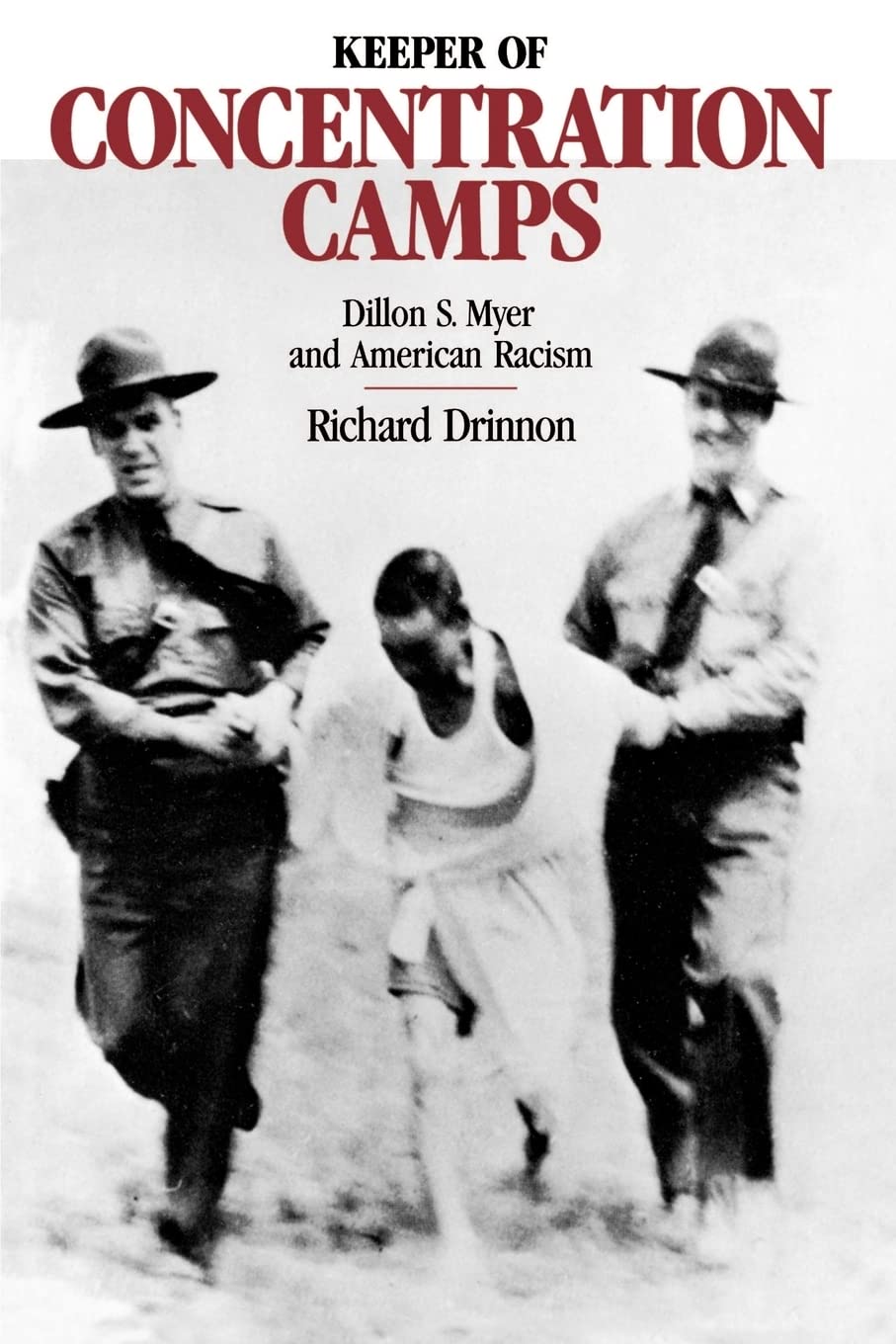
Keeper of the Concentration Camps: Dillon S. Myer and American Racism
$19.63
by Richard Drinnon



Analyzing the career of Dillon S. Myer, Director of the War Relocation Authority during WWII and Commissioner of the Bureau of Indian Affairs from 1950-53, Richard Drinnon shows that the pattern for the Japanese internment was set a century earlier by the removal, confinement, and scattering of Native Americans. "The most significant piece of extended scholarship yet produced on the subject of the Japanese-American evacuation."--Arthur H. Hansen, "Arizona Historical Society Journal Richard Drinnon is the author of Facing West: The Metaphysics of Indian-Hating and Empire-Building (1980) and is Professor Emeritus of History at Bucknell University. Keeper of the Concentration Camps: Dillon S. Myer and American Racism By Richard Drinnon University of California Press Copyright 1989 Richard Drinnon All right reserved. ISBN: 0520066014 Chapter I The WRA Story of Human Conservation Neither I nor most of my staff were well informed regarding the problems we faced. We lacked information about the evac- uees and their history. We were generally uninformed regard- ing the anti-Oriental movements on the West Coast, and the pressures, rumors and fears that had led to the evacuation. Dillon S. Myer, Uprooted Americans, 1971 In early 1944 key officials in the Washington office of the War Relocation Authority discussed their agency with Dorothy Swaine Thomas of the University of California. Head of the "Japanese American Evacuation and Resettlement Study" (JERS) in Berkeley, Professor Thomas chatted knowledgeably with them about various matters, learned they proposed to close one of their two camps in Arkansas, and concluded that the morale of Director Dillon S. Myer, Solicitor Philip M. Glick, Morrill M. Tozier, chief of the Reports Division, and other members of the staff was very high indeed: There is, in the first place, enormous admiration for Myer. Tozier, in particular, has an extreme case of hero worship. "The boss was magnificent yesterday. He knew all the answers, etc. etc. etc." (Tozier writes Myer's speeches for him.) In the second place, WRA is a typical, New Deal, idealistic agency (I worked for FERA [Federal Emergency Relief Administration] for quite a period under Harry Hopkins and observed exactly the same phenomena). They carry the torch for the Japanese people, but always in abstract, idealistic terms without much understanding of the problems that are being faced in the projects, or of what the people themselves really want. . . . In the third place, the Washington group is held together by the attacks they are receiving from the outside, which makes crusaders of them, and by a terrible fear they will lose their agency. ["High Points in Conversation . . .," January 20, 1944, JERS 67/14, suppl., cart. 2] Thomas's few lines catch, for a moment, the WRA leaders in their natural habitat and correctly identify them. The men who ran America's concentration camps were liberals of the genus New Deal. 2 From second and third levels of the administration, these officials had little understanding of their charges and less of what had called their agency into being. Milton S. Eisenhower has related in his memoirs, The President Is Calling (PIC ; 1974), that Franklin Delano Roosevelt summoned him to the White House on March 10 or 11, 1942, and abruptly enjoined him: "Milton, your war job, starting immediately, is to set up a War Relocation Authority to move the Japanese-Americans off the Pacific coast. I have signed an executive order which will give you full authority to do what is essential. . . . And Milton . . . the greatest possible speed is imperative" (p. 95). Told that Budget Director Harold Smith would fill him in on the details, the startled appointee barely had a chance to ask and get permission to take along his staff from the Agriculture Co-ordinating Office. "Like most Americans at the time," Eisenhower explained, "I knew very little about the problem of the Japanese-Americans on the West Coast." The administration's fledgling expert on the "problem" even had to be informed by the budget director that it broke down into Issei , the immigrants from Japan; Nisei , their children who were born and educated in this country; and Kibei , their children who were born here but educated in Japanamong the last, he learned, "were people who probably posed the threats to our security." It was all very confusing, especially when Harold Smith added that Lieutenant General John L. DeWitt of the Western Defense Command had pronounced it impossible to "tell the difference between a loyal and a disloyal Japanese-American." Eisenhower also knew very little about the events after Pearl Harbor that led Roosevelt to sign Executive Order 9066 on February 19, 1942. Earlier Admiral Ernest Stark, chief of Naval Operations, should have put to rest fears of