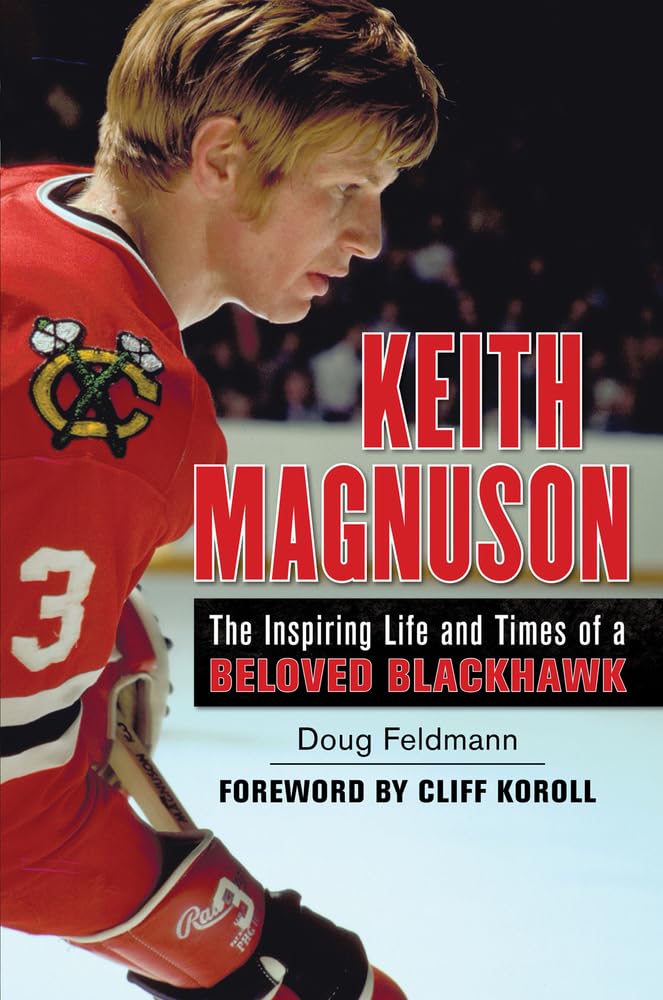
Keith Magnuson: The Inspiring Life and Times of a Beloved Blackhawk
$10.98
by Doug Feldmann



Written with the full support of Keith Magnuson’s wife and children, this thrilling and insightful biography pays tribute to a Chicago icon and true hockey legend. One of the most popular Chicago Blackhawks of all time, defenseman Keith Magnuson was raised on the raw, rough traditions of hockey in western Canada. He captained the University of Denver team to its second straight NCAA championship in the spring of 1969 and by autumn joined Blackhawks stars Bobby Hull, Stan Mikita, and Tony Esposito, becoming the much-needed “policeman” for the team. Over the course of the next several seasons, Magnuson and the Blackhawks fell painfully short of their Stanley Cup aspirations; nonetheless, Magnuson’s leadership qualities led to his being named captain of the team. On December 15, 2003, Magnuson was in Toronto riding in a car driven by former player, Rob Ramage: he was killed when the car veered over the center line and struck an oncoming vehicle. As veteran sportswriter Bob Verdi described Magnuson upon his retirement from the Blackhawks, “there have been many finer athletes in Chicago, but not one finer person,” and this biography shares the story of his remarkable life. Doug Feldmann is a professor in the College of Education at Northern Kentucky University and a former scout for the Cincinnati Reds, Seattle Mariners, and San Diego Padres. He is the author of numerous books, including El Birdos , Fleeter Than Birds , Miracle Collapse , September Streak , and St. Louis Cardinals Past and Present . He lives in Cincinnati, Ohio. Cliff Koroll and Keith Magnuson were teammates growing up in Saskatchewan, at the University of Denver, as well as on the Chicago Blackhawks. He delivered the eulogy at Magnuson’s funeral and is the current president of the Blackhawks Alumni Association. He lives in Chicago. Keith Magnuson The Inspiring Life and Times of a Beloved Blackhawk By Doug Feldmann Triumph Books Copyright © 2013 Doug Feldmann All rights reserved. ISBN: 978-1-60078-831-4 Contents Foreword by Cliff Koroll, Preface, 1. From Wadena to Saskatoon, 2. A Pioneer in America, 3. Rookie at the Madhouse, 4. One Win Away, 5. Life without the Jet, 6. New Bullies, 7. Transitions, 8. Coach Maggie, 9. "I Probably Won More than I Lost", Epilogue, Appendix: Keith Magnuson's Career Statistics, Acknowledgments, Sources, References, Photo Gallery, CHAPTER 1 From Wadena to Saskatoon "A person's toughness must come from somewhere, and in my case I believe it came from where I was born. Gothic , I learned in school, was something stark and unadorned, medieval, perhaps even primitive. My rural beginnings were somewhat like this." — Keith Magnuson, 1973 The driving distance from Chicago, Illinois, to Wadena, Saskatchewan, is exactly 2,000 kilometers, or 1,243 miles, to the northwest. The path cuts across some of the most unforgiving landscapes in North America — a vast, endless expanse of prairie and plains, with each gaze at the horizon more barren than the last. Endlessly in front of the traveler is a true northern frontier, through which fewer and fewer will pass in going further north. For generations, many of the greatest players in the sport of ice hockey have been carved out of this frontier, individuals crafted in a region where the frigid arctic air is whipped up in thick, hearty slices that oppress creatures in its way. With temperatures plummeting lower than 30 degrees below zero for weeks at a time, young hockey players in western Canada nonetheless are happy to scratch their skates across the countless frozen ponds and lakes, battling against the cold — and each other. These are not the climate-controlled, suburban indoor rinks that hide players and their parents from the wind. They are raw places of war, where a deep commitment to the game is a prime requisite for survival. Ill-fitting skates, passed down from one brother to another, serve as little defense against frost-bitten toes in these parts, toes which need to be thawed near a fire as darkness falls at the end of a day's play. And with no "pro shop" nearby for proper equipment, curled-up magazines serve as shin guards and hunting trousers make do as hockey pants. This has been the Canadian rite of passage for many decades. But still today, as they always have, the ponds and lakes around Wadena — like those in Parry Sound and Point Anne over in Ontario, and so many other Canadian villages like them — remain the frosted proving grounds for hockey's future legends, similar to the sun-baked rural and urban sandlots in the United States that have traditionally produced baseball's next superstars. A small hamlet of about 500 people halfway between Edmonton and Winnipeg, Wadena is perhaps as honorably nondescript as any such place that one could examine. It was here where a red-haired boy named Keith Arlen Magnuson was born on April 27, 1947, the youngest of four children to Joe and Birdie Magnuson. Joe ran a hardwar