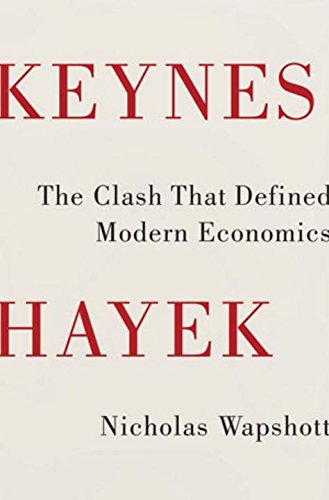



Can government fix a broken economy? Two great economists disagreed eighty years ago, and their debate dominates politics to this day. As the stock market crash of 1929 plunged the world into turmoil, two men emerged with competing claims on how to restore balance to economies gone awry. John Maynard Keynes, the mercurial Cambridge economist, believed that government had a duty to spend when others would not. He met his opposite in a little-known Austrian economics professor, Freidrich Hayek, who considered attempts to intervene both pointless and potentially dangerous. The battle lines thus drawn, Keynesian economics would dominate for decades and coincide with an era of unprecedented prosperity, but conservative economists and political leaders would eventually embrace and execute Hayek's contrary vision. From their first face-to-face encounter to the heated arguments between their ardent disciples, Nicholas Wapshott here unearths the contemporary relevance of Keynes and Hayek, as present-day arguments over the virtues of the free market and government intervention rage with the same ferocity as they did in the 1930s. Keynes Hayek: The Clash That Defined Modern Economics
Nicholas Wapshott. Norton, $28.95 (352p) ISBN 978-0-393-07748-3Wapshott masterfully recounts the clash between Hayek and Keynes. Wapshott offers a colorful look at the theories that epitomize the economic divide still shaping Anglo-American politics. Publishers Weekly. "Told brilliantly." Alan Caruba's Warning Signs. "Mr. Wapshott has written an important book. It is compelling not only as a history of two distinctive thinkers and their influence, but as a narrative of political decision-making and its underlying priorities. Underlying Mr. Wapshott's analysis are vital questions for this moment in American history." Nancy F. Koehn, The New York Times I reported the rise and reign of Margaret Thatcher at close quarters and wrote a great deal about her rejection of Keynes in favor of Hayek. Then I wrote a book about Reagan and Thatcher, whose political marriage was founded on a shared belief that Hayek was right. So the story of Keynes and Hayek is a subject that has been long on my mind. Nicholas Wapshott - interviewed in The New York Sun The General Theory. The Road to Serfdom. The men responsible for these ideas -- John Maynard Keynes and Friedrich von Hayek -- peered at each other across a yawning gap that defined the most potent economic battle of our time: whether government should intervene in markets. In the ruins of World War I, both men studied the boom and bust of the business cycle and came to very different conclusions. Hayek thought altering the "natural equilibrium" of the economy would result in rampant inflation. Keynes believed the mass unemployment and misery that marked the end of a cycle could be short-circuited by government spending. They would disagree for the rest of their lives. Over twenty years, the two debated by letter, through learned articles, then in heated private conversations, and eventually through their ardent disciples, from John Kenneth Galbraith to Milton Friedman. Eloquent and charismatic, Keynes embraced an toptimistic vision of a world whether government planning and regulation would buoy the economy, a view that was soon adopted by a generation of politicians and economists on both sides of the Atlantic. In contrast, Hayek, a punctilious logician and dogged contrarian, found champions among pro-market advocates and libertarians. Both men's ideas would swing in and out of favor with politicians from Franklin Roosevelt to George W. Bush and would eventually influence the lives and livelihoods of millions. From the Great Depression to World War II, and from postwar recovery to the present dady, veteran journalist Nicholas Wapshott here examines the spirited debates between two giants of the twentieth century whose disparate visions shaped the rise and fall of economies all over the world and still hold the world in their thrall. "Nicholas Wapshott's Keynes Hayek is a smart and absorbing account of one of the most fateful encounters in modern history, remarkably rendered as a taught intellectual drama. Wapshott brilliantly brings to life the human history of ideas that continue to mold our lives." -- Sean Wilentz, author of The Rise of American Democracy and The Age of Reagan ." 'Even the most practical man of affairs is usually in the thrall of the ideas of some long-dead economist,' and as this fascinating book shows, we are indeed all still in thrall to ideas that were sparked in the great debate tween two economists -- Friedrich Hayek and Keynes himself -- over eighty years ago. In the fluencey of his writing and his ability to make complex financial questions easily comprehensible, Nicholas Wapshott has done economics itself a great service, by opening the subject up to the general readers, as seen through the prism of one of the most important intellectual gladiatorial contests