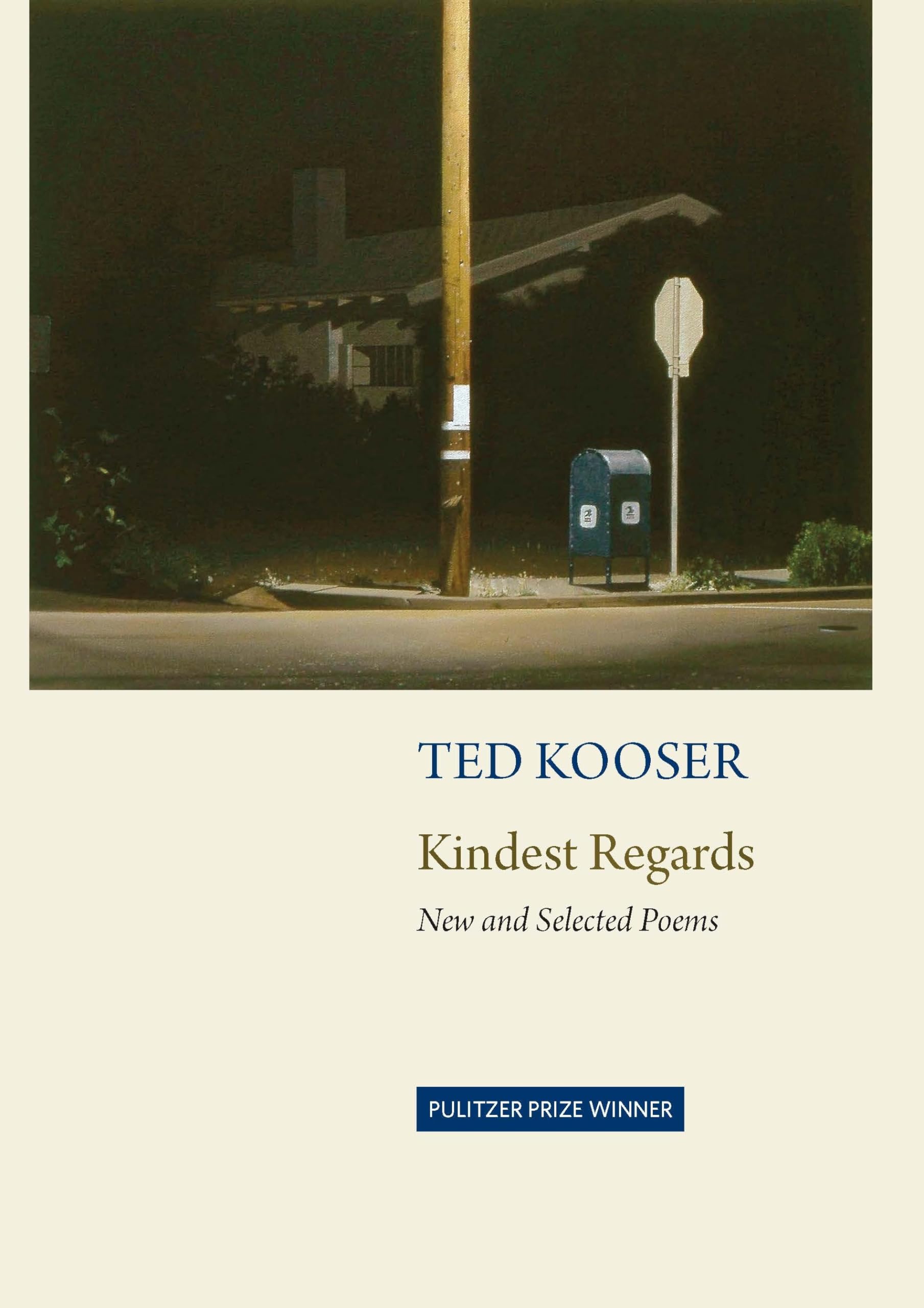



Four decades of poetry―and a generous selection of new work―make up this extraordinary collection by Pulitzer Prize winner Ted Kooser. Firmly rooted in the landscapes of the Midwest, Kooser’s poetry succeeds in finding the emotional resonances within the ordinary. Kooser’s language of quiet intensity trains itself on the intricacies of human relationships, as well as the animals and objects that make up our days. As Poetry magazine said of his work, “Kooser documents the dignities, habits, and small griefs of daily life, our hunger for connection, our struggle to find balance.” “Kooser’s greatest assets have long been his generous eye and his way with understatement, two qualities abundantly present in this book of new and selected poems.”― The New York Times “Routine, which orders the lives of Kooser and his country neighbors, has a monastic intensity in his poems, as the repetition of domestic ritual is embraced, not merely endured.”― The Christian Science Monitor “[Kooser] will one day rank alongside Edgar Lee Masters, Robert Frost, and William Carlos Williams.”― The Star Tribune “There is a sense of quiet amazement at the core of all Kooser's work.”― The Washington Post “Kooser’s ability to discover the smallest detail and render it remarkable is a rare gift.”― The Bloomsbury Review “[Kooser] brushes poems over ordinary objects, revealing metaphysical themes that way an investigator dusts for fingerprints. His language is so controlled and convincing that one can't help but feel significant truths behind his lines.”― The Philadelphia Inquirer “Kooser documents the dignities, habits, and small griefs of daily life, our hunger for connection, our struggle to find balance in natural and unnaturally human worlds.”― Poetry Ted Kooser is the author of numerous books of poetry and prose, and he served as the Poet Laureate of the United States (2004-2006). Raised and educated in the Midwest, Kooser worked for most of his life as a life insurance executive in Lincoln, Nebraska. His book Delights & Shadows won the Pulitzer Prize for poetry. Kooser remains one of the best-selling poets in the U.S., and recently retired as the Presidential Professor at the University of Nebraska where he taught courses in poetry and nonfiction writing. He continues to be an important spokesperson for poetry through his newspaper column "American Life in Poetry." He lives with his wife in Garland, Nebraska. Selecting a Reader First, I would have her be beautiful, and walking carefully up on my poetry at the loneliest moment of an afternoon, her hair still damp at the neck from washing it, She should be wearing a raincoat, an old one, dirty from not having money enough for the cleaners. She will take out her glasses, and there in the bookstore, she will thumb over my poems, then put the book back up on its shelf. She will say to herself, "For that kind of money, I can get my raincoat cleaned." And she will. The Widow Lester I was too old to be married, but nobody told me, I guess they didn't care enough. How it had hurt, though, catching bouquets all those years! Then I met Ivan, and kept him and never knew love. How his feet stunk in the bed sheets! I could have told him to wash, but I wanted to hold that stink against him. The day he dropped dead in the field. I was watching. I was hanging up sheets in the yard, and I finished. In the Basement of the Goodwill Store In musty light, in the thin brown air of damp carpet, doll heads and rust, beneath long rows of sharp footfalls like nails in a lid, an old man stands trying on glasses, lifting each pair from the box like a glittering fish and holding it up to the light of a dirty bulb. Near him. a heap of enameled pans as white as skulls looms in the catacomb shadows, and old toilets with dry red throats cough up bouquets of curtain rods. You've seen him somewhere before. He's wearing the green leisure suit you threw out with the garbage, and the Christmas tie you hated, and the ventilated wingtip shoes you found in your father's closet and wore as a joke. And the glasses that finally fit him, through which he looks to see you looking back— two mirrors that flash and dance— are those through which one day you too will look down over the years, when you have grown old and thin and no longer particular, and the things you once thought you were rid of forever have taken you back in their arms. Daddy Longlegs Here, on fine long legs springy as steel, a life rides, sealed in a small brown pill that skims along over the basement floor wrapped up in a simple obsession. Eight legs reach out like the master ribs of a web in which some thought is caught dead center in its own small world, a thought so far from the touch of things that we can only guess at it. If mine, it would be the secret dream of walking along across the floor of my life with an easy grace, and with love enough to live on at the center of myself. The Urine Specimen In the cli