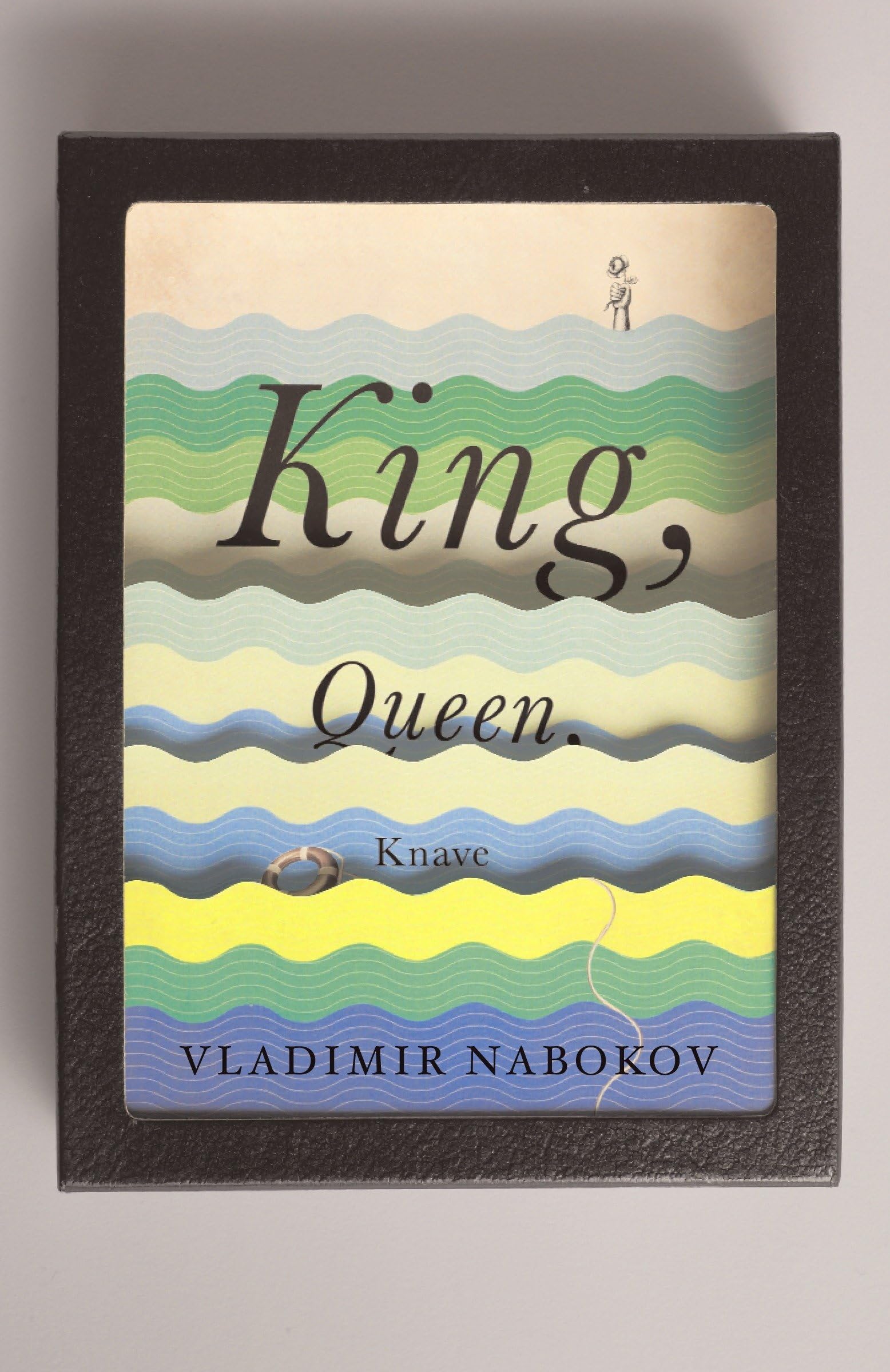



The novel is the story of Dreyer, a wealthy and boisterous proprietor of a men's clothing emporium store. Ruddy, self-satisfied, and thoroughly masculine, he is perfectly repugnant to his exquisite but cold middle-class wife Martha. Attracted to his money but repelled by his oblivious passion, she longs for their nephew instead, the myopic Franz. Newly arrived in Berlin, Franz soon repays his uncle's condescension in his aunt's bed. Novel by Vladimir Nabokov, first published in Russian in 1928 as Korol, dama, valet. With this novel, Nabokov began his career-long obsession with gamesmanship, word play in several languages, and multiple, surreal images and characterizations. The image of a deck of playing cards is used throughout the novel. Franz, an unsophisticated young man, works in the department store of his rich uncle Dreyer. Out of boredom Martha, the uncle's young wife, seduces Franz. The lovers subsequently plot to drown Dreyer and marry each other. Martha changes her mind abruptly when she learns that an invention by Dreyer stands to increase his wealth, but she then dies suddenly from pneumonia. Her husband never discovers his wife's duplicity. -- The Merriam-Webster Encyclopedia of Literature the story of Dreyer, a wealthy and boisterous proprietor of a men's clothing emporium store. Ruddy, self-satisfied, and thoroughly masculine, he is perfectly repugnant to his exquisite but cold middle-class wife Martha. Attracted to his money but repelled by his oblivious passion, she longs for their nephew instead, the myopic Franz. Newly arrived in Berlin, Franz soon repays his uncle's condescension in his aunt's bed. The novel is the story of Dreyer, a wealthy and boisterous proprietor of a men's clothing emporium store. Ruddy, self-satisfied, and thoroughly masculine, he is perfectly repugnant to his exquisite but cold middle-class wife Martha. Attracted to his money but repelled by his oblivious passion, she longs for their nephew instead, the myopic Franz. Newly arrived in Berlin, Franz soon repays his uncle's condescension in his aunt's bed. Vladimir Vladimirovich Nabokov was born on April 23, 1899, in St. Petersburg, Russia. The Nabokovs were known for their high culture and commitment to public service, and the elder Nabokov was an outspoken opponent of antisemitism and one of the leaders of the opposition party, the Kadets. In 1919, following the Bolshevik revolution, he took his family into exile. Four years later he was shot and killed at a political rally in Berlin while trying to shield the speaker from right-wing assassins. The Nabokov household was trilingual, and as a child Nabokov was already reading Wells, Poe, Browning, Keats, Flaubert, Verlaine, Rimbaud, Tolstoy, and Chekhov, alongside the popular entertainments of Sir Arthur Conan Doyle and Jules Verne. As a young man, he studied Slavic and romance languages at Trinity College, Cambridge, taking his honors degree in 1922. For the next eighteen years he lived in Berlin and Paris, writing prolifically in Russian under the pseudonym Sirin and supporting himself through translations, lessons in English and tennis, and by composing the first crossword puzzles in Russian. In 1925 he married Vera Slonim, with whom he had one child, a son, Dmitri. Having already fled Russia and Germany, Nabokov became a refugee once more in 1940, when he was forced to leave France for the United States. There he taught at Wellesley, Harvard, and Cornell. He also gave up writing in Russian and began composing fiction in English. In his afterword to Lolita he claimed: "My private tragedy, which cannot, and indeed should not, be anybody's concern, is that I had to abandon my natural idiom, my untrammeled, rich, and infinitely docile Russian tongue for a second-rate brand of English, devoid of any of those apparatuses--the baffling mirror, the black velvet backdrop, the implied associations and traditions--which the native illusionist, frac-tails flying, can magically use to transcend the heritage in his own way." [p. 317] Yet Nabokov's American period saw the creation of what are arguably his greatest works, Bend Sinister (1947), Lolita (1955), Pnin (1957), and Pale Fire (1962), as well as the translation of his earlier Russian novels into English. He also undertook English translations of works by Lermontov and Pushkin and wrote several books of criticism. Vladimir Nabokov died in Montreux, Switzerland, in 1977.