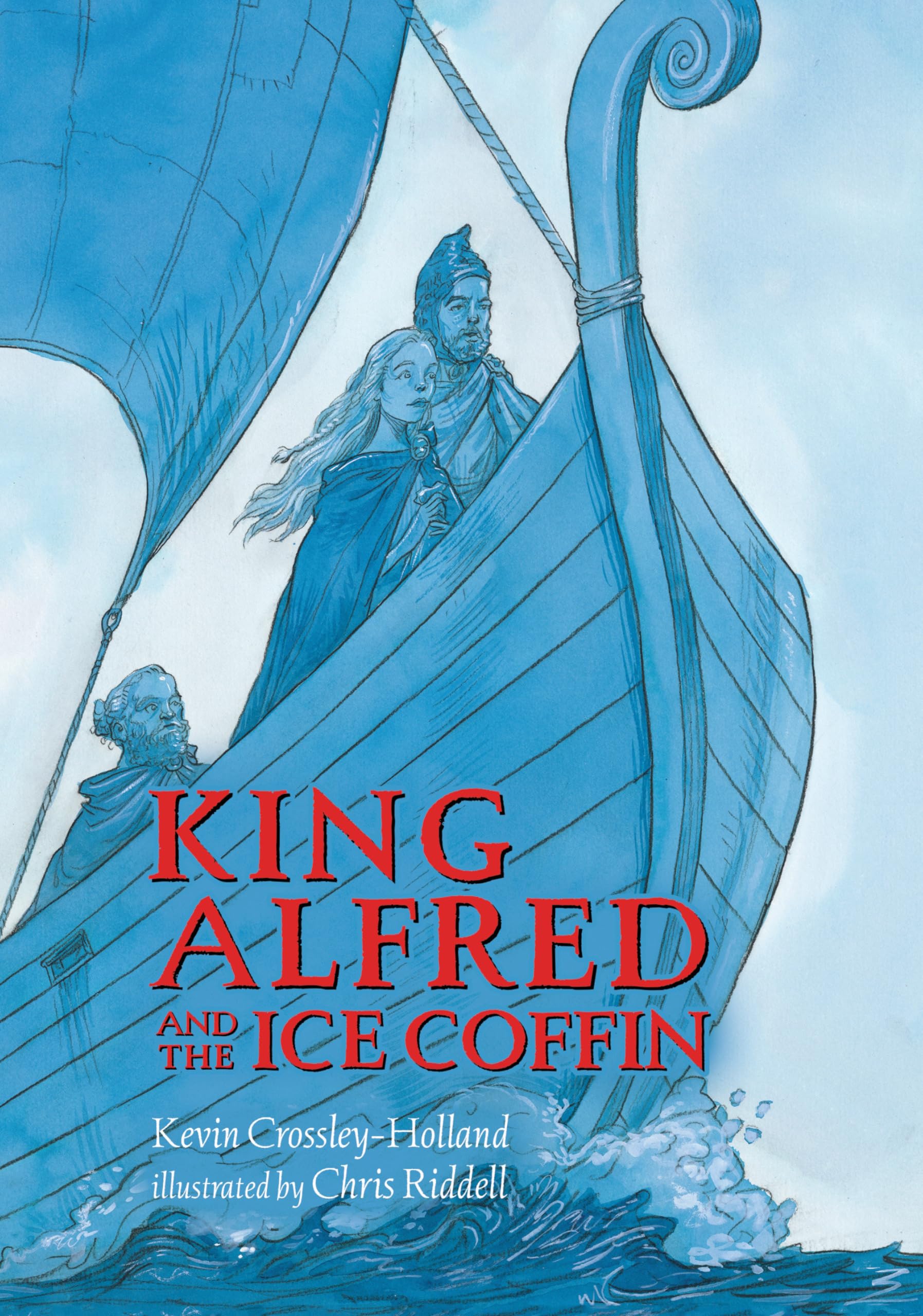



The illustrious creators of Arthur, the Always King return with a tale within a tale, focused on a heroic West Saxon king who championed the power of storytelling. When Wulfstan, an intrepid ninth-century sailor, arrives at King Alfred’s court, he soon enchants the king with his riveting tale of stormy seas, thrilling races on horseback, and a ruler encased in ice. In this extraordinary collaboration, the award-winning Kevin Crossley-Holland and former British Children’s Laureate Chris Riddell reunite to bring Wulfstan’s tale, and the world of King Alfred the Great, to life. Told in lyrical prose and richly illustrated, this story of a West Saxon king known for fighting off the Vikings will captivate readers of all ages. An author’s note details King Alfred’s wish to enable his people to read books in their own language, learning Latin himself so he could translate the written works into English and incorporate tales of northern lands, such as the one retold here, that were recounted to him by travelers. The sweeping story brilliantly blends historical details with adventure, utilizing a lovely lyrical text to tell the appealing tale, while Ridell’s illustrations elegantly conjure the coziness of a fire-lit hall and the vastness of a sweeping sea. An enchanting ode to stories and their power to educate and inspire. —Booklist Pushing back against the sticky false narratives of medieval peoples’ simplicity, cultural isolation, and technological ineptitude, Crossley-Holland depicts with bracing energy a gender-expansive and interconnected medieval world, invested in multiple types of art, literacy, and labor, and highlighting world travel. —The Bulletin (starred review) Quick, lyrical prose, an ear for the music of words, and an affection for Britain’s medieval past characterize much of Crossley-Holland’s work. —The Horn Book Kevin Crossley-Holland is a Carnegie Medal–winning author as well as a poet, librettist, reteller, and teacher. His world-renowned Arthur trilogy has sold well over one million copies and been translated into twenty-five languages. His retellings include Across the Rainbow Bridge: Stories of Norse Gods and Humans , illustrated by Jeffrey Alan Love; Between Worlds: Folktales of Britain and Ireland , illustrated by Frances Castle; and Norse Myths: Tales of Odin , Thor , and Loki , illustrated by Jeffrey Alan Love. After seven years teaching in the US, Kevin Crossley-Holland now lives with his wife in England. Chris Riddell is an award-winning illustrator, a writer of children’s books, and a political cartoonist. He is the illustrator of Jonathan Swift’s Gulliver , retold by Martin Jenkins, as well as A Great Big Cuddle: Poems for the Very Young and Honey for You , Honey for Me: A First Book of Nursery Rhymes , both by Michael Rosen. The winner of three Kate Greenaway Medals and a former British Children’s Laureate, Chris Riddell lives in England. Within an arrow’s shot of the ancient fort, home of ravens and screeching sea eagles . . . Inside the circle of stone walls built by Romans, crumbling now, collapsing . . . In the very place some people still call Camelot, Alfred the King ruled the West Saxons from his hall in Winchester. “This is the hub and beating heart of my whole wide kingdom.” That’s what the king said. But each spring and summer, each autumn and winter, he rode around all his royal estates, an unholy progress of ponies and carts picking along unpaved green lanes, over sandy heath and through silent forest, slogging through mud, crossing swollen streams. Bath and Worcester, Wallingford, Chichester, west in Wareham, east in Rochester, wherever the king was, he held court— forever leaving Winchester, forever returning. At dawn all the king’s duties began. As soon as he heard his day-trumpeters, Alfred dressed, proceeded to the hall, and held court. He conferred with advisors and heard messengers; he listened to arguments and petitions, handed down decisions, and gave grants of land, rewards, punishments. And on many days the king met members of his household and thanked them for their work—his weaponsmiths and craftsmen, his falconers, huntsmen, and kennelmen. But late each afternoon, on every day except Sunday, when he rode out hunting—hunting or hawking—the king retreated to a quiet inner chamber with Asser, his Welsh priest. That’s where the king of Wessex became an eager pupil! Sitting on an oak stool, or sometimes standing at a slanted desk, he listened with both ears to the words and phrases that Asser taught him, and learned Latin. “You’ve told me,” the king said, “that some books are so wise, so wonderful that we should be able to hear them, but they’re all in Latin! You say there’s one that describes distant places, distant people, but tells almost nothing about us here, perched as we are on the edge of the ocean. I’ll translate it! An