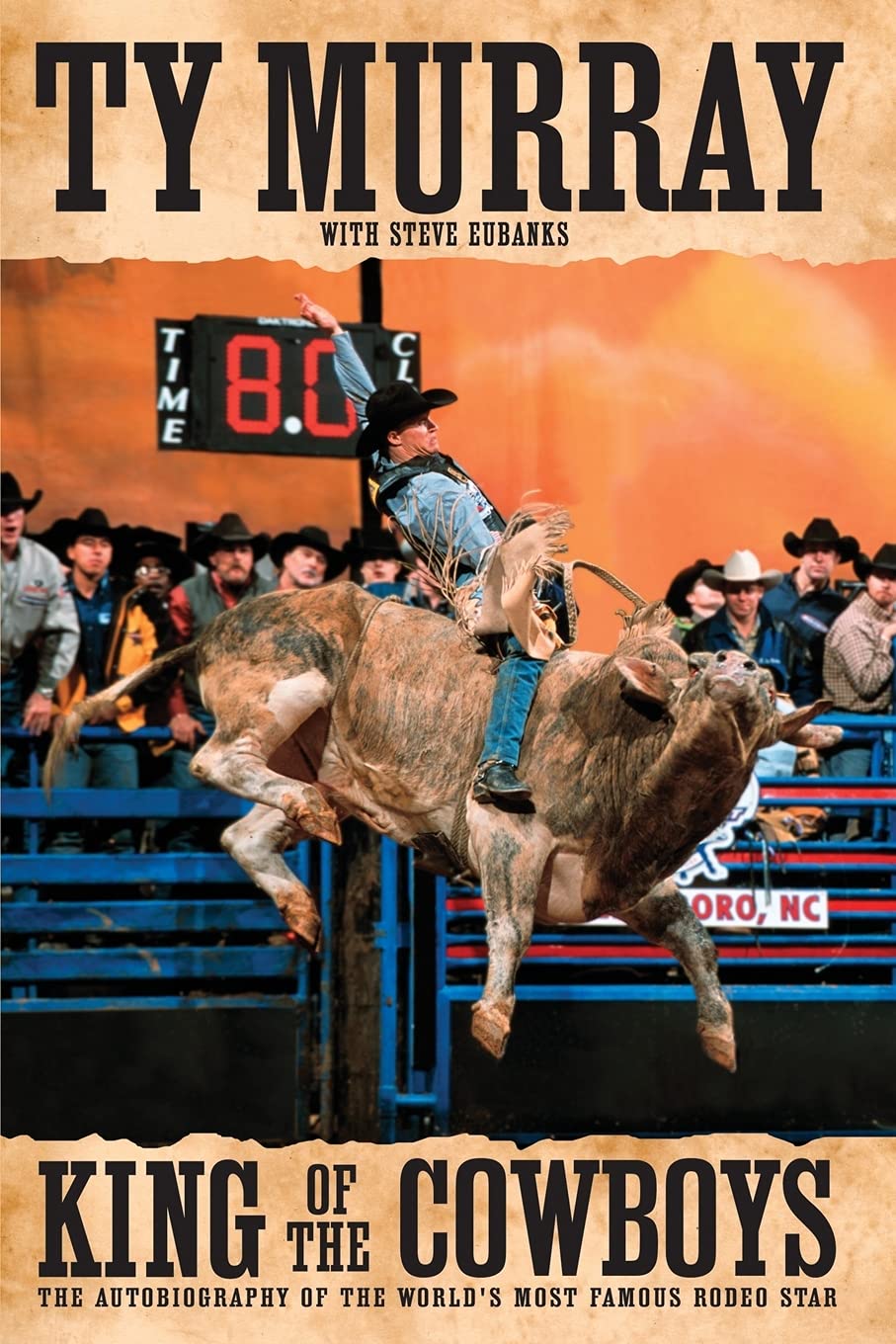



The most famous rodeo champion of all time tells his amazing true story -- and opens a fascinating window into the world of the professional cowboy. Ty Murray was born to be a rodeo star -- in fact, his first words were "I'm a bull rider." Before he was even out of diapers, he was climbing atop his mother's Singer sewing machine case, which just so happened to be the perfect mechanical bull for a 13-month-old. Before long, Ty was winning peewee events by the hatful, and his special talent was obvious...obvious even to a man called Larry Mahan. At the time the greatest living rodeo legend, six-time champion Mahan invited a teenaged Ty Murray to spend a summer on his ranch learning not just rodeoing but also some life lessons. Those lessons prepared Ty for a career that eventually surpassed even Mahan's own -- Ty's seven All-Around Championships. In King of the Cowboys, Ty Murray invites us into the daredevil world of rodeo and the life of the cowboy. Along the way, he details a life spent constantly on the road, heading to the next event; the tragic death of his friend and fellow rodeo star Lane Frost; and the years of debilitating injuries that led some to say Ty Murray was finished. He wasn't. In fact, Ty Murray has brought the world of rodeo into the twenty-first century, through his unparalleled achievements in the ring, through advancing the case for the sport as a television color-commentator, and through the Professional Bull Riders, an organization he helped to build. In the end, though, Ty Murray is first and foremost a cowboy, and now that he's retired from competition, he takes this chance to reflect on his remarkable life and career. In King of the Cowboys, Ty Murray opens up his world as never before. Ty Murray was born in Glendale, Arizona, in 1969. By the time he was nineteen he had won Professional Rodeo Cowboys Association's Overall and Bareback Riding Rookie of the Year. The following year, he won his first PRCA World All-Around Championship, and by 23 was the youngest cowboy millionaire the sport had ever known. In all, he has won a record seven all-arounds, as well as PRCA World Bull Riding titles in 1993 and 1998, and the Wrangler National Finals Rodeo average crowns in 1993 (bareback riding) and 1998 (bull riding). In 2000, Ty Murray was inducted into the ProRodeo Hall of Fame in Colorado Springs, Colorado, and he retired from professional rodeo in 2001. He lives in Stephenville, Texas. Chapter 1: The Cowboy Way "So," he said, "why do you do it?" I've been giving interviews most of my life, so this one was nothing unusual. We were outside the locker room at a Professional Bull Riders (PBR) event sitting on a stack of portable seats, the kind you'd find on an arena floor during a concert. The reporter asked some intelligent questions -- it's always nicer when these guys have done their homework -- but after a few minutes he asked that question, the one I'd heard more than any other since I'd begun riding. The people who ask that question are always sincere. After several thousand interviews I expect it. But I still have a hard time answering it, not because I don't know why I'm a cowboy, but because the concept of the cowboy way is so foreign to some people that I have a hard time boiling it down to a simple sound bite. "I'm a cowboy because I've always been a cowboy," I said to this reporter. It was the umpteenth time I'd used that line, but I wasn't sure my media buddies got it. "I was born to it." The reporter's eyes glazed over, and I knew I needed to do a better job of explaining myself. As far as I was concerned, asking a cowboy why he's a cowboy is like asking a Frenchman why he's French. Still, I needed to give it another shot. "A cowboy is a cowboy no matter how he makes his living," I said. "Not all of us wear chaps and hats. You'll find plenty of cowboys wearing Brooks Brothers' suits on Wall Street, or playing in the NFL. Those real estate developers who borrow millions to build big office towers, a lot of them are cowboys. The cowboy way is about how you approach things, whether you're talking about a businessman, an artist, or a housewife. Being a cowboy is in your DNA. You either have it or you don't." I still wasn't sure I was getting through to this reporter, so I tried another tack. "Look. When I won my first all-around championship, I was twenty years old. Almost every reporter asked me if I was surprised by how well I'd done so early in my career. That seemed funny to me. They asked it as if I just woke up one morning and found a gold buckle on my belt. I'd been working to win that first all-around championship since I was two years old. "Being a cowboy was never a conscious choice. I never considered doing anything in life other than rodeo. "Why do I do it? From the time I was old enough to walk I've always known where I wanted to go with my life, and I grew up in an environment where if I worked my butt off every day, I knew I would get there. "I