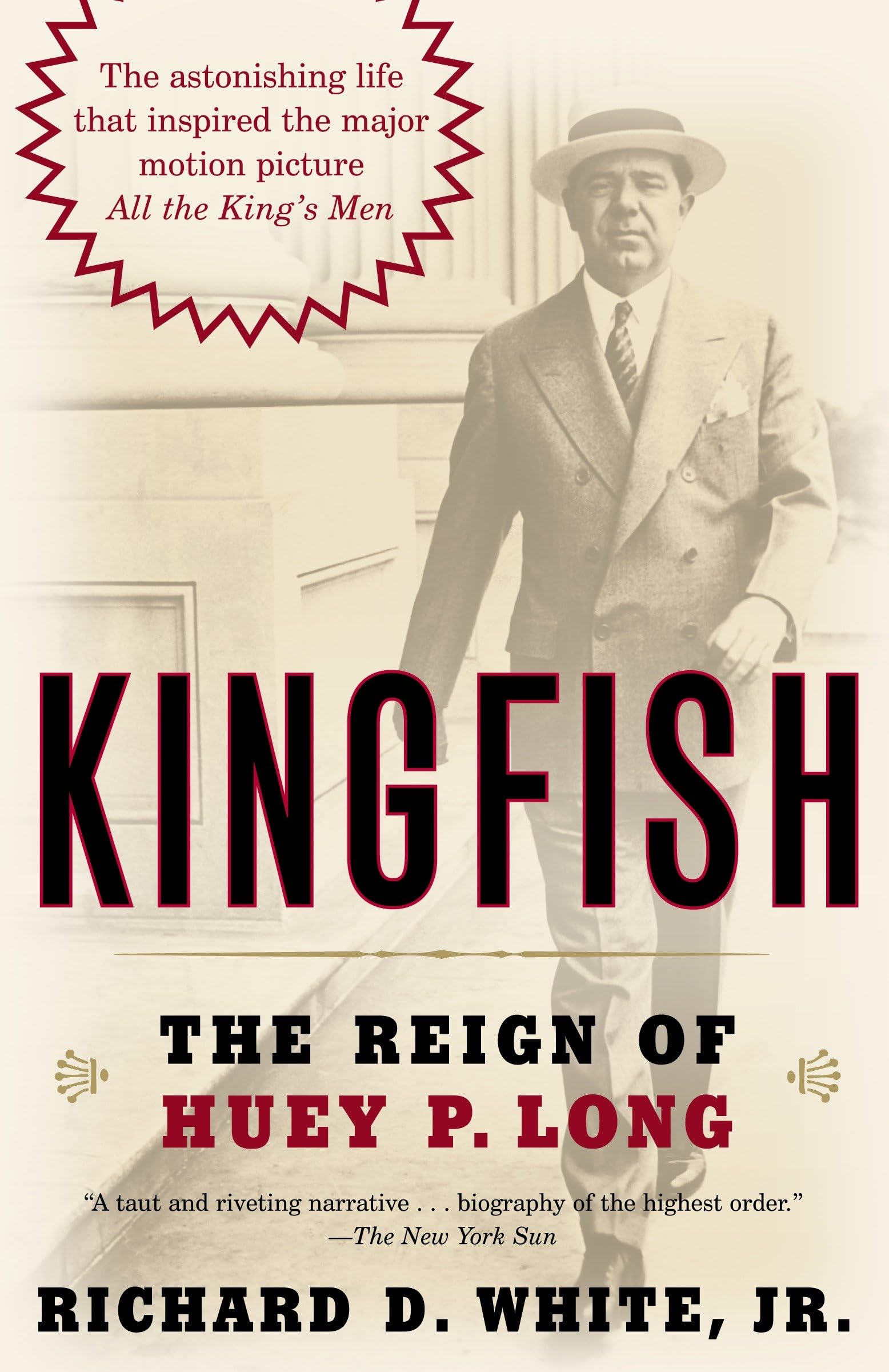



From the moment he took office as governor in 1928 to the day an assassin’s bullet cut him down in 1935, Huey Long wielded all but dictatorial control over the state of Louisiana. A man of shameless ambition and ruthless vindictiveness, Long orchestrated elections, hired and fired thousands at will, and deployed the state militia as his personal police force. And yet, paradoxically, as governor and later as senator, Long did more good for the state’s poor and uneducated than any politician before or since. Outrageous demagogue or charismatic visionary? In this powerful biography, Richard D. White, Jr., brings Huey Long to life in all his blazing, controversial glory. White taps invaluable new source material to present a fresh, vivid portrait of both the man and the Depression era that catapulted him to fame. From his boyhood in dirt-poor Winn Parish, Long knew he was destined for power–the problem was how to get it fast enough to satisfy his insatiable appetite. With cunning and crudity unheard of in Louisiana politics, Long crushed his opponents in the 1928 gubernatorial race, then immediately set about tightening his iron grip. The press attacked him viciously, the oil companies howled for his blood after he pushed through a controversial oil processing tax, but Long had the adulation of the people. In 1930, the Kingfish got himself elected senator, and then there was no stopping him. White’s account of Long’s heyday unfolds with the mesmerizing intensity of a movie. Pegged by President Roosevelt as “one of the two most dangerous men in the country,” Long organized a radical movement to redistribute money through his Share Our Wealth Society–and his gospel of pensions for all, a shorter workweek, and free college spread like wildfire. The Louisiana poor already worshiped him for building thousands of miles of roads and funding schools, hospitals, and universities; his outrageous antics on the Senate floor gained him a growing national base. By 1935, despite a barrage of corruption investigations, Huey Long announced that he was running for president. In the end, Long was a tragic hero–a power addict who squandered his genius and came close to destroying the very foundation of democratic rule. Kingfish is a balanced, lucid, and absolutely spellbinding portrait of the life and times of the most incendiary figure in the history of American politics. Richard D. White, Jr., is a professor of public administration at Louisiana State University and the author of Roosevelt the Reformer: Theodore Roosevelt as Civil Service Commissioner 1889—1895. He lives in Baton Rouge. CHAPTER 1 1927 A WEDDED MAN WITH A STORM FOR A BRIDE Huey Long climbed onto a large bale of fresh-picked cotton and gazed out at a crowd of farmers attending a country fair. For a few moments he stood motionless, his shoulders hunched like a boxer waiting for the first bell to ring. Leaning forward to talk to the men in the front row, Huey began speaking in a whispery voice so quiet that the crowd shuffled closer to hear him. After a couple of minutes, he slowly raised his voice, a little louder each minute, until he roared to the gathering throng. He threw off his coat, rolled up his shirtsleeves, and slackened the red silk tie hanging around his neck. His voice booming across the dusty fairgrounds, Huey pummeled his audience with old-fashioned soapbox oratory and hell-for-leather political bluster. He whooped and hollered, pounded his fist, and punched in the air at imaginary enemies. His face turned the color of a ripe tomato. Twirling his arms above his head in the sweltering Louisiana heat, perspiration pouring down his cheeks, he quickly captivated the audience with spellbinding charisma and homespun guile. It was the summer of 1927 and Huey was running full speed for governor of Louisiana. At every stop on the campaign trail, he treated his listeners to a boiling mixture of snake-oil salesmanship, burlesque tap dancing, evangelicism, and blistering billingsgate. He would preach to the crowd, holding a Bible in his hand in holy uplift and quoting from memory lengthy passages of the Scriptures. From Galatians he taunted his adversaries. “Am I therefore become your enemy because I tell you the truth?” More often though, Huey spewed a torrent of abuse upon his foes. He branded his political opponents with epithets like “low-down vile and slanderous men,” “thieves, bugs, and lice,” “grafters and money boodlers,” “graveyard robbing politicians,” and “blackguards in full-dress suits.” His audience, mostly rural folk who took their politics raw like corn whiskey, could not get enough. “You tell ’em, Huey,” the farmers yelled back. “Go get ’em.” Huey’s crowd of farmers looked up at a man in his thirties, of medium height, approaching pudginess with a round face, puffy jowls, and skin glowing pink like a fresh sunburn. An unruly mop of chestnut-colored hair topped his head, with a curly forelock that tumbled down. An oversized nose