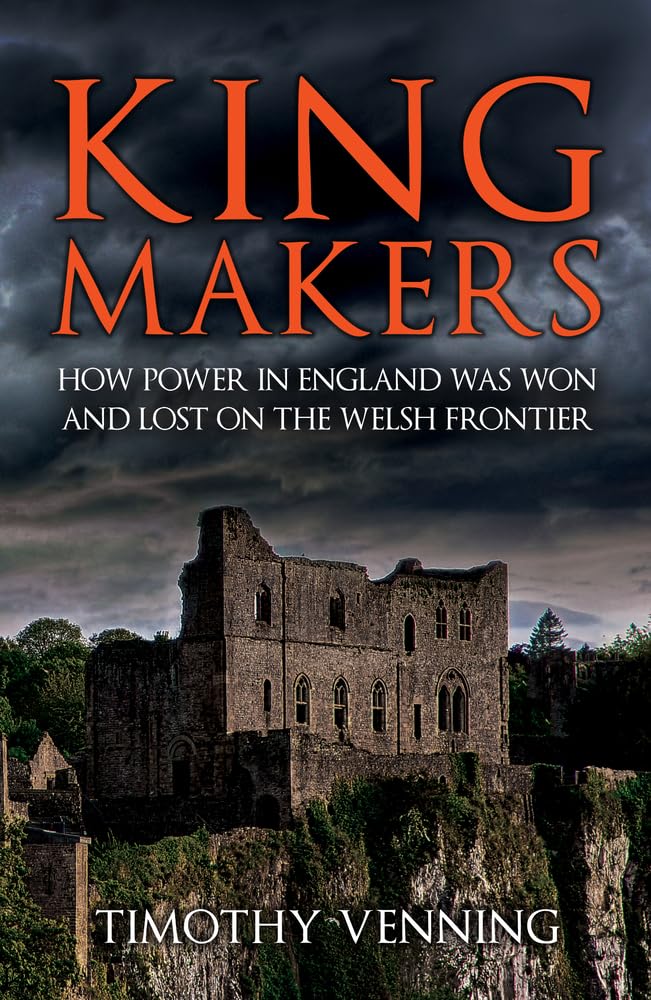
Kingmakers: How Power in England Was Won and Lost on the Welsh Frontier
$18.18
by Timothy Venning



New paperback edition - Explores the history of the Marcher Lords through their turbulent history on the Welsh frontier from trusted nobles to individual powerhouses and eventually to kings themselves. For a medieval English king, delegation was a necessary evil; and nowhere more necessary – nor more potentially disastrous – than on the Anglo-Welsh borders. The Marcher lords first empowered by William I were relied upon by subsequent Norman and Plantagenet kings to protect the dangerous frontiers of the realm. In Wales, as in Ireland, the smaller size and military weakness of divided neighboring states encouraged conquest, with the seized lands enhancing the power of the aggressive English lords. They were granted ever greater authority by the monarch, to the point where they believed they ruled like kings. They intermarried, schemed for extra lands and snatched power in a complex and often violent political process. Owing to their resources and unparalleled military effectiveness, they soon came to overawe kings and dominate national events. The strength of the Marcher lords would come to the fore at numerous times in the nation’s history in the shape of notorious figures such as Simon de Montfort and Roger Mortimer. The civil war of King Stephen’s reign, the baronial resistance to King John, the overthrow of Edward II and Richard II; all of these crises turned upon the involvement of the lords of the Marches. Timothy Venning explores their mentality and reveals the dramatic careers both of those who prospered from their loyalty to the king and those whose power was gained by treachery – from the Norman Conquest to the beginnings of the Tudor dynasty. 'I'm happy to recommend this book, particularly to anyone living close the border with Wales.', The Writing Desk, December 2023 Timothy Venning studied history at Kings College, London to PhD level, winning the London University History Prize in 1979. He has written articles for the Dictionary of National Biography , as well as a book on Oliver Cromwell and reference works on British office-holders and the chronology of the Byzantine Empire. He also contributes to major biographical publications and his research forms the basis for many other publications. The society of the Welsh Marches, the sociopolitical and administratively distinct district of the Anglo-Welsh border after the Norman Conquest, was a region constructed from a mosaic of small and larger lordships under the new Norman government after the conquest of 1066. The latter date saw Duke William of Normandy and his followers take over the established state and society of Anglo-Saxon (and Anglo-Scandinavian) England and transform it into a French-speaking and partially ‘Frenchified’ ‘European’ state, based on the same lines of governance and culture as the new leadership elite’s Continental homeland. This applied to the Anglo-Welsh frontier as it did across England, with the existing higher ranks of society marginalised and mostly replaced – with the irony that the incomers on this border faced a militarily advantageous situation recently created by King Harold’s destruction of the threat of a unified Welsh state under Gruffydd ap Llywelyn ap Seisyll, king of Gwynedd and Powys and conqueror of Deheubarth, in 1063. This precariously reunited state, more of a ‘union of crowns’ than a viable long-term regime due to complex Welsh inheritance law and the multitude of potential heirs to the five main Welsh kingdoms, had indeed reconquered parts of western Herefordshire from the English in the 1050s and forced King Edward ‘the Confessor’ to recognise this – the Welsh were a serious military threat then and thus caused an English military reaction, which the arriving Normans later followed up. The private army/bodyguard of housecarls that Harold Godwinson relied on to lead his army at the Battle of Hastings, and which the Normans destroyed there, ‘blooded’ themselves under Harold (as Earl of Hereford) in fighting off the threat posed by Gruffydd in 1057–63 and had finally broken up his kingdom to install a group of new dynasts as Harold’s nominees. Indeed, the experiment of using ‘Norman’ cavalry to defeat the Welsh infantry and castles to defend the landscape had already been tried out in the 1050s, with only limited success – King Edward was half-Norman and used to using French cavalry knights against infantry. But it was William and his new group of frontier lords who reaped the benefit. The post-1066 frontier was governed as a part of the kingdom of England by a military-based ruling class almost entirely North French (mostly but not exclusively Norman) in ethnic origin and cultural orientation, though inter-married with local Anglo-Saxon and Welsh heiresses. It was not that different in its creation by the first King William from the lands governed by the elite in the rest of his new regime. As with the remainder of England, the pre-1066 ruling class (a mixture of Anglo-Saxon and Scand