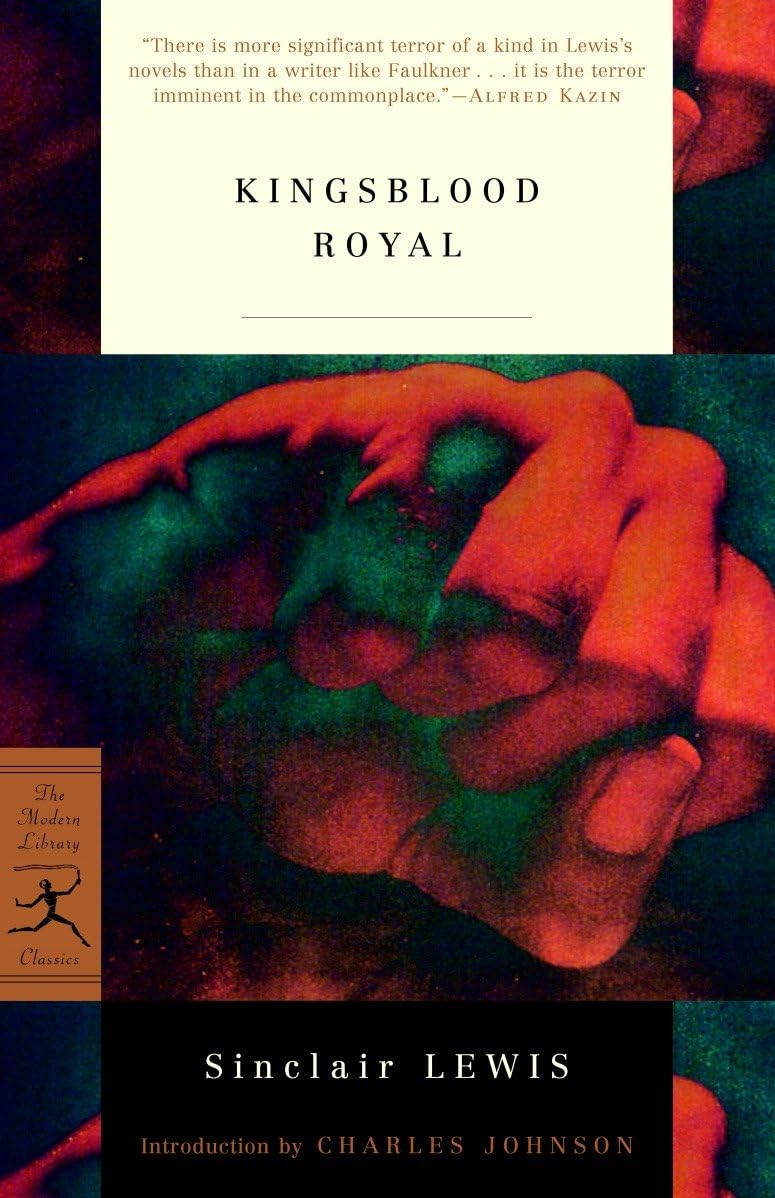



A neglected tour de force by the first American to win the Nobel Prize in literature, Kingsblood Royal is a stirring and wickedly funny portrait of a man who resigns from the white race. When Neil Kingsblood a typical middle-American banker with a comfortable life makes the shocking discovery that he has African-American blood, the odyssey that ensues creates an unforgettable portrayal of two Americas, one black, one white. As timely as when it was first published in 1947, one need only open today's newspaper to see the same issues passionately being discussed between blacks and whites that we find in Kingsblood Royal , says Charles Johnson. Perhaps only now can we fully appreciate Sinclair Lewis's astonishing achievement. This novel has taken a back seat to Lewis's more noted works, e.g., Dodsworth. It deals with a successful white man who well into his life discovers that he is part black, quite a controversial subject for 1947. This might actually find a larger audience today. Copyright 2001 Reed Business Information, Inc. "There is more significant terror of a kind in Lewis's novels than in a writer like Faulkner... it is the terror imminent in the commonplace." A neglected tour de force by the first American to win the Nobel Prize in literature, Kingsblood Royal is a stirring and wickedly funny portrait of a man who resigns from the white race. When Neil Kingsblood a typical middle-American banker with a comfortable life makes the shocking discovery that he has African-American blood, the odyssey that ensues creates an unforgettable portrayal of two Americas, one black, one white. As timely as when it was first published in 1947, one need only open today's newspaper to see the same issues passionately being discussed between blacks and whites that we find in Kingsblood Royal , says Charles Johnson. Perhaps only now can we fully appreciate Sinclair Lewis's astonishing achievement. A neglected tour de force by the first American to win the Nobel Prize in literature, Kingsblood Royal is a stirring and wickedly funny portrait of a man who resigns from the white race. When Neil Kingsblood a typical middle-American banker with a comfortable life makes the shocking discovery that he has African-American blood, the odyssey that ensues creates an unforgettable portrayal of two Americas, one black, one white. As timely as when it was first published in 1947, one need only open today's newspaper to see the same issues passionately being discussed between blacks and whites that we find in Kingsblood Royal, says Charles Johnson. Perhaps only now can we fully appreciate Sinclair Lewis's astonishing achievement. Charles Johnson's many books include Middle Passage , which won the 1990 National Book Award. He lives in Seattle. 1 Mr. Blingham, and may he fry in his own cooking-oil, was assistant treasurer of the Flaver-Saver Company. He was driving from New York to Winnipeg, accompanied by Mrs. Blingham and their horrible daughter. As they were New Yorkers, only a business trip could have dragged them into this wilderness, and they found everything west of Pennsylvania contemptible. They laughed at Chicago for daring to have skyscrapers and at Madison for pretending to have a university, and they stopped the car and shrieked when they entered Minnesota and saw a billboard advertising “Ten Thousand Lakes.” Miss Blingham, whom they called “Sister,” commented, “Unless you had a New York sense of humor, you would never be able to understand why that sign is so funny!” When they came to their first prairie hamlet in Minnesota, six cottages, a garage, a store and a tall red grain elevator, Mrs. Blingham giggled, “Why, they’ve got an Empire State Building here!” “And all the Svensons and Bensons and Hensons go up to the Rainbow Room every evening!” gurgled Sister. Their laughter buoyed them for a hundred miles, till it was time to think of lunch. Mrs. Blingham looked at the map. “Grand Republic, Minnesota. That seems to be about forty miles from here, and it’s quite a village—85,000 people.” “Let’s try it. They ought to have some sort of a hotel to eat at,” yawned Mr. Blingham. “All the best people there eat at the Salvation Army Shelter!” yelped Mrs. Blingham. “Oh, you slay me!” said Sister. When, from the bluffs of the Sorshay River, they looked down to the limestone shaft of the Blue Ox National Bank Building and the welter of steel and glass sheds that had been erected for the Wargate Wood Products Corporation since 1941, Mr. Blingham said, “Fair-sized war plant they got there.” Since the beginning of World War II, Grand Republic had grown from 85,000 to 90,000. To some ninety thousand immortal souls, it was the center of the universe, and all distances were to be measured from it; Moscow was defined as a place 6,100 miles from Home, and Saudi Arabia as a market for Wargate wallboard and huts and propellers. The Blinghams, who knew that the true center of the solar system is the corner of Fifth Avenu