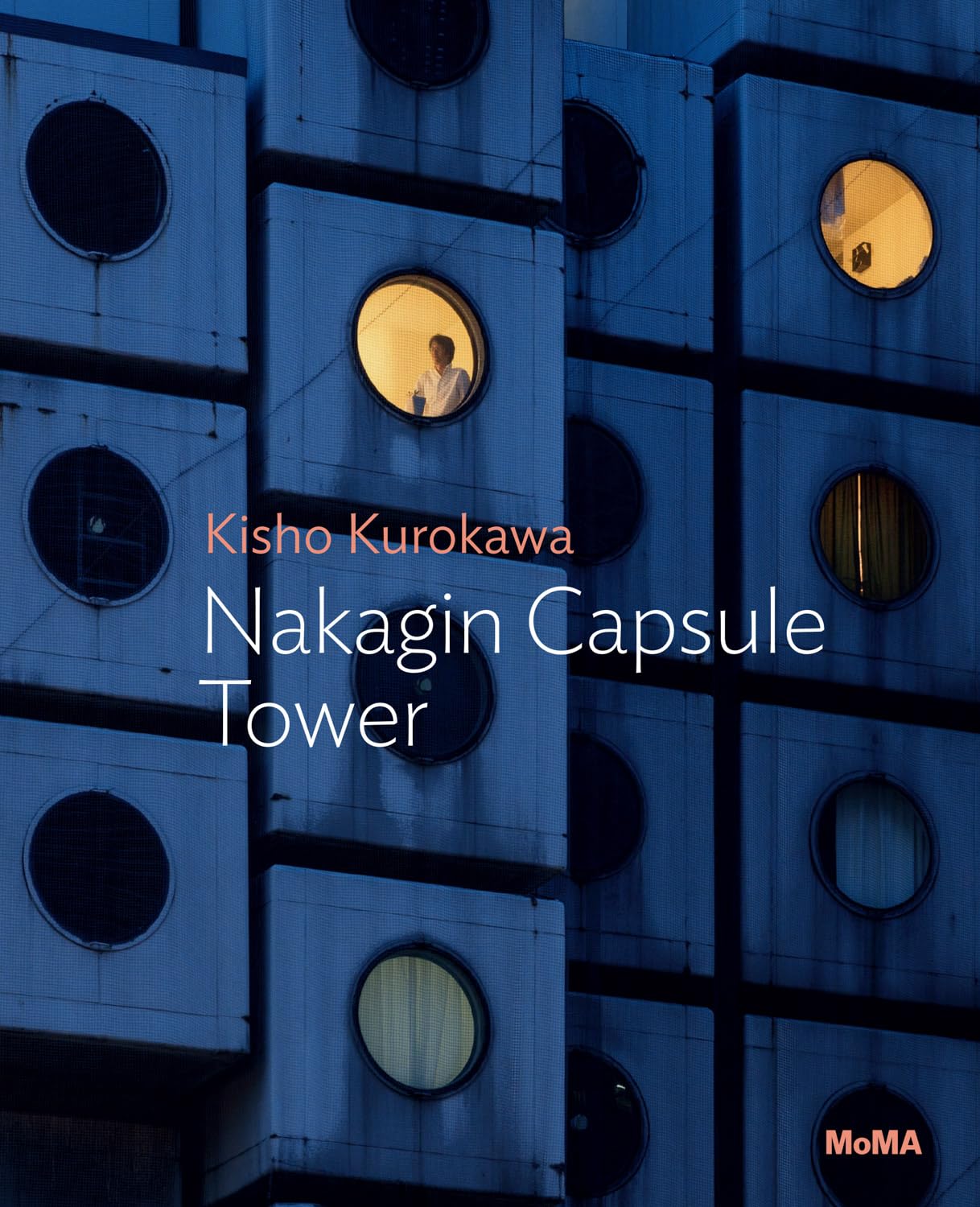



A look inside the Nakagin Capsule Tower, a landmark of the Japanese Metabolist movement that stood for over 50 years Comprised of two steel and concrete towers outfitted with 140 prefabricated living capsules, the Nakagin Capsule Tower in Tokyo is one of the most iconic and influential architectural marvels of the postwar period. A touchstone of the Metabolist movement, the tower was designed by the office of Japanese architect Kisho Kurokawa (1934–2007) and completed between 1970 and 1972. Each capsule was intended for single occupancy and came outfitted with its own ensuite bathroom, a foldout desk, a telephone, a reel-to-reel tape player, a Sony color television and a "porthole" window overlooking the city. In this volume of the MoMA One on One series, curator Evangelos Kotsioris delves into the groundbreaking design, construction, evolution and ultimate need for the demolition of this remarkable structure in 2022. It is published in advance of MoMA's exhibition of one of the original capsules, the first to be publicly shown in the United States. In a city shaped by constant renewal, this retrospective probes what it means to preserve an architectural concept. -- Kat Barandy ― designboom Kisho Kurokawa’s groundbreaking feat of Metabolism will be given a proper consideration with a recovered capsule (#A1305 – once the building’s highest) and 45 other archival materials that showcase and contextualize the visionary contribution to late-modernism that the world lost in 2022 at the conclusion of a drawn-out process. -- Josh Niland ― Archinect As Japan’s beloved Nakagin Capsule Tower resurfaces, we celebrate an architectural marvel. -- Oliver Wainright ― The Guardian [Offers] further insight into the building’s design, transformation, and legacy. -- Niall Patrick Walsh ― Archinect Built in Tokyo’s Ginza district in 1972 and dismantled in 2022, the structure was once among the clearest architectural expressions of Metabolism in Japan, a movement that sought to mirror natural growth and transformation in the built environment. Now, through a single, fully restored capsule and a constellation of archival materials, MoMA reactivates that legacy with the goal of inspiring inquiry over nostalgia. -- Kat Barandy ― Designboom The architect had always imagined that his poster-child of metabolist architecture would transform and change. While Kurosawa once drew up plans for a twin building to Nakagin Capsule Tower that was never realized, the latest exhibition is an invitation to imagine both the structure’s past lives and its future potential we have yet to experience. -- Zoria Petkoska ― The Japan Times That Kurokawa was able to create a building that so many people cherished and felt deep personal connections to is perhaps his most enduring achievement, and one that will live on indefinitely. -- Diana Budds ― Wallpaper* With this tribute, MoMA reintroduces the Nakagin Capsule Tower not merely as a building, but as an ecosystem: a prototype of flexible urban living and a utopian vision, perhaps ultimately unfulfilled, yet still capable of offering a vital lesson on architecture’s adaptability and the enduring power of its many lives. -- Ilaria Bonvicini ― Domus Thankfully, here we can encounter the complete capsule in all its glory. -- Anthony Paletta ― Curbed