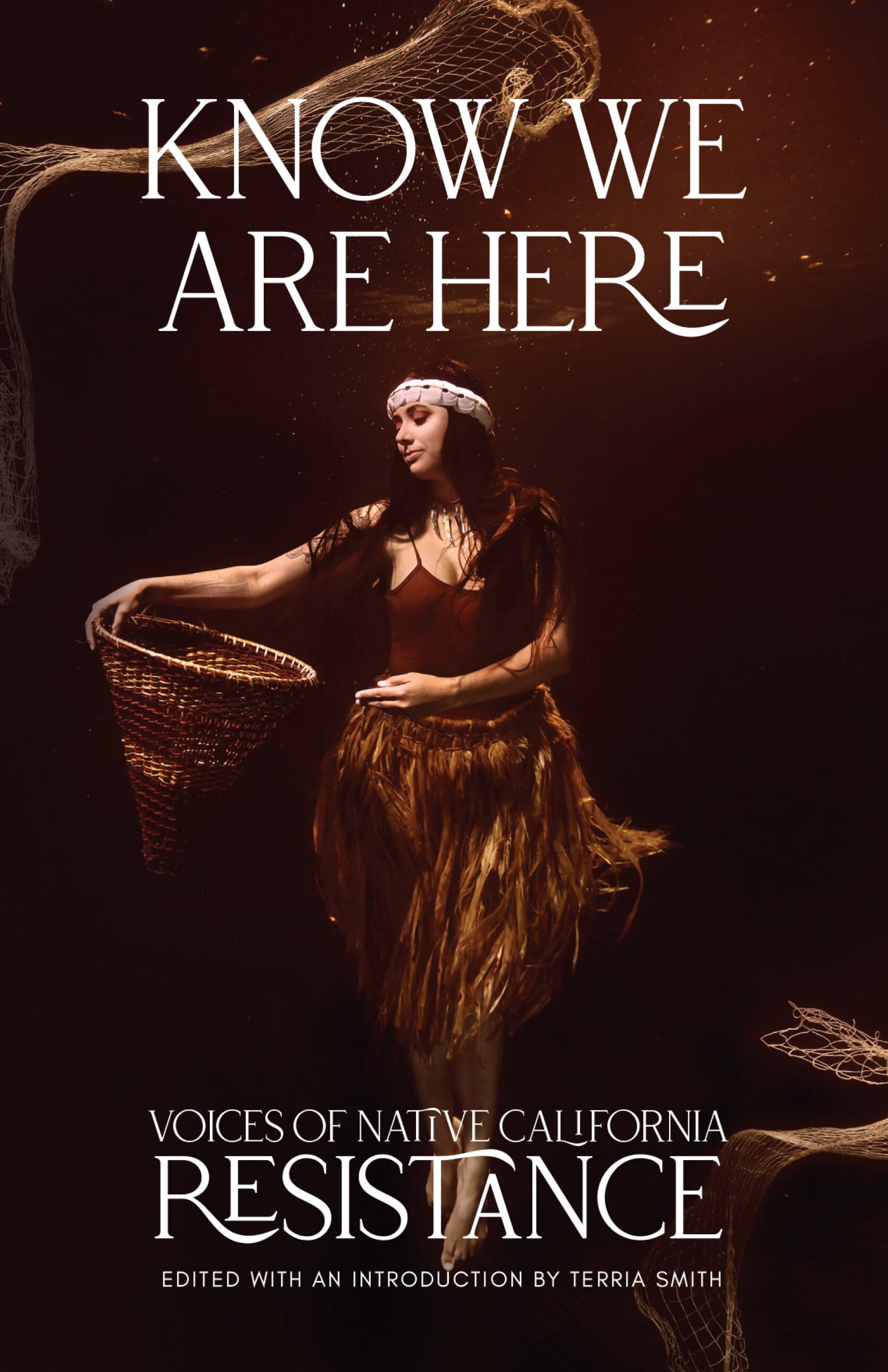



An essential look at the ways California’s Native nations are resisting colonialism today, from education reform to protests against environmental injustice and beyond. Collecting over twenty-five essays written by more than twenty California Indian authors, Know We Are Here surveys many of the ways California’s Indigenous communities are resisting the legacies of genocide. Focusing on the particular histories, challenges, and dynamics of life in Native California—which are often very different from elsewhere in the United States—the book collects essays from writers across the state. It encompasses the perspectives of both elders and the rising generation, and the contributors include activists, academics, students, memoirists, and tribal leaders. The collection examines histories of resistance to colonialism in California, the reclaiming of cultures and languages, the connection of place and nature to wellness in tribal communities, efforts to overhaul the racist presentation of California Indians in classrooms and popular culture, and the meanings of solidarity in Native California. Unifying the book is an introduction by Terria Smith (Torres Martinez Desert Cahuilla Indians), editor of the renowned and long-running magazine News from Native California . This book is an indispensable resource for California Indian readers, educators of all levels in California, and students in Native studies courses nationally. "A fascinating collection of essays by a wide variety of California Indian authors addressing an equally varied spectrum of issues but all focused on one critical theme: resistance to colonialism, past and present." — Benjamin Madley , author of An American Genocide: The United States and the California Indian Catastrophe, 1846-1873 "An essential resource to learn about the many trials and triumphs of the Indigenous people of California who rise to revitalize their cultures, tell their true histories, and honor their ancestors through retelling stories that keep them remembered in these landscapes. Their love of the land, their cultures, and the pride in their history shine through." — M. Kat Anderson , author of Tending the Wild: Native American Knowledge and the Management of California's Natural Resources Terria Smith is the editor of News from Native California magazine and director of the Berkeley Roundhouse, Heyday’s California Indian publishing program. She is a tribal member of the Torres Martinez Desert Cahuilla Indians in Southern California and an alum of the UC Berkeley Graduate School of Journalism. INTRODUCTION BY TERRIA SMITH I had a friend in college who was consistently pointing out that the root word of ignorance is ignore. Thus, she believed that someone was making the choice to ignore something. I agree. This is something I see all the time in the work that I do. People claim their ignorance is unintentional when actually it is a thin excuse to ignore the existence of tribal people in California. It’s certainly a conscious act. I am convinced of that. Tribes in this state have a lot of physical visibility. Everywhere. If you drive across the state, on almost all of our major highways you’ll see clearly visible signs that mark where tribal reservations are. In the north there are signs for Table Bluff Reservation, Big Lagoon Rancheria, the Yurok Tribe, and many others along 101. In the south, along I-10 from Los Angeles to Phoenix, you will find the Morongo Band of Mission Indians, Agua Caliente Band of Cahuilla Indians, Cabazon Band of Mission Indians, and the Twenty-Nine Palms Band of Mission Indians. The I-8 is officially named the Kumeyaay Highway and goes through Campo Kumeyaay Nation, the Viejas Band of the Kumeyaay Nation, and Fort Yuma Quechan Tribe in Winterhaven. Also along Highway 101, you have signs for Pinoleville, Coyote Valley, Round Valley, and Robinson Rancheria. There are cities, towns, and parks all up and down the state with names derived from California tribal languages, including (but certainly not limited to): Aguanga, Azusa, Cahuenga, Petaluma, Point Mugu, Ojai, Rancho Cucamonga, Sisquoc, Tehachapi, Yucaipa, and Yosemite. In the city of Palm Springs (half of which is the Agua Caliente reservation), you have several streets named after Cahuilla families: Andreas, Arenas, Belardo, and Vista Chino. I could go on with contemporary geography alone to make this case for physical visibility. But the bottom line is this: when there are well over one hundred federal tribal reservations, and when there are also more than fifty tribes that are unrecognized (many in some of the state’s largest urban areas), there is going to be a presence absolutely everywhere. No matter where you turn, there is no denying that there are tribal nations all over California. Yet still there are people—both those who are not Native American as well as people who were relocated from tribes in other parts of the country—who react in surprise when I introduce myself as Desert Cahui