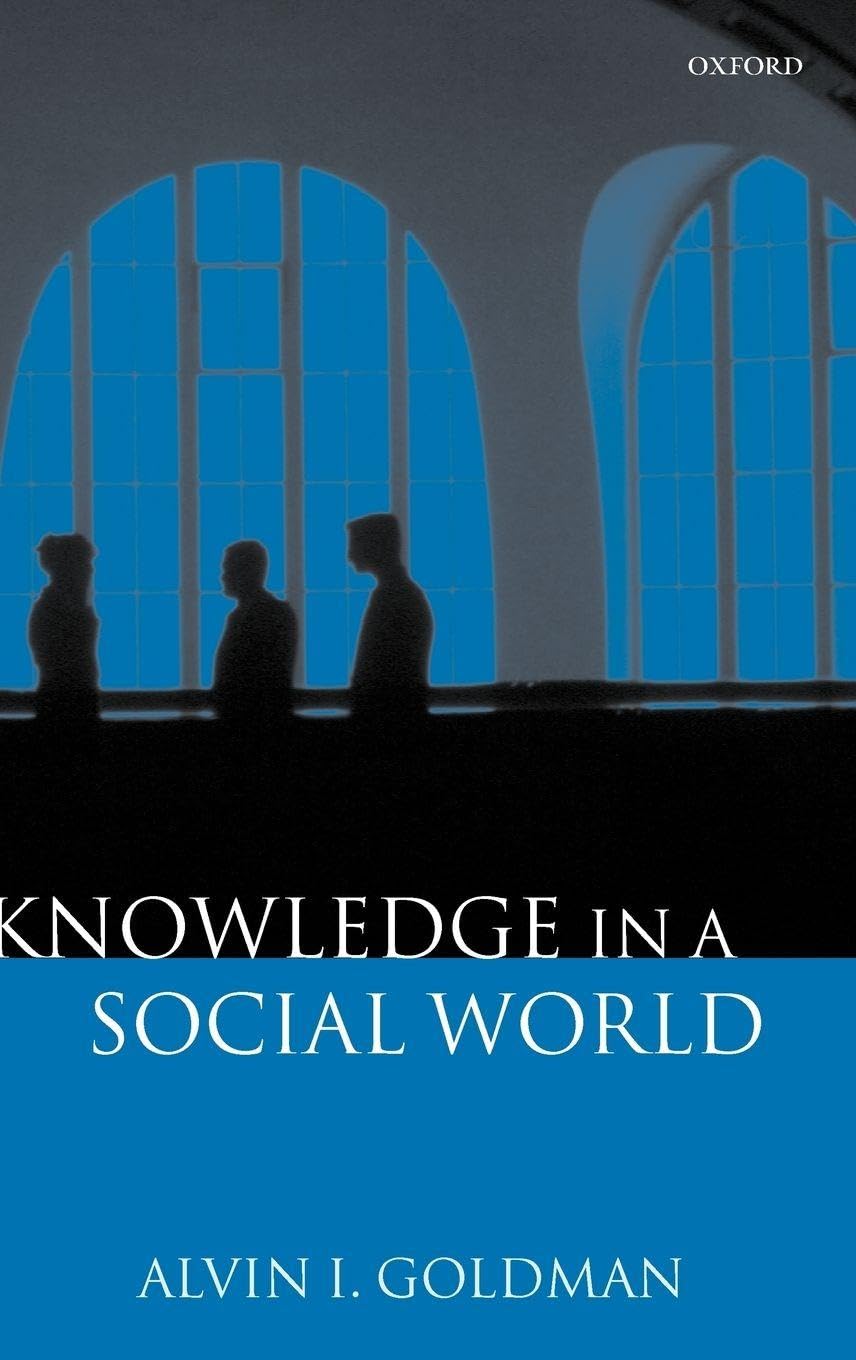



Knowledge in a Social World offers a philosophy for the information age. Alvin Goldman explores new frontiers by creating a thoroughgoing social epistemology, moving beyond the traditional focus on solitary knowers. Against the tides of postmodernism and social constructionism Goldman defends the integrity of truth and shows how to promote it by well-designed forms of social interaction. From science to education, from law to democracy, he shows why and how public institutions should seek knowledge-enhancing practices. The result is a bold, timely, and systematic treatment of the philosophical foundations of an information society. `I recommend Chapter Three as a fine overview regarding current debates concerning truth, and Chapter Seven as an original criticism of an economic interpretation of the marketplace of ideas. Goldman is innovative also in his suggestions on testimony' Martin Kusch, Department of History and Philosophy of Science, Cambridge, Studies in History and Philosophy of Science`interesting and insightful ... offers a rich supply of insights into the veritistic properties of society.' Australasian Journal of Philosophy, vol. 79, no. 3`Once again, Goldman has done a huge job in collecting relevant information for his evaluative enterprise. ... Its lucid style makes it accessible to people without philosophical education.' Australasian Journal of Philosophy, vol. 79, no. 3`well constructed and well written ... The topic is worthy of attention and the ideas are provocative ... Goldman does raise interesting questions for assessing quality and utility in an era of information overload.' Deborah Barreau, Jnl. Americ. Soc. for Inf. Science and Tech., 01/01/01.`one of the most recent contributions to the field, and a very welcome one too.' Luciano Floridi, TLS, 28 Jan 2000.`Alvin Goldman's Knowledge in a Social World belongs to a sparse tradition in epistemology given to the epistemic evaluation of social institutions. Landmarks in this tradition include Bacon's The Advancement of Learning, Locke's Some Thoughts Concerning Education, and Dewey's Social Inquiry. Goldman's book is the equal of these influential volumes in breadth of vision, mastery of relevant contemporary thought, and practical utility, and surpasses them in theoretical depth. It is a work crafted with supreme philosophical skill.' Frederick Schmitt, Professor of Philosophy, University of Illinois at Urbana-Champaign.`An important work of monumental scope. Its central concern is the ways in which social practices and familiar institutions contribute to and undermine the pursuit of knowledge. To that extent it reveals a sensitivity to the animating, if ultimately misdirected and misleading, insight of the postmodernists that we are socially situated beings; at the same time it brilliantly defends the idea that this fact about our situatedness does nothing to undermine the possibility of truth and objective knowlegde. This is a book of singular importance to lawyers, political theorists, social and natural scientists as well as to educators and theorists of education. It is a major contribution to all these fields and not just because of its insights into them, but for its accessibility to intelligent practitioners as well. It may well be the most significant interdisciplinary philosophy book of the decade.' Jules Coleman, Professor of Jurisprudence, Yale Law School`Alvin Goldman, the premier epistemologist of the past two decades, has written a pioneering book that will define the field of social epistemology. Scholars will learn from his judicious and lucid proposals, and they will be wrestling for years with the exciting and important problems he raises.' Philip Kitcher, Professor of Philosophy, University of California, San Diego Alvin I. Goldman is one of the world's foremost epistemologists; he is Regents Professor of Philosophy at the University of Arizona, and a Past President of the Pacific Division of the American Philosophical Association. Alvin I. Goldman is Regents Professor of Philosophy at the University of Arizona.