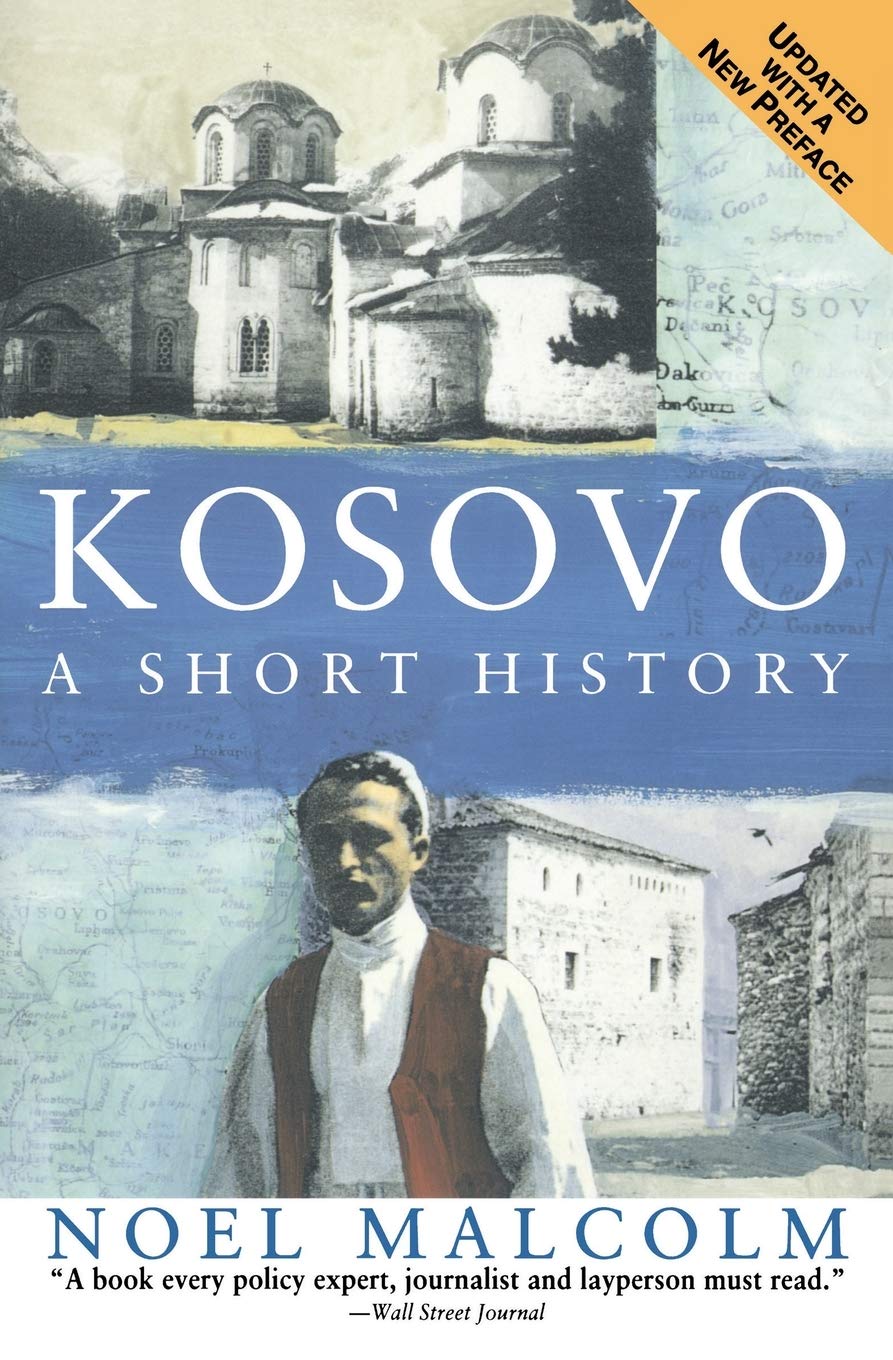
Kosovo: A Short History – An Essential Chronicle of the Balkans, Ethnic Tensions, and Political Independence
$12.99
by Noel Malcolm



"Malcolm's narrative is gripping, even brilliant at times. . . . He takes to his task with the vigor of a detective driven by true passion. At times his claims are, in terms of Balkan history,quite revolutionary." "What could have been mere academic hairsplitting in the hands of another author is transformed by Malcolm into a thrilling detective story." -- "New York Times Book Review""Malcolm's narrative is gripping, even brilliant at times. . . . He takes to his task with the vigor of a detective driven by true passion. At times his claims are, in terms of Balkan history, quite revolutionary." -- "The Economist" ""Kosovo: A Short History" by Noel Malcolm shows that the conflict between Serbs and Albanians is less about religion and bloodlines and more about history and differing views of national origins. Malcolm, a British historian now at Harvard, disputes Serbian claims to Kosovo." -- "USA Today""In this awe-inspiring work, Malcolm has created an essential aid to anyone who wishes to understand this tragic region today . . . . His book is exceptional not only for his unimpeachable research, but also for his equitable examination of the conflicting ethnic views of what really happened in this contentious region, and his determination to debunk dangerous myths." --" Publishers Weekly""Excellent." -- "New York Review of Books" Kosovo A Short History By Malcolm, Noel Perennial Copyright © 2004 Noel Malcolm All right reserved. ISBN: 0060977752 Chapter One Orientation: places, names and peoples A journalistic cliche of the nineteenth century described the Kosovo region as the lost heart of the Balkans. Like many cliches, this one was both slightly foolish and, at the same time, suggestive of a significant truth. Although Kosovo has played a central role in Balkan history, it has remained, during much of that history, mysterious and little known to outsiders. Western knowledge of the whole central Balkan area was confined to the major through-routes until surprisingly recently: European maps of this area contained gross inaccuracies well into the late nineteenth century. Yet it was not only Westerners who knew little of this area. According to a Bulgarian geographer who visited Kosovo during the First World War, parts of the Kosovo region had been, until just a few years previously, `almost as unknown and inaccessible as a stretch of land in Central Africa' .Z Political factors are the main reason for the inaccessibility of Kosovo during the last period of Ottoman rule, which was marked by chronic disorder, violent rebellion and even more violent repression. But simple physical geography also matters, helping as it does to explain both the seclusion of the area and, at the same time, its near-central importance. The present borders of Kosovo -- that is, of the `Autonomous Province' of the post-1945 Yugoslav constitutions -- are of course the products of political history. At the same time, they correspond more or less to a physical fact. Kosovo forms a geographical unit because it is ringed by ranges of mountains and hills. The most dramatic of these is the range of the far mountains (Alb.: Sharr) which runs eastwards out of the mountain complex of northern Albania and forms much of Kosovo's southern border. Its highest peaks are over 2,500 metres (nearly 8,000 feet), some of them crowned with permanent snow; the high pastures, green and Alpine, are places of breathtaking beauty, grazed in the summer by herds of semi-wild horses, which veer off from the approaching traveller like flocks of starlings on the wing. On the western side of Kosovo, running northwards from the Albanian massif into Montenegro, is another range, the `Accursed Mountains' (Srb.: Prokletije; Alb.: Bjeshket a Nemura), so called because of their fierce impenetrability: rivers have sliced through their dry limestone like wires through cheese, creating a network of vertiginous gorges. The borders of Kosovo continue (still moving clockwise) along another mountain range until, at their northernmost extension, they cross a different massif the Kopaonik range, which pushes down into Kosovo from the highlands of central Serbia. On the eastern side of Kosovo the circuit of mountains softens, with a string of summits less than half the height of those of the south and west, until we come back, in the south-eastern corner of Kosovo, to the easternmost extension of the far mountains -- a range of hills known as the Skopska Crna Gora (Alb.: Karadak, from the Turkish for `Black Mountain'; this is also the meaning of Srb. `Crna Gora'). Within this ring of peaks and hills, the interior of Kosovo is raised up, its plains qualifying as plateaux, 1,200 feet or more above sea level. Some idea of the elevation, and the near-central position of Kosovo in this Balkan region, can be gained from the curious fact that rivers run out of Kosovo into each of the three coastlines of the Balkans: the Aegean, the Black Sea and the Adriatic.' One,