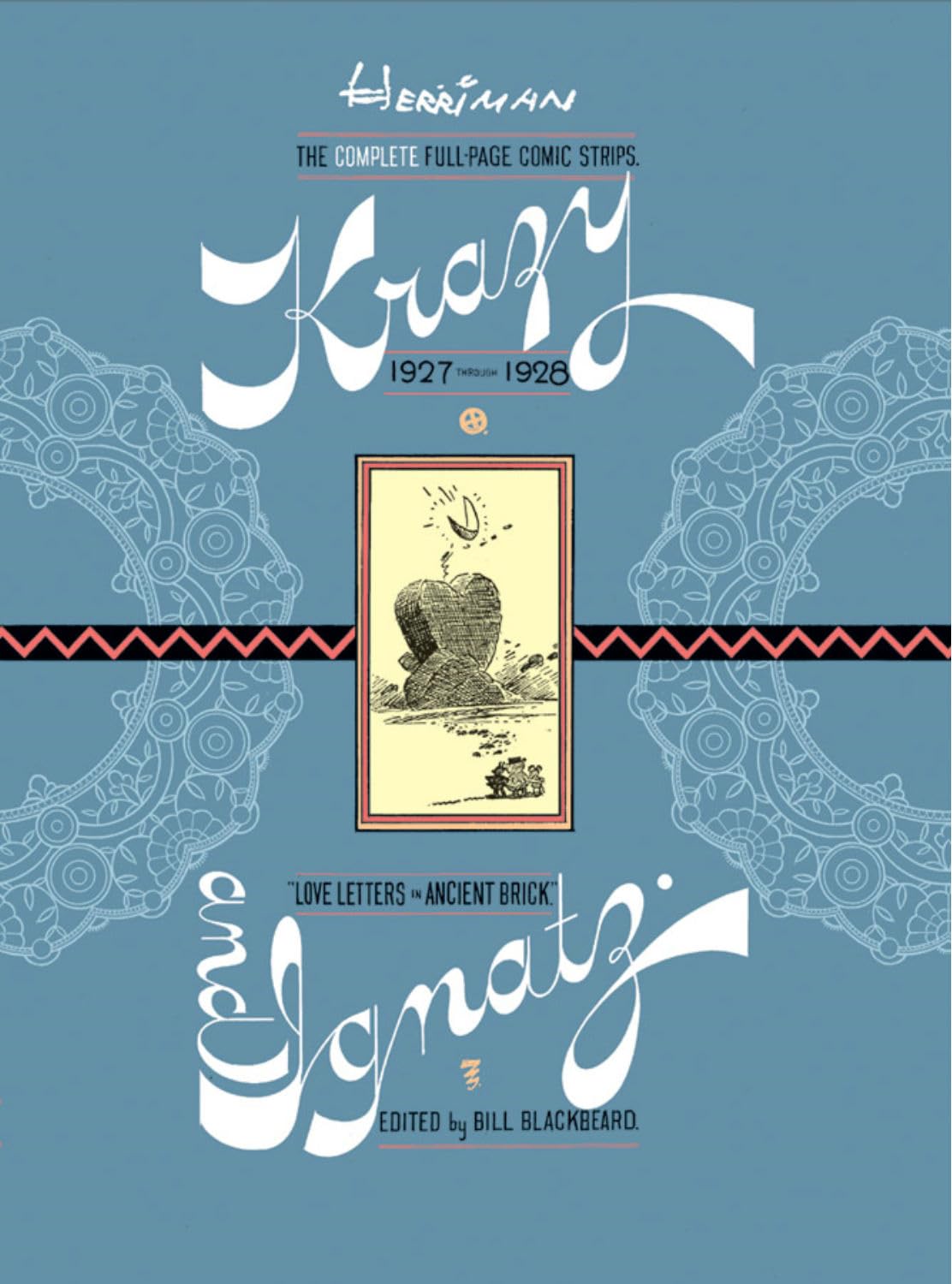



Krazy & Ignatz: Komplete 1927-1928 Herriman's comic strip "Krazy Kat," which ran in newspapers from 1913 until Herriman's death in 1944, is widely regarded as one of the greatest examples of the comics as art. Comics creators from Charles Schulz and Bill Watterson to Jeff Smith and Art Spiegelman have sung its praises. This volume is the second in Fantagraphics's series reprinting the complete strips from the Sunday pages, picking up where an earlier series from the now-defunct Eclipse Books left off. The strip's basic situation is simple: Ignatz Mouse loves to bop Krazy Kat on the head with bricks. Krazy, who loves Ignatz, receives each blow as if it were a token of affection, and Officer Pupp, who loves Krazy, tries to thwart Ignatz's abuse. In most of the strips here, Herriman's boldness is hampered by the eight-panel format temporarily forced upon him, but his wit with words, constantly changing desertscapes, and inventiveness are in full play. The strips are presented in their original black and white. Smaller libraries might be content with a sample volume or with the out-of-print anthology Krazy Kat: The Comic Art of George Herriman (Abrams, 1986). Large libraries and specialists in comics history should kollect this klassic komplete. Copyright 2002 Reed Business Information, Inc. It isn't uncommon now for comics to aspire to high-art status, but Herriman's newspaper strip, "Krazy Kat," which debuted in 1913, reached still unsurpassed artistic heights during the medium's early, declasse years. It centers on the titular, apparently genderless feline; its nemesis and beloved, Ignatz Mouse, whose mission in life was heaving bricks at Krazy, who perceived them as love offerings; and Offissa Pupp, a dog policeman dedicated to jailing Ignatz and winning Krazy's affections. Herriman situated this simple triangle of misdirected and unrequited love in the vast universe of Coconino County--the scene would change radically from one panel to the next, independent of the characters' movements--rendered in a distinctively scratchy, idiosyncratic style; and he gave Krazy a fanciful argot based, maybe, on Yiddish-accented English: "There is a heppa lend, fur fur away." Simultaneously simple and profound, the strip was adored by the era's intelligentsia. This, the second volume of a project reprinting the strip's 28-year run, showcases the 1927-28 Sunday strips in black and white, for color wasn't used until 1935. Gordon Flagg Copyright © American Library Association. All rights reserved Krazy Kat is as fresh now as when it first appeared and repays repeated reading. -- Jeet Heer, Saturday Post A road map to Herriman's wistfully beautiful world. -- Los Angeles , January 2003, Robert Ito Harriman's vision shines through: Krazy Kat continues to be a beacon of sanity in a world gone irreversibly ga-ga. -- Bizarre Herriman was one of the very great artists, in any medium, of the 20th century. -- Michael Chabon, author of The Amazing Adventures of Kavalier & Clay One of the most poetic and profound works of any popular art...one of the greatest portraits of love ever conceived. -- Andrew Arnold, Time.com's #3 Best Comic of the Year 2002 Reproductions of the strip are unbelievably clean and crisp...a work of absolute genius in the best possible light. Grade: A. -- S. A. Bennett, The Comics Buyer's Guide , 1 February 2002 Something magical happens and you find yourself still chuckling about it days later. -- The Guardian [London], 16 June 2002 There's poetry in Krazy's absurd phrases and magic in the image of a hero(ine?) so unselfconscious... -- The Village Voice , 11 December 2002 Widely regarded as one of the greatest examples of the comics as art. ...kollect this klassic komplete. -- Library Journal , 1 November 2002 [S]omething way better than the greatest strip: it's a milestone of 20th century visionary art....Geez, this stuff is wonderful. -- Tom DeHaven, author of Funny Papers George Herriman (1880-1944), the creator of Krazy Kat , was born in New Orleans and lived most of his life in Los Angeles, California. He is considered by many to be the greatest strip cartoonist of all time. Bill Blackbeard , the founder-director of the San Francisco Cartoon Art Museum, is the world's foremost authority on early 20th Century American comic strips. As a freelance writer, Blackbeard wrote, edited or contributed to more than 200 books on cartoons and comic strips, including The Smithsonian Collection of Newspaper Comics , 100 Years of Comic Strips , and the Krazy & Ignatz series. Ben Schwartz is an essayist and screenwriter who has written for The New York Times, Bookforum, LA Weekly , and TV shows too embarrassing to mention. He is working on The Lost Laugh , a history of American humor set between the world wars, for 2011 from Fantagraphics Books. Franklin Christenson "Chris" Ware is an American cartoonist known for his Acme Novelty Library series (begun 1994) and the