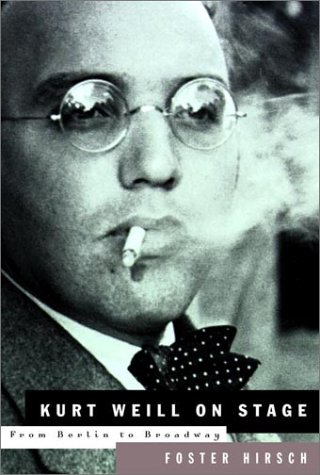



Oh, the shark has pretty teeth, dear, And he shows them pearly white. Just a jackknife has Macheath, dear, And he keeps it out of sight. The words are by Bertolt Brecht. The music is by Kurt Weill. The song is “Mack the Knife,” the number-one song of Weill’s internationally famous Threepenny Opera , originally performed on a stage in the Weimar Berlin of 1928. Its tough, sexy sound became, a quarter-century later, a signature song of America’s greatest recording stars, among them Ella Fitzgerald and Frank Sinatra. And when in 1933 Weill, already Germany’s most renowned composer, fled the Nazis to come to America (“For every age there is a place about which fantasies are written. In Mozart’s time it was Turkey. For Shakespeare, it was Italy. For us in Germany, it was always America”), he joined his appetite for the United States to his European roots and classical training and soon became one of the most admired composers of the American musical stage. He wrote one successful Broadway show after another— Lady in the Dark , Knickerbocker Holiday , One Touch of Venus , Street Scene , Lost in the Stars , among others. He worked with such theatrical greats as Gertrude Lawrence, Ira Gershwin, Maxwell Anderson, Mary Martin, Agnes de Mille, Joshua Logan, Ogden Nash, Harold Clurman, Walter Huston, E. Y. Harburg, and Elia Kazan. Always at the center of his life was his great love of thirty years, his leading lady, interpreter of his music, his wife (they were divorced in Berlin in 1933 but remarried four years later in America), the actress-singer Lotte Lenya. Foster Hirsch, using Weill’s letters, journals, and notes, and interviewing Weill’s friends and colleagues, writes about his life, his experimental, political composing in Germany, his Broadway music in America—both aspects of his work being a source of controversy among music lovers for years. Lotte Lenya said, “There is no American Weill, there is no German Weill. There is no difference between them. There is only Weill.” Hirsch details the writing, casting, and production of Weill’s eleven hit shows. He writes about Weill’s years in Hollywood and the friends he made and lost along the way. He evokes Weill’s complicated, intense collaborations with Brecht, Maxwell Anderson, Langston Hughes, Alan Jay Lerner, Elmer Rice, Moss Hart, and Ira Gershwin. In Kurt Weill on Stage , Hirsch has given us a vivid portrayal of a remarkable artist and a fabulous era of American musical theater. The Berlin premiere of The Threepenny Opera in 1928 was a pivotal event for Kurt Weill, securing him wide notoriety as a composer for musical theater and provoking a number of raised eyebrows from traditional figures in Weimar Germany. His exotic rhythms, evocative harmonic changes, and unique jazzy flavor all combined to produce a distinctive sound. Hirsch (film, CUNY, Brooklyn Coll.) traces Weill's illustrious career from these early days through his immigration to the United States, his ultimate destination after fleeing from the Nazis. Here, Weill wrote the scores for such memorable shows as Lady in the Dark, Knickerbocker Holiday, Lost in the Stars, and others. Hirsch provides details about each production, including an analysis of its artistic, theatrical, and social components as well as commentary on its public reception. Insights are offered into Weill's relationships, including his complex marriage to Lotte Lenya, his collaborations with the mercurial Bertolt Brecht, and his associations with Ira Gershwin, Alan Jay Lerner, Agnes de Mille, and countless others. In addition to his basic research, Hirsch incorporates material based upon a number of interviews that he recently conducted with prominent individuals (Harold Prince, Fred Ebb, etc.), enabling him to present additional perspectives on Weill's life and work as compared to previous biographies. This absorbing and well-researched work should be especially appealing to those interested in the history and evolution of musical theater. Carol J. Binkowski, Bloomfield, NJ Copyright 2002 Cahners Business Information, Inc. Weill was already famous for innovatively fusing jazz and classical idioms when he fled Germany for America in 1933, but moving to New York was what made him a composer of popular music. So argues Hirsch in this well-researched, gracefully written biography that starts with Weill's success in Weimar, Germany, which climaxed in his seminal collaboration with Bertolt Brecht, The Threepenny Opera , and proceeds to Broadway and beyond. Throughout, Hirsch focuses tightly on Weill's music, offering close readings of his German work and his American shows, which include Lady in the Dark , Knickerbocker Holiday , and One Touch of Venus . This isn't a juicy, gossip-filled life like, say, Steven Bach's tidbit-filled Dazzler: The Life and Times of Moss Hart (2001), but a clear, careful, reasoned analysis of its subject's work--his music--and its evolution, though Hirsch does consider the role of Lotte