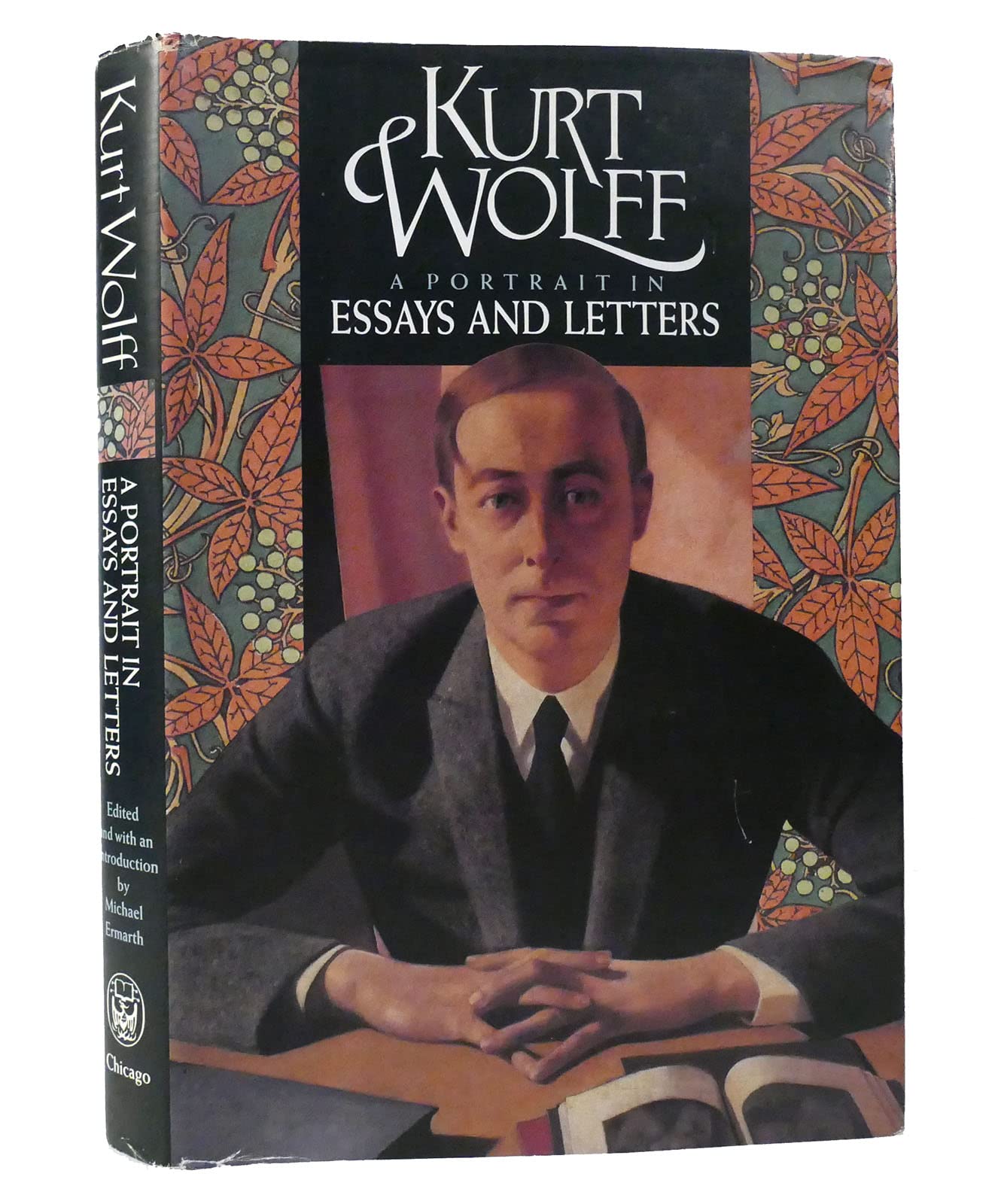



Kurt Wolff (1887-1963) was a singular presence in the literary world of the twentieth century, a cultural force shaping modern literature itself and pioneering significant changes in publishing. During an intense, active career that spanned two continents and five decades, Wolff launched seven publishing houses and nurtured an extraordinary array of writers, among them Franz Kafka, Lou Andreas-Salomé, Boris Pasternak, Günter Grass, Robert Musil, Paul Valéry, Julian Green, Lampedusa, and Anne Morrow Lindbergh. The personality of the eminent publisher comes vividly to life in this interesting collection. Wolff, who began his career in Germany, provided early encouragement for such then-unknown 20th-century writers as Franz Werfel and Franz Kafka. After emigrating to the U. S., he established Pantheon Books, became the publisher to the Bollingen Foundation, and he and his wife Helen established their own imprint at Harcourt, Brace, Jovanovich. His essays on individual authors (Werfel, Kafka, Karl Kraus, Rabindranath Tagore, and Lou Andreas-Salome) and his correspondence (with Rainer Maria Rilke, Boris Pasternak, Heinrich and Thomas Mann, Hermann Hesse, Anne Morrow Lindbergh, and Gunter Grass) are valuable, but it is his essays on his publishing philosophy that should be required reading for anyone in the book trade. - Michael T. O'Pecko, Towson State Univ., Md. Copyright 1991 Reed Business Information, Inc. A biographical sketch of Wolff--founder of Pantheon Books--by his wife Helen, brief essays and anecdotes he produced for German radio in the early 1960's, and a smattering of correspondence--all ably edited by Ermarth (History/Dartmouth). Starting as a young publisher in Weimar Germany, Wolff (1887- 1963) sought out the fresh voices and daring literary talents of that era, and this collection reflects his steady support of and extensive contact with authors such as Kafka, Franz Werfel, Karl Kraus, and Heinrich Mann, and poets of the caliber of Rilke and Georg Trakl. Many of the writers published by the Kurt Wolff Verlag became known as Expressionists, but for Wolff their talent mattered more than the label, and these essays and letters make clear that he went out of his way to nurture their work. The economic and political situation in Germany put an end to his venture in 1930 and he emigrated with the coming of Hitler, but unlike many who failed to make the transition Wolff came to New York in the early 1940's and founded Pantheon Books, a legacy in American publishing that was to rival his accomplishments of 20 years before. While this small sampling provides a glimpse at best of his activity across five decades as a publisher, still the details of correspondence and reminiscence gathered here indicate the magnificent scope of his contribution to modern literature. Tantalizing in its view of Wolff and his world, especially the pre-Weimar period--and a sad commentary on how little publishers today heed his excellent example. -- Copyright ©1991, Kirkus Associates, LP. All rights reserved. “The invaluable correspondence, intoxicating recollections, and, best of all, engaging voice of perhaps this century’s most discriminating publisher.” ― New York Times Book Review “Pure oxygen and nutrition for exhausted and demoralized editors and publishers. One of the prophetic publishers of the century . . . Kurt Wolff instances in these modest reminiscences and correspondence with authors (Kafka, Werfel, Kraus, Rilke, Mann, Pasternak, Grass, et al.) the vision and devotion that bound them to him and that made him—the secret of his calling—‘synonymous with his work.’” ― Nation “This beautifully designed, lovingly printed book is a bouillabaisse of memorabilia, containing historic-quality letters and poems and rich excerpts from published works. It provides a fine bouquet of examples of the cultural and literary delights Wolff’s imprint guaranteed. . . . This is a highly personal, sentimental, enriching book and many admirers of Pantheon―with which Kurt Wolff was long associated―will find it meaningful and revealing. Sentimentalists will be pleased to find the famous Lou Andreas-Salomé here. And the special section entitled ‘Adventures in Publishing’ will offer a surprise with the appearance of James Joyce. As for the section headed ‘On Luring Away Authors,’ it is virtually worth the price of the book to all editors.” ― Washington Post Michael Ermarth is professor of history at Dartmouth College. Deborah Lucas Schneider is a prolific translator whose other projects have included Caligula: A Biography ,by Aloys Winterling, and Florence and Baghdad: Renaissance Art and Arab Science , by Hans Belting.