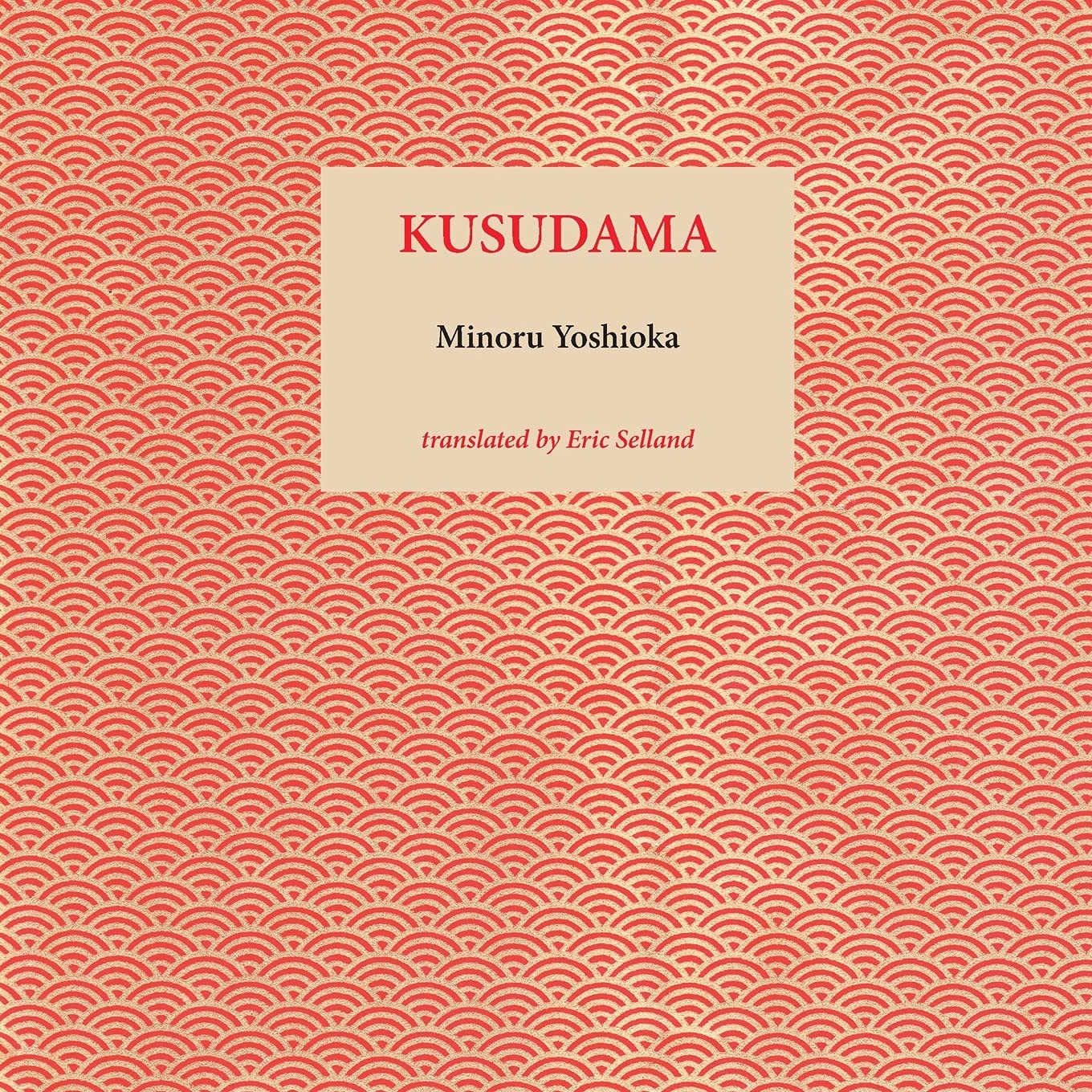



"Kusudama . The classical meaning is a small perfumed pouch, the scent created through a mixing of herbs and flowers, but Yoshioka's childhood memories would associate this word with brightly colored papier-mâché balls that were hung in the covered market places of prewar Tokyo, and which were placed in front of newly opened shops to attract customers. These kusudama were once a common sight in Tokyo, especially in Shitamachi, Tokyo's lower-town neighborhood located along the Sumida River, where Yoshioka grew up. Several meanings converge in this word: the exotic pouch or grab-bag containing all manner of things; the teeming, crowded and very worldly market place; and embedded within kusudama we find kusuri (medicine), which can be taken in the same way as the Native American term - a kind of magic - and tama , which means gem or, with a different written character, spirit or soul." (From the translator's afterword.) Minoru Yoshioka (1919-1990), the great late-modernist poet, published nine major collections between 1955 and 1984. After his second collection, Monks , won an important prize for younger poets in 1959, he was embraced by the avant-garde, and in the following years would influence a broad range of younger poets, including Kazuko Shiraishi and Takashi Hiraide. In the 1970s he began experimenting with appropriation and collage as a means of stepping outside his now well-established poetic language by 'borrowing the voices of others.' The culmination of these experiments is his magnum opus, Kusudama (1984), a multi-voiced collage of inner voices and quotations, here brilliantly translated by Eric Selland. In the 1980s the young Eric Selland was living in Tokyo and spending his Saturday afternoons at the Top Café in Shibuya, where Yoshioka regularly met with younger poets. While working on his translation of Kusudama Selland received much help and encouragement, and many answers to specific questions about the text from the author himself. The result was the remarkable translation of Kusudama published by Leech Books in Vancouver in 1991 - which Yoshioka, sadly, did not live to see. Now Eric Selland has revisited his translation for this second edition, lightly revising the text on occasions, adjusting the layout so that it more closely follows Yoshioka's original lineation, and adding some helpful notes. The result brings back into English-language circulation the most important work of one of Japan's most important late-twentieth-century modernist poets. Minoru Yoshioka (1919-1990), the great late-modernist poet, published nine major collections between 1955 and 1984. He was born in the working-class district of Tokyo known as Shitamachi and attended public school until age 15, before going to work as an apprentice at a publisher of medical books. He spent most of the war years in Manchuria as a buck private assigned to caring for the officers' horses. He was repatriated to Japan by the Americans by the end of 1945, and he began putting his life back together in the ruins of Tokyo where he took a job with a publisher. During his long career as an editor and book designer, the manuscripts of many of Japan's major literary figures passed through his hands, most notably the collected works of Junzaburō Nishiwaki, who became a close friend and mentor. When in 1959 his second collection, Monks, won a major prize for younger poets, he was embraced by the avant-garde, and in the following years would influence a broad range of younger poets, including Kazuko Shiraishi and Takashi Hiraide. In the 1970s he began experimenting with appropriation and collage as a means of stepping outside his now well-established poetic language by 'borrowing the voices of others.' The culmination of these experiments is his magnum opus, Kusudama (1984). Yoshioka died suddenly of kidney failure in 1990. Always surrounded by young poets who would gather to meet him regularly at his legendary hangout, the Top Café in Shibuya, Yoshioka remained excited about new ideas, new forms and experiment to the very end. Eric Selland is an American poet and translator living in Tokyo. He is the author of Object States (Theenk Books, 2018), Beethoven's Dream (Isobar Press, 2015), Arc Tangent (Isobar Press, 2013), Still Lifes (Hank's Original Loose Gravel Press, 2012), and The Condition of Music (Sink Press, 2000). Selland began his study of Japanese while still in his teens, and spent a year of intensive language and cultural study at Sophia University in Tokyo before receiving his BA in Japanese from San Francisco State University. Early exposure to the Japanese language and to its poetry has contributed to the development of a poetics rooted in the practice of translation. After college, which included exposure to San Francisco's dynamic experimental poetry scene of the late 70s and early 80s, he spent ten years living in Japan where he became intimate with the experimental poetry community there. Selland has transl