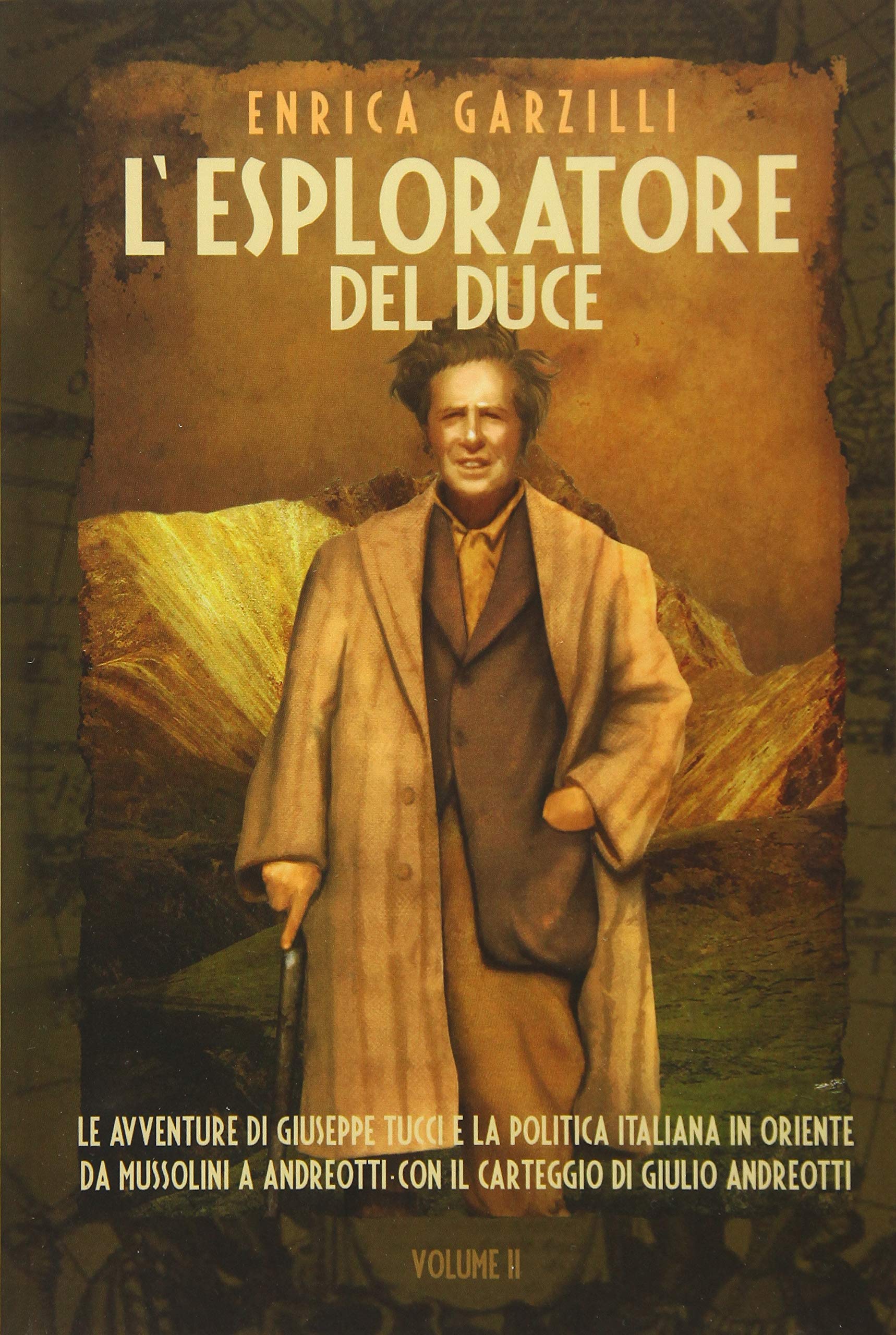
L'esploratore Del Duce: Le Avventure Di Giuseppe Tucci E La Politica Italiana in Oriente Da Mussolini a Andreotti- Con Il Carteggio Di Giulio Andreott
$45.00
by Enrica Garzilli



When the capital of Tibet was still the mythical “Forbidden City”, a mysterious destination for the most adventurous explorers, whenNepal was covered with forests and swamps, swarming with dangerous beasts and forbidden to foreigners, when Italy was ruled by the Fascist regime greedily eyeing potential colonial possessions in Asia, a learned and adventurous man, the perfect embodiment of that era’s virile ideals, entered places where no Western man had before set foot: crossing glittering peaks of snow, desolate deserts and ruins of ancient cities, constantly challenging himself, he discovered archaeological treasures from past civilizations. Even today, in the East as well as in the West, the name of this intrepid Italian explorer and insatiable researcher is cloaked in an aura of legend. One could hardly imagine a richer and more exciting life than that of Giuseppe Tucci (1894-1984), the scholar who may quite rightly be considered one of the fathers of modern Oriental Studies and a central protagonist of Fascist cultural policy in Asia: from his first expeditions to the valleys of the Himalayas and the plains of the Ganges, to his diplomatic activity in Japan as spokesman for the Duce; from his encounters with scholars and leaders such as Gandhi, Tagore, the Dalai Lama, Mircea Eliade and Giovanni Gentile, who was his great protector together with Giulio Andreotti, to the archaeological excavations in Pakistan, Afghanistan and Iran in more recent years; a human and intellectual adventure inextricably linked to the history of modern Italy, on which he often managed to shed new light. An adventure that can be traced in the pages of this book, where the pace of a thrilling narrative combines with the scientific and historical reconstruction of the Fascist policy in Asia, and of Tucci’s favorite creation, the powerful Italian Institute for the Middle and Far East. A history based on eyewitness accounts and historical documents, such as the original and unedited correspondence between Tucci and Andreotti, and the unpublished notes of Mussolini. Il primo libro dedicato a uno dei più importanti e misteriosi uomini di cultura italiani. Esploratore, archeologo, erudito, spia: Giuseppe Tucci viene "radiografato" da un'opera rigorosamente scientifica che si legge come un romanzo d'avventura. -Guglielmo Duccoli, direttore de "L'Illustrazione Italiana" The first book dedicated to one of the most important and mysterious men of Italian culture. Explorer, archaeologist, scholar, spy: Giuseppe Tucci is "x-rayed" by this strictly scientific work that reads like an adventure novel. -Guglielmo Duccoli, Editor-in-Chief of "L'Illustrazione Italiana" Enrica Garzilli is a scholar of classical and modern Asia. Harvard Alumna, since 1995 she is the Editor-in-Chief of the academic journals International Journal of Tantric Studies and Journal of South Asia Women Studies . After her first degree in Sanskrit and Indology at the Oriental School in Rome with the most famous disciples of Giuseppe Tucci, in 1988 she won a Fellowship from the Indian governemnt and was a Research Affiliate at the P.G.D.A.V. College, one of the oldest institutions of the University of Delhi, working under the supervision of pandit Prof. Nityanand Sharma, and residing in India for over two years. In 1992-2011 she won the Senior Fellowship of the Harvard Center for the Study of World Religions and taught as a Lecturer of Sanskrit at the Dept. of Sanskrit and Indian Studies of Harvard University, served as Editor-in-Chief of the Harvard Oriental Series - Opera Minora and Managing Editor of the HOS. In 1994-96 she was a Visiting Researcher at the Harvard Law School, then a professor at the Italian universities of Perugia, Macerata and Turin. She has published the books "Journal of South Asia Women Studies: 1995-1997 (Milano, 1997), Translating, Translations, Translators: From India to the West" (Harvard Oriental Series - OM, Cambridge 1996), "The Bhāvopahāra of Cakrapāṇinātha. A Sanskrit Hymn to Śiva (11th-12th century A.D.)" (Napoli, 1992), "Lo Spandasaṃdoha di Kṣemarāja. Traduzione dall' originale sanscrito del XII sec. d.C." (Napoli, 1989) and some 88 scholarly papers and reviews on the main international academic journals and encyclopaedias. She collaborates with the RSI Swiss Radio-television and Italian leading newspapers and magazines such as Limes, Ispi - Istituto per gli Studi di Politica Internazionale, Il Fatto Quotidiano, L'Illustrazione Italiana, Il Sole 24 Ore, mainly on foreign politics and human rights. Giuseppe Tucci is her paramaguru.