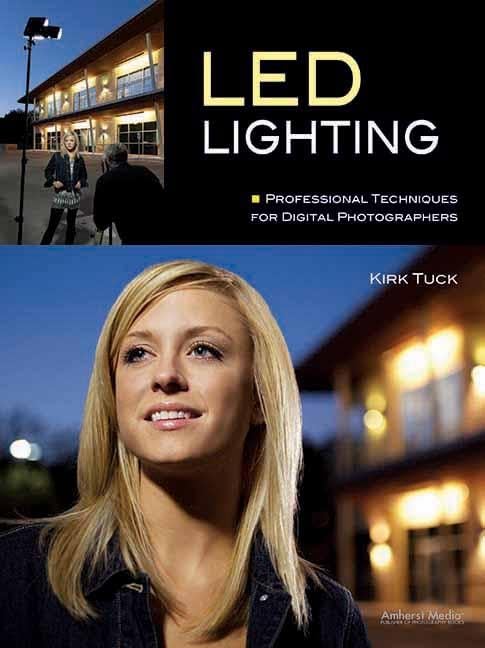



Accessible for professionals and hobbyists alike, this guide helps photographers navigate the transition from traditional flash and hot lights to light-emitting diode (LED) lights, the hottest new trend in lighting technology. The arrival of cost effective LED lights has facilitated radical advances in photographic science and required photographers to change the way they use lighting. This book explains how these innovations have influenced conventional light theory and offers a seamless transition from old lighting technologies to new ones. It demystifies the process of choosing the right LED light for projects, presents common sense methods for using LEDs, and offers suggestions for achieving the perfect lighting color and balance. In addition, numerous examples using a range of LED lights provide instruction on how to use them in still life images, portraits, and even moving pictures. Using the tools in this handy reference, visual artists can invent new styles unencumbered by the limits imposed by standard light sources. "This book marks the start line of the next big wave of evolution for photographers. . . . The best place to start I've seen." —Will Crockett, CEO of CrockettCo Technologies and FridayPhotoSchool.com "Tuck, a corporate advertising photographer, demonstrates to digital photographers techniques for using LED lighting and how they work." —www.BookNews.com "If LED is indeed the lighting of the future, Tuck's enlightening and informative book is a great introduction." —www.portlandbookreview.com "Easy to follow and an invaluable tool for anyone who is using LED lights professionally, or is an amateur looking to learn more about using LEDs effectively." —www.ephotozine.com The road to my LED Lighting book is a bumpy one that includes twenty years of working in the trenches of advertising photography. The actual book is the distillation of new information about LEDs mixed with a couple years of shooting with them, and my general knowledge of photographic lighting. When I started out I worked as a teaching assistant for several professors who taught commercial photography at the University of Texas. We used 4x5 and 8x10 inch view cameras and, to get deep enough focus, we used small f-stops and very powerful studio electronic flash units. Over time film got better and better which meant you could get nearly as good quality with smaller and smaller formats. Flashes got smaller but the lighting essentials remained the same. You worked with: Color TemperatureQuantity of Light (volume)Quality of Light (hard or soft)&Direction of Light*When I started working in the advertising field as a creative director in the early 1980's I started coming up with creative ideas for television commercials and writing the scripts for the commercials. This required me to be "on the set" to inform the director how I wanted a scene or segment or read to "feel." With my background in commercial photography it was only natural that I'd delve into what made TV lighting work.*The first thing you realize is that all light on a set is going to be continuous lighting. And in ample quantity. Tungsten lights were the lights of the day and that meant "hot lights." Very hot lights! I learned what all the different kinds of movie lights did and why DP's set up their lights the way they did. How they "designed" with lights.*I quickly realized that all lighting directors had their own styles and their own looks. And I realized that you could get a nasty burn just handling the light fixtures. On film sets and TV sets of yore everyone who handled the lights had a pair of heatproof gloves hanging out of a pocket. And you had to be careful of what you hung in front of the lights, too. If a gel got too close to the light beam of a powerful light it would start to smoke. So would wooden clothespins.And all the lighting back then, still and motion stuff, was very, very heavy and consumed a lot of electrical power. In the case of tungsten lighting it returned most of the power back to you in the form of infrared= heat.*When Canon and Panasonic started coming out with DSLR's that had really, really good HD video, coupled with big sensors, I started to get excited again about shooting video. Or making my own little "indy" films. So I started doing research. I wanted to find the current sweet spot in the market for things like microphones and fluid heads for tripods. But most of all I realized that I'd need a source of continuous lighting. I had a wish list that came about because I like to be able to go out at the drop of a hat and shoot with myself as my only crew . That meant everything on my list should be small and light and easy to handle. I can't do projects by myself where sound is important but I sure can light stuff and then shoot by myself....* The wish list: 1. Small and easy to move/handle2. Capable of good runtime on battery power.3. Close to daylight balance.4. Cool running. (Hey, I live in T