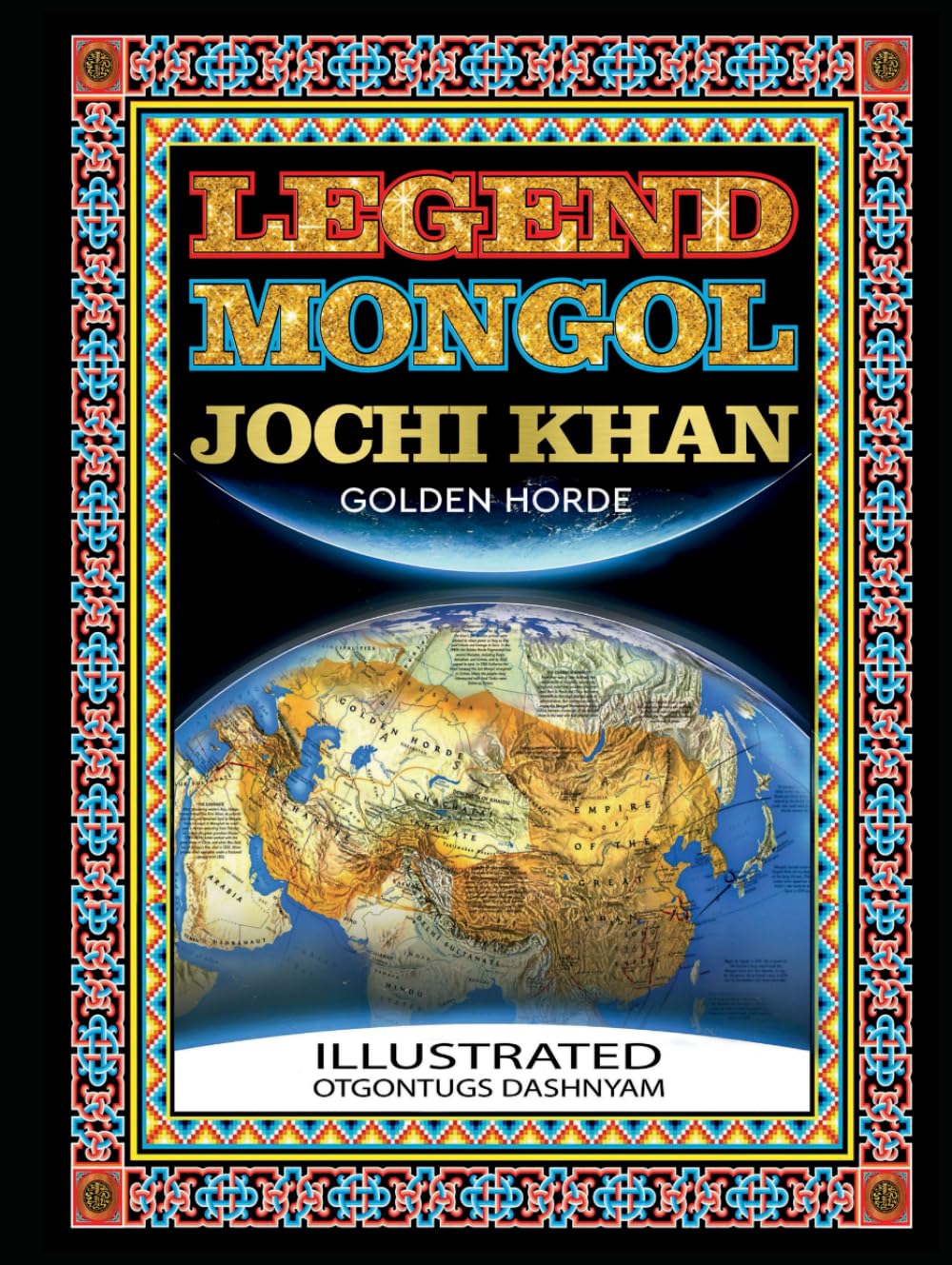
LEGEND MONGOL JOCHI KHAN GOLDEN HORDE: LEGEND MONGOL GENGHIS KHANS SON JOCHI KHAN GOLDEN HORDE ILLUSTRATED BY: TOM DASHNYAM OTGONTUGS (LEGEND MONGOL
$50.00
by Otgontugs Tom Dashnyam



LEGEND MONGOL GENGHIS KHANS SON JOCHI KHAN GOLDEN HORDE ILLUSTRATED BY: TOM DASHNYAM OTGONTUGS The Golden Horde, self-designated as Ulug Ulus ('Great State' in Turkic), was originally a Mongol and later Turkicized khanate established in the 13th century, originating from the northwestern part of the Mongol Empire. After the division of the Mongol Empire in 1259, it became a functionally independent khanate. It is also known as the Kipchak Khanate, or the Ulus of Jochi, and replaced the earlier, less organized Cuman–Kipchak confederation. It originally consisted of the lands bequeathed to Jochi (d.1227). It grew significantly under Batu Khan, the founder of the Blue Horde. After Batu died in 1256, his dynasty flourished for a full century, until 1359, though Nogai's intrigues sparked a partial civil war in the late 1290s. The Horde's military power peaked during the reign of Özbeg Khan (1312–1341), who adopted Islam. The territory of the Golden Horde at its peak extended from Siberia and Central Asia to parts of Eastern Europe from the Urals to the Danube in the west, and from the Black Sea to the Caspian Sea in the south, while bordering the Caucasus Mountains and the territories of the Mongol dynasty known as the Ilkhanate. The khanate experienced a period of great political instability known as the Great Troubles (1359–1381), before it briefly reunited under Tokhtamysh (1381–1395). However, soon after the 1396 invasion of Timur, the founder of the Timurid Empire, the Golden Horde broke into smaller khanates, which declined steadily in power. By the start of the 15th century, the Horde had begun to fall apart. By 1466, it was being referred to simply as the "Great Horde". Within its territories, there emerged numerous predominantly Turkic khanates. These internal struggles allowed Moscow to formally rid itself of the "Tatar yoke" at the Great Stand on the Ugra River in 1480, which traditionally marks the end of Mongol rule over Russia. The Crimean Khanate and the Kazakh Khanate, the last remnants of the Golden Horde, survived until 1783 and 1847, respectively, when they were conquered by the expanding Russian state.