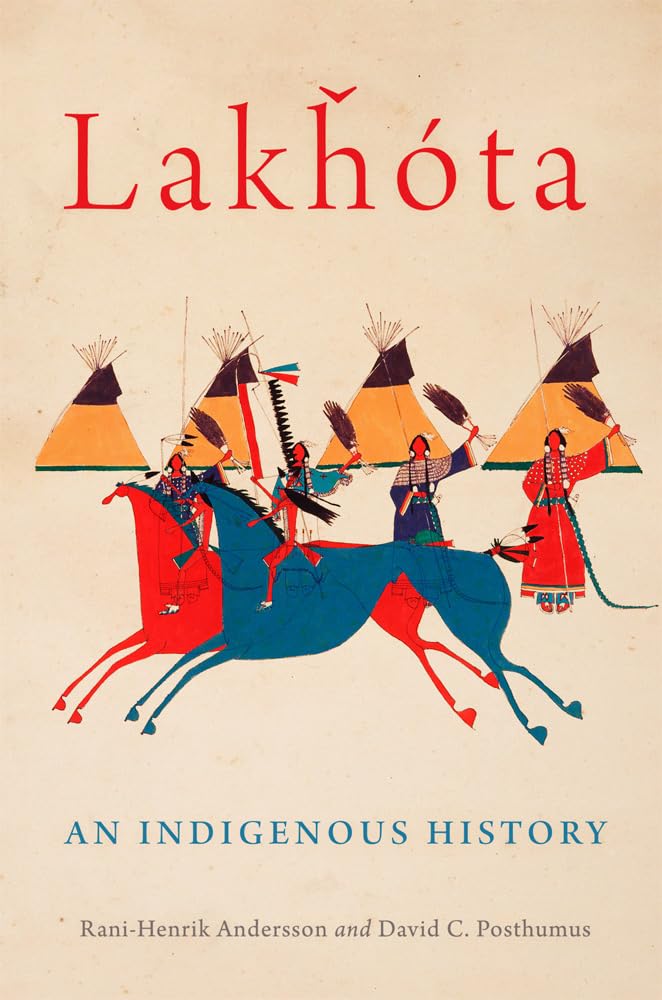
Lakhota: An Indigenous History (Volume 281) (The Civilization of the American Indian Series)
$30.01
by Rani-Henrik Andersson



The Lakȟóta are among the best-known Native American peoples. In popular culture and even many scholarly works, they were once lumped together with others and called the Sioux. This book tells the full story of Lakȟóta culture and society, from their origins to the twenty-first century, drawing on Lakȟóta voices and perspectives. In Lakȟóta culture, “listening” is a cardinal virtue, connoting respect, and here authors Rani-Henrik Andersson and David C. Posthumus listen to the Lakȟóta, both past and present. The history of Lakȟóta culture unfolds in this narrative as the people lived it. Fittingly, Lakhota: An Indigenous History opens with an origin story, that of White Buffalo Calf Woman (Ptesanwin) and her gift of the sacred pipe to the Lakȟóta people. Drawing on winter counts, oral traditions and histories, and Lakȟóta letters and speeches, the narrative proceeds through such periods and events as early Lakȟóta-European trading, the creation of the Great Sioux Reservation, Christian missionization, the Plains Indian Wars, the Ghost Dance and Wounded Knee (1890), the Indian New Deal, and self-determination, as well as recent challenges like the #NoDAPL movement and management of Covid-19 on reservations. This book centers Lakȟóta experience, as when it shifts the focus of the Battle of Little Bighorn from Custer to fifteen-year-old Black Elk, or puts American Horse at the heart of the negotiations with the Crook Commission, or explains the Lakȟóta agenda in negotiating the Fort Laramie Treaty in 1851. The picture that emerges—of continuity and change in Lakȟóta culture from its distant beginnings to issues in our day—is as sweeping and intimate, and as deeply complex, as the lived history it encompasses. “In this rangy, ambitious work, Rani-Henrik Andersson and David C. Posthumus center Lakȟóta voices, language, and conceptual worlds to craft a stunning narrative that takes readers on a journey far removed from old familiar histories. Lakȟóta: An Indigenous History is a remarkable and important contribution, one not to be missed.”— Philip J. Deloria, author of Becoming Mary Sully: Toward an American Indian Abstract “This book surpasses earlier histories of the Lakȟóta. With its meticulous attention to the distinctive cultural and complex political foundations of the Lakȟóta, it sets a new standard in Plains Indian scholarship.”— Mark van de Logt , author of War Party in Blue: Pawnee Scouts in the U.S. Army “ Lakȟóta: An Indigenous History brilliantly contextualizes winter counts and other Lakȟóta sources to reveal a Native point of view on events commonly interpreted through a Western lens.”— Candace S. Greene , coeditor of The Year the Stars Fell: Lakota Winter Counts at the Smithsonian "In revealing how Lakhota traditions illuminate this people's perspectives on their own past, Rani-Henrik Andersson and David C. Posthumus have rendered a clear, comprehensive exploration of Lakhota experience, initiative, and endurance. Lakhota: An Indigenous History is a rare achievement."— Louis S. Warren , author of God’s Red Son: The Ghost Dance Religion and the Making of Modern America “The two authors have done their research. I recommend this scholarly work for all who seek insight into the traditional beliefs, rituals and complex history of the Lakhóta [Sioux] people. In the past, the telling of our story has often been misrepresented by preconceived notions from historians with their Judeo-Christian world view. This telling seeks to give an authentic Lakhóta perspective.” – SD Nelson for Western Writers of America “Andersson and Posthumus have much to be commended for in Lak ȟ óta . They achieved something often thought impossible, a tribal history well-grounded in Lakota culture and almost exclusively through the lens of tribal members. They did this by saturating the narrative in Lakota language names and concepts, translating little used Lakota language texts, combing the archives for Lakota perspectives, using Lakota sources like winter counts and oral histories, and engaging deeply with the modern Lakota community. In doing so, the authors set an ethical standard for the study of Indigenous people that most other scholars do not live up to.”— Nebraska History Rani-Henrik Andersson holds a Ph.D. in History from the University of Tampere in Finland. He has served as the McDonnell Douglas Chair, Professor of American Studies at the University of Helsinki and is currently working as a Core Fellow at the University of Helsinki Collegium for Advanced Studies. He has published a number of scholarly articles about topics in Native American history, and has held a position as a visiting research fellow at Indiana University where he worked with Lakota experts Ray DeMallie and Doug Parks. Andersson is the author of The Lakota Ghost Dance of 1890 (University of Nebraska Press, 2008). David C. Posthumus holds a PhD in Anthropology