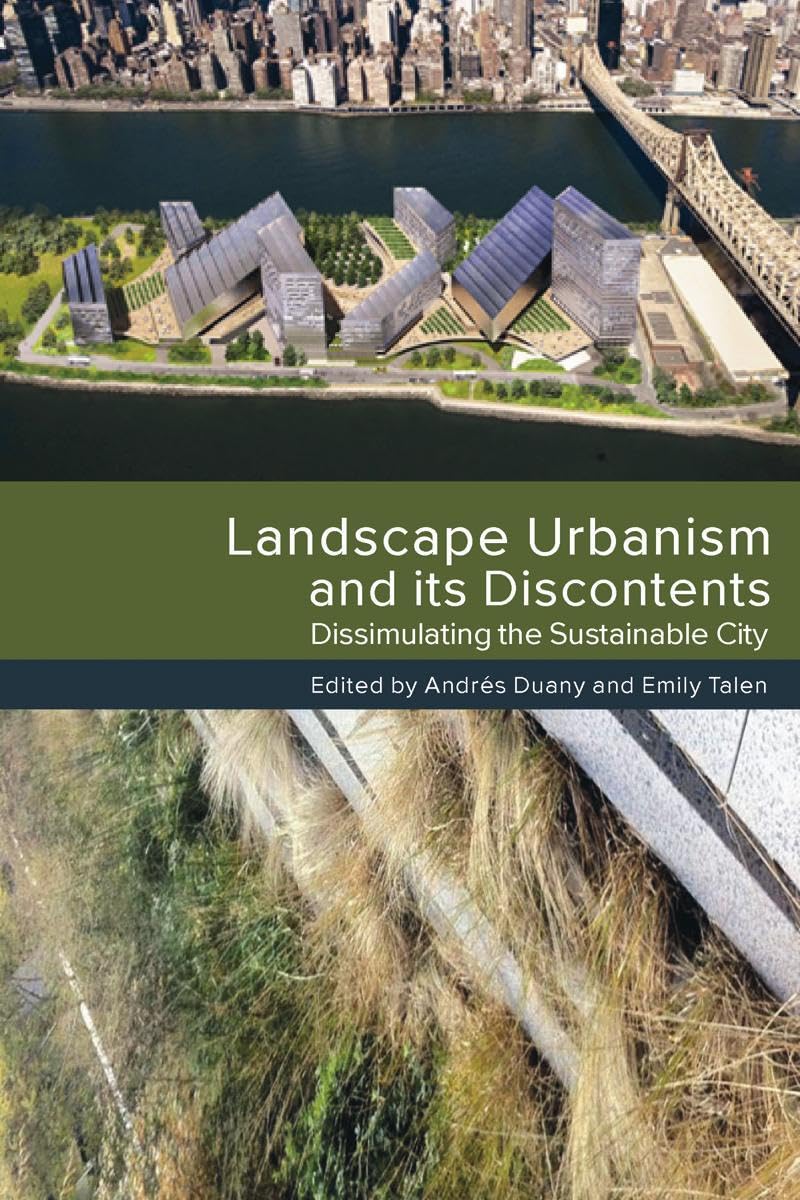
Landscape Urbanism and its Discontents: Dissimulating the Sustainable City
$23.00
by Andrés Duany



Landscape Urbanism and New Urbanism - negotiating the relationship between cities and the natural world In contemporary Western society, urban development is regarded as an unfortunate blight from which nature provides a much-needed respite. This apparent dichotomy ignores the interdependence between human settlement and the natural world. In fact, one of the most pressing problems facing urban theorists today is determining how to resolve the tension between the built and natural environments, in the process creating truly sustainable cities. Landscape Urbanism and its Discontents is a collection of essays exploring the debate over urban reform, now polarized around the two competing paradigms of Landscape Urbanism and the New Urbanism. Landscape Urbanism is conceived as a more ecologically based approach, while New Urbanism is more concerned with the built form. Well-known and influential urban theorists such as Andrés Duany and James Howard Kunstler delve into the impact of the tension between the two perspectives on: Smart growth - Neighborhood design - Sustainable development - Creating cities that are in balance with nature While there is significant overlap between Landscape Urbanism and the New Urbanism, the former has assumed prominence amongst most critical theorists, whereas the latter's proponents are more practically oriented. Given that these two sets of ideas are at the forefront of sustainable urban design, the analysis– and potential reconciliation―offered by Landscape Urbanism and its Discontents is long overdue. Andrés Duany is a leading proponent of the New Urbanism and is a founding principal at Duany Plater-Zyberk & Company. Emily Talen is a professor at Arizona State University and the author of four previous books on urban design. Herein one can find the most articulate and insightful debate on Urbanism to surface in decades. The issues raised should be at the heart of any serious dialog about the human prospect. ―Peter Calthorpe, author, Urbanism in the Age of Climate Change Landscape Urbanism propaganda famously vaunts its own doctrinal incompleteness, indeterminateness, openness, while paradoxically broadcasting a possible maturation. In this unique compendium formidable antagonists pay the LU gobbledygook more attention than it is capable to sustain and scrupulously expose the extent to which LU is but old modernist wine presented in new greenwashed bottles. ―Leon Krier, Louis Kahn Visiting Professor, Yale University This important collection of essays lays bare the comprehensive wrongheadedness at the foundation of Landscape Urbanist theory, from its apparently unconscious preference of the symbolic over the real to its surprisingly outdated conception of man's proper relationship to nature. We've known for decades that the best way to protect the landscape is to stay the heck away from it, collecting ourselves in dense, walkable cities. Any alternative to this time-tested model is still carbon-belching sprawl, however well it drains. ―Jeff Speck, author, Walkable City: How Downtown Can Save America, One Step at a Time ... the most articulate and insightful debate on urbanism to surface in decades. The issues raised should be at the heart of any serious dialog about the human prospect. ― Peter Calthorpe, author of Urbanism in the Age of Climate Change ... scrupulously expose[s] the extent to which Landscape Urbanism is but old modernist wine presented in new greenwashed wineskins. ― Leon Krier, Louis Kahn Visiting Professor, Yale University Landscape Urbanism and its Discontents explores the debate around two competing paradigms. Landscape Urbanism is conceived as ecological in terms of natural processes, while New Urbanism engages ecology in terms of sociocultural processes. In this collection of essays, influential urban theorists delve into the tension between the two perspectives. While there should be significant overlap between Landscape Urbanism and New Urbanism , the former has assumed prominence amongst environmental administrators and critical theorists, whereas the latter has approached paradigmatic status in the market and among planning professionals. Given that both these power bases are at the forefront of sustainable urban design, the analysis ― and potential reconciliation ― offered by these essays may help catalyze a resolution to the various crises besetting the new century. This important collection of essays lays bare the comprehensive wrongheadedness at the foundation of Landscape Urbanist theory... We've known for decades that the best way to protect the landscape is to stay the heck away from it, collecting ourselves in dense, walkable cities. Any alternative to this time-tested model is still carbon-belching sprawl, however well it drains. ― Jeff Speck, author of Walkable City: How Downtown Can Save America Andrés Duany is a New Urbanist, a recipient of the