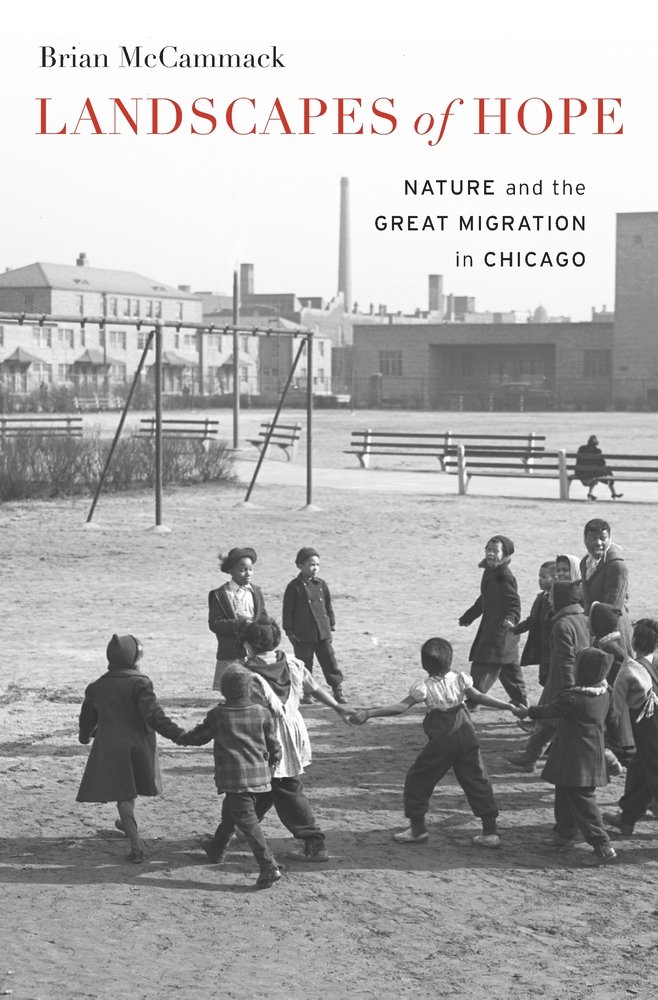



Winner of the Frederick Jackson Turner Award Winner of the George Perkins Marsh Prize Winner of the John Brinckerhoff Jackson Book Prize In the first interdisciplinary history to frame the African American Great Migration as an environmental experience, Landscapes of Hope travels to Chicago’s parks and beaches as well as youth camps, vacation resorts, and the farms and forests of the rural Midwest. Despite persistent racial discrimination and violence in many of these places, African Americans retreated there to relax and sometimes work, reconnecting with southern identities and lifestyles they had left behind. Between 1915 and 1940, hundreds of thousands of African Americans moved away from the South to begin new lives in the urban North. In Chicago alone, the black population quintupled to more than 275,000 in a quarter century. Most historians map the integration of southern and northern black culture through labor, religion, politics, and popular culture. Brian McCammack follows a different path, recapturing black Chicagoans as they forged material and imaginative connections to nature. In the relatively prosperous migration years but also in the depths of the Great Depression, Chicago’s black community―women and men, young and old, working class and upper class―sought out, fought for, built, and enjoyed natural and landscaped environments. No matter how crowded or degraded, green spaces provided a refuge for black Chicagoans and an opportunity to realize the promise of nature and of the Great Migration itself. Situated at the intersection of race and place in American history, Landscapes of Hope traces the contours of a black environmental consciousness that runs throughout the African American experience. “A beautifully written, smart, painstakingly researched account that adds nuance to the growing field of African American environmental history.” ― Colin Fisher , American Historical Review “A major work of history that brings together African-American history and environmental studies in exciting ways.” ― Davarian L. Baldwin , Journal of Interdisciplinary History “McCammack uncovers the untold history of African Americans’ migration to Chicago as they constructed both material and immaterial connections to nature… His attention to the complex landscapes that African Americans navigated is compelling.” ― Teona Williams , Black Perspectives “The way nature helped African-Americans endure the segregated spaces they inhabited in and around Chicago forms the subject of Landscapes of Hope …If in the South nature was associated with labor, for the inhabitants of the crowded tenements in Chicago, nature increasingly became a source of leisure.” ― Reinier de Graaf , New York Review of Books “Anyone interested in the history of Black Chicago as well as the history of Chicago and the natural space in which the city was built and has existed for nearly two centuries will find the book filled with important information and telling insights.” ― Patrick Reardon , Third Coast “Deeply researched and beautifully written, Landscapes of Hope shows how African American migrants to Chicago experienced, adapted to, and reshaped their new world. Through a close examination of African American life in the northern metropolis, Brian McCammack reveals an urban environment that was far more rich, varied, and dynamic than we had imagined, and one that was more than a mere stage for contests over jobs, housing, and political power. Rather, he demonstrates that African Americans’ efforts to claim urban space and enjoy the city’s outdoor parks, beaches, playgrounds, and nature preserves formed a vital element of their larger struggle for freedom.” ― Andrew W. Kahrl, author of The Land Was Ours “McCammack’s book provides a literal landscaping of black modernity. In doing so, it shines new light on Black Chicago, forcing us to look again at things we thought we knew so well. Landscapes of Hope brings together environmental justice and African American history in new ways, reminding us that race must be central both to our debates about environmental injustice and to our general understanding of the environment itself.” ― Davarian L. Baldwin, author of Chicago’s New Negroes Brian McCammack is Assistant Professor of Environmental Studies at Lake Forest College.