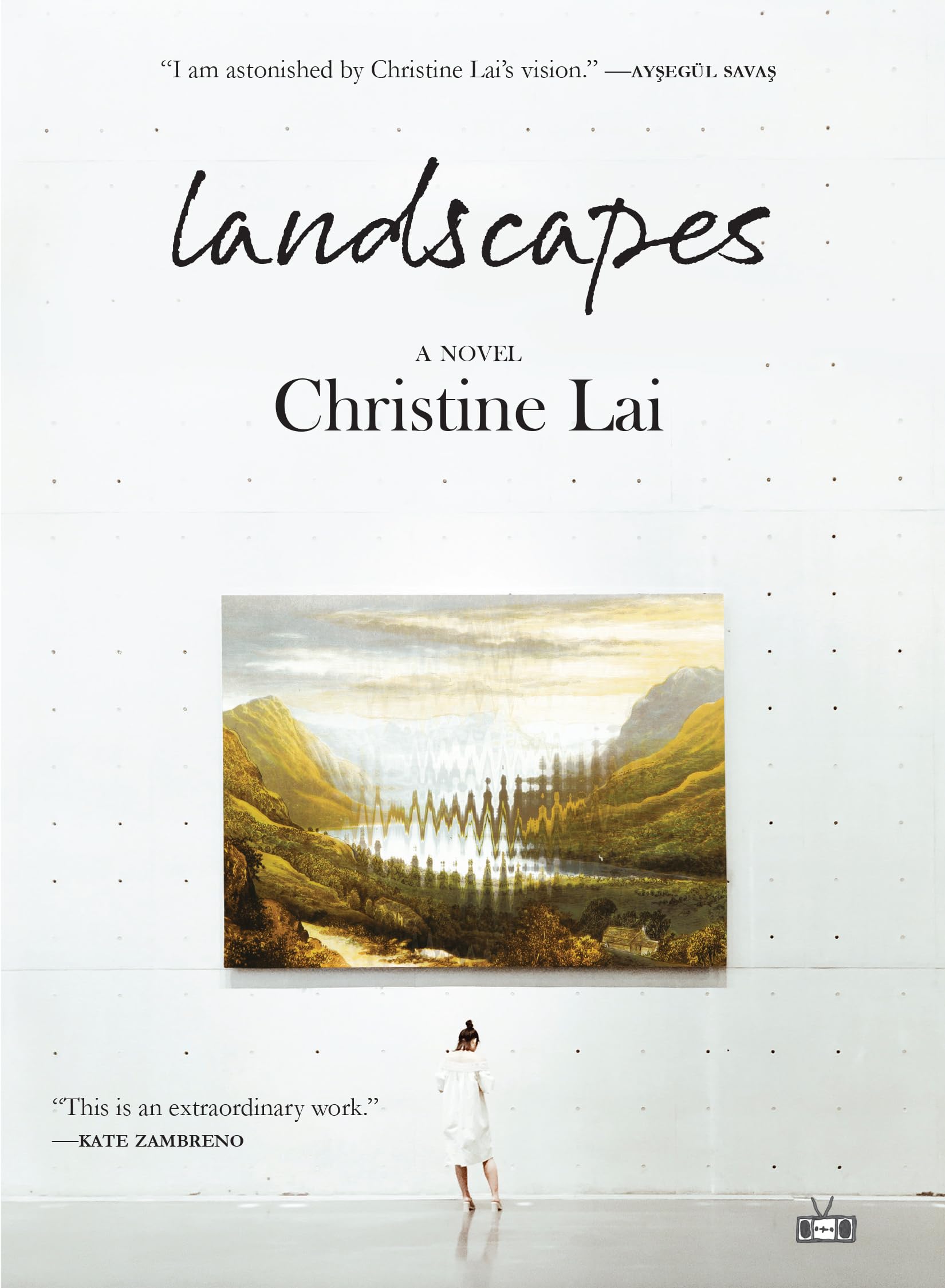



An entrancing and prismatic debut novel by Christine Lai, set in a near future fraught with ecological collapse, Landscapes brilliantly explores memory, empathy, preservation, and art as an instrument for recollection and renewal. In the English countryside―decimated by heat and drought―Penelope archives what remains of an estate’s once notable collection. As she catalogues the library’s contents, she keeps a diary of her final months in the dilapidated country house that has been her home for two decades and a refuge for those who have been displaced by disasters. Out of necessity, Penelope and her partner, Aidan, have sold the house and its scheduled demolition marks the pressing deadline for completing the archive. But with it also comes the impending return of Aidan’s brother, Julian, at whose hands Penelope suffered during a brief but violent relationship twenty-two years before. As Julian’s visit looms, Penelope finds herself unable to suppress the past, and she clings to art as a means of understanding, of survival, and of reckoning. Recalling the works of Rachel Cusk and Kazuo Ishiguro, Landscapes is an elegiac and spellbinding blend of narrative, essay, and diary that reinvents the country house novel for our age of catastrophe, and announces the arrival of an extraordinarily gifted new writer. * 2024 CLMP Firecracker Awards for Independently Published Literature, Finalist * 2023 Republic of Consciousness Prize, Finalist * A Best Book of the Year ―NPR, CBC, Nerdette , Independent Book Review * An October 2023 ABA "Indie Next List" Pick. * A Publishers Weekly 's "Writers to Watch" "Exquisite... Immersed in the works of Turner throughout, Landscapes likens one character (Julian) to Turner’s shadows, another (Aidan) to his light, and Penelope to a place between light and dark, appearing and disappearing―which, in Landscapes , is the place where writing happens. To exist between collapse and renewal, in other words, is to live with an awareness that destruction has always been with us; the choice, Lai has suggested, is not between beauty and rot but whether to see their proximity to each other. There is some hope in this way of seeing. The closer Penelope looks at disaster, the more she sees acts of reparation, resilience in the face of loss." ―Scott Schomburg, Public Books * Christine Lai is a Publishers Weekly 's "Writers to Watch": "Lai wanted to write a country house novel that subverts the glamor of depictions like that of Downton Abbey . She was influenced by W.G. Sebald’s narratives of houses similar to Mornington, which required for their construction the devastation of landscapes and villages. 'I was fascinated by this idea that something that appears very beautiful and respectable is in fact complicit in this history of destruction.'" ―Matt Seidel, Publishers Weekly "Just now I’m reading Landscapes by Christine Lai... She has a very special way of writing about violence, loss, and memory." ―Jenny Erpenbeck, author of Kairos , longlisted for the International Booker Prize 2024 "Working against time to catalog artists and storytellers before the building is demolished, [Penelope's] archive becomes a diary of solace and poignant recollection until she learns Julian―Aidan’s brother and Penelope’s rapist―is returning to see his former home one last time. As she writes an elegy of preservation, Penelope navigates a prosaic detour around her future shock." ―Marcela Davison Avilés, NPR "Andrew loved this book, which explores the futility and importance of preserving and archiving art at the end of the world. 'It really made me think about why we care about art―any sort of art―in the face of all these major things happening in the world,' he says. Largely told in the form of journal entries from an archivist living on a crumbling estate, this book is for art lovers and the apocalypse-curious alike. 'It did make me wanna just walk around museums and look at the different pieces that are unpacked in this one,' Greta says." ―Greta Johnsen, WBEZ Chicago, with Andrew Limbong "In the process of rereading Penelope’s analytical entries, I noticed that the precise locations of each insertion serve as an ingenious sort of plot device. See, after a point, the reader can surmise that Penelope herself is a survivor of assault. She can’t help but to carefully analyze art as she does; it’s how she heals and makes sense of the world... The most avid readers will have a hard time believing that Landscapes is a debut novel." ―S. Elizabeth Sigler, The Common "I envy readers entering this world for the first time. You will find beauty here, and wisdom." ―Ayşegül Savaş (author of White on White ), Electric Literature "An Archivist for the End of the World": An excerpt from Landscapes , Recommended by Ayşegül Savaş" "The story of an archive―discovered in not only what it preserves, but what it leaves out―is compelling, and Landscapes has a lot to say about art, ruins, and beauty." ―Aman