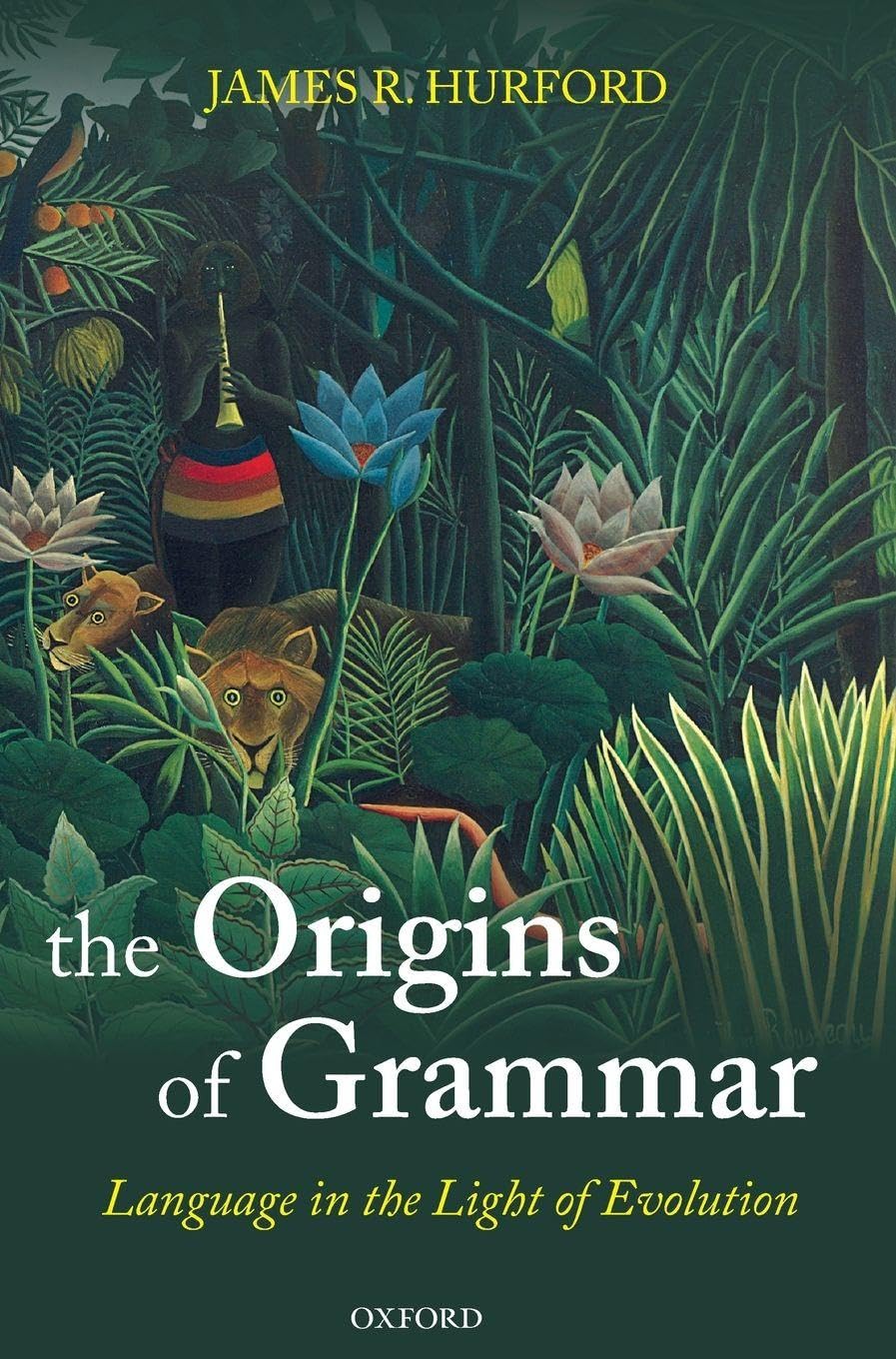
Language in the Light of Evolution, Vol. 2: The Origins of Grammar
$82.00
by James R. Hurford



This is the second of the two closely linked but self-contained volumes that comprise James Hurford's acclaimed exploration of the biological evolution of language. In the first book he looked at the evolutionary origins of meaning, ending as our distant ancestors were about to step over the brink to modern language. He now considers how that step might have been taken and the consequences it undoubtedly had. The capacity for language lets human beings formulate and express an unlimited range of propositions about real or fictitious worlds. It allows them to communicate these propositions, often overlaid with layers of nuance and irony, to other humans who can then interpret and respond to them. These processes take place at breakneck speed. Using a language means learning a vast number of arbitrary connections between forms and meanings and rules on how to manipulate them, both of which a normal human child can do in its first few years of life. James Hurford looks at how this miracle came about. The book is divided into three parts. In the first the author surveys the syntactic structures evident in the communicative behaviour of animals, such as birds and whales, and discusses how vocabularies of learned symbols could have evolved and the effects this had on human thought. In the second he considers how far the evolution of grammar depended on biological or cultural factors. In the third and final part he describes the probable route by which the human language faculty and languages evolved from simple beginnings to their present complex state. "[A] towering account of our species' path from being once without language ... Particularly important are his careful efforts to review and explain all the ways in which human language can be simpler than we normally think, from the "home sign" systems that emerge in households of Deaf children with hearing parents, to the pidgins and creoles of suddenly formed communities such as the plantation slave populations of the New World."-- Nick Enfield, Times Literary Supplement "This is a model exercise in how substantial theorizing about language evolution can be achieved. It is entertainingly written but not oversimplistic, interdisciplinary but not at the expense of rigor, and Hurford is open about the limits of his own expertise. He is to be congratulated on formulating insights that he offers with a precision that makes disagreement, hence advances, possible.... This is a delightful and thought-provoking read.... I warmly recommend it and very much look forward to its follow-up volume." Ruth Kempson, Language "Wide-ranging and often entertaining."-- Science The heart of the book is grammar, especially syntax. Syntacticians are a notorious bunch, fond of complex but often inexplicit argument about arcane matters. Hurford strives valiantly to make this work accessible to the uninitiated. I feel that he succeeds...Hurford has done the trick."-- The Quarterly Review of Biology "[T]here is certainly no better introduction to linguistics around for evolutionarily inclined outsiders." -- Evolutionary Anthropology The second volume in James Hurford's acclaimed two-volume exploration of the biological evolution of language James R. Hurford is Emeritus Professor of General Linguistics, University of Edinburgh. He is co-editor, with Kathleen Gibson, of OUP's Studies in Language Evolution , co-founder, with Simon Kirby, of the Language Evolution and Computation Research Unit at the University of Edinburgh, and co-founder, with Chris Knight, of the EVOLANG series of international conferences on the evolution of language. His books include The Linguistic Theory of Numerals (CUP, 1975), Language and Number: The Emergence of a Cognitive System (Blackwell, 1987), Grammar: A Student's Guide (CUP 1994), and The Origins of Meaning (OUP 2007).